Department of Epidemiology, School of Public Health, University of Alabama at Birmingham, 700 South 18th Street, Suite 609, Birmingham, AL, 35294-0009, USA.
Environ Health. 2022 Dec 12;21(1):127. doi: 10.1186/s12940-022-00946-9.
Persons who experience paraquat poisoning rapidly develop damage to a variety of organ systems including acute kidney injury (AKI), the occurrence of which is associated with an increased risk of death. However, little is known about the effects of chronic paraquat exposure on renal function and the onset of chronic renal disease. The objective of the current study is to assess the association between paraquat exposure and the incidence of end stage renal disease (ESRD) in the United States.
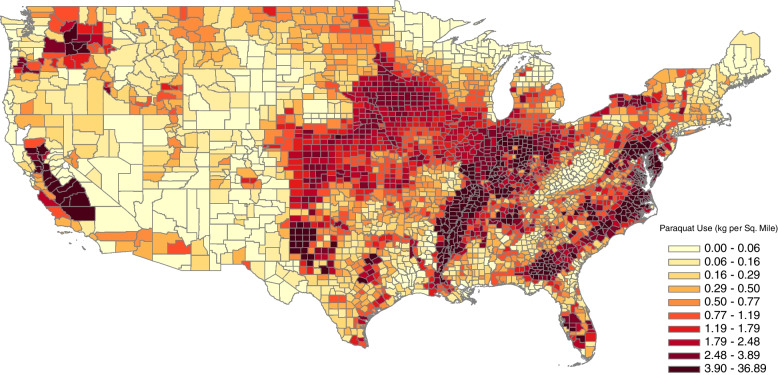
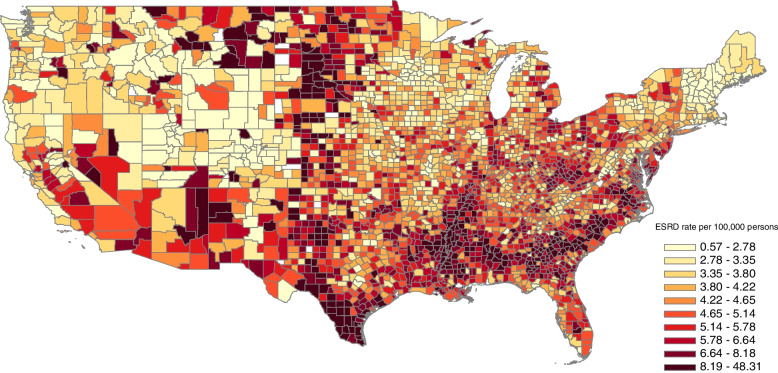
Data on the incidence of ESRD for the period 2010 through 2017 and kilograms of paraquat use per square mile for each county in the conterminous United States was obtained from the United States Renal Data System (USRDS) and the National Water Quality Assessment (NAWQA) Program, respectively. Negative binomial regression was used to estimate rate ratios (RRs) and 95% confidence intervals (CIs) for the association between quartiles of paraquat exposure and the incidence of ESRD.
The incidence of ESRD increased with increasing paraquat density. Based on a 20-year exposure lag, those in the highest paraquat density quartile had a 21% higher rate of ESRD compared to the lowest quartile whereas for a 15-year lag the increase was 26%. Adjusted associations were attenuated though still followed an increasing linear trend across quintiles.
The results of this study are consistent with a large number of studies documenting a high incidence of AKI and a small number of studies chronic renal disease following acute and chronic paraquat exposure, respectively. While the pathophysiological mechanisms underlying kidney injury following paraquat poisoning are well understood, more research is necessary to understand the natural history of chronic kidney disease due to chronic paraquat exposure.
接触百草枯的人会迅速对各种器官系统造成损害,包括急性肾损伤(AKI),其发生与死亡风险增加有关。然而,人们对慢性百草枯暴露对肾功能和慢性肾脏病发病的影响知之甚少。本研究的目的是评估美国百草枯暴露与终末期肾病(ESRD)发病率之间的关系。
从美国肾脏数据系统(USRDS)和国家水质评估(NAWQA)计划中分别获得 2010 年至 2017 年期间 ESRD 的发病率以及美国大陆各县每平方英里百草枯用量的数据。使用负二项回归估计 quartiles 与 ESRD 发病率之间的暴露关联的比率比(RR)和 95%置信区间(CI)。
ESRD 的发病率随百草枯密度的增加而增加。基于 20 年的暴露滞后,与最低密度 quartiles 相比,最高密度 quartiles 中的 ESRD 发生率高 21%,而对于 15 年的滞后,增加了 26%。调整后的关联虽然减弱了,但仍沿 quintiles 呈递增线性趋势。
本研究的结果与大量记录急性 AKI 发病率高的研究以及少数记录急性和慢性百草枯暴露后慢性肾脏病的研究一致。虽然百草枯中毒后肾损伤的病理生理机制已得到很好的理解,但仍需要更多的研究来了解慢性百草枯暴露引起的慢性肾脏病的自然史。