Abdul K S M, De Silva P Mangala C S, Ekanayake E M D V, Thakshila W A K G, Gunarathna S D, Gunasekara T D K S C, Jayasinghe S S, Asanthi H B, Chandana E P S, Chaminda G G T, Siribaddana S H, Jayasundara Nishad
Institute of Biomedical and Pharmaceutical Sciences, Guangdong University of Technology, Guangzhou 510006, China.
Department of Zoology, Faculty of Science, University of Ruhuna, Matara 81000, Sri Lanka.
Int J Environ Res Public Health. 2021 Mar 22;18(6):3278. doi: 10.3390/ijerph18063278.
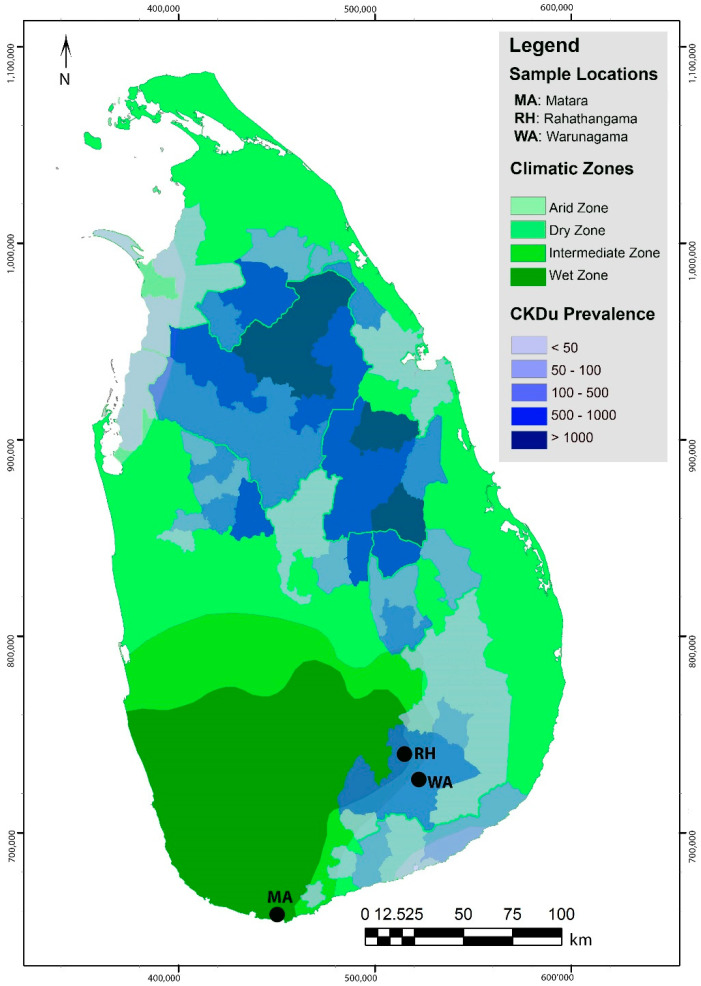
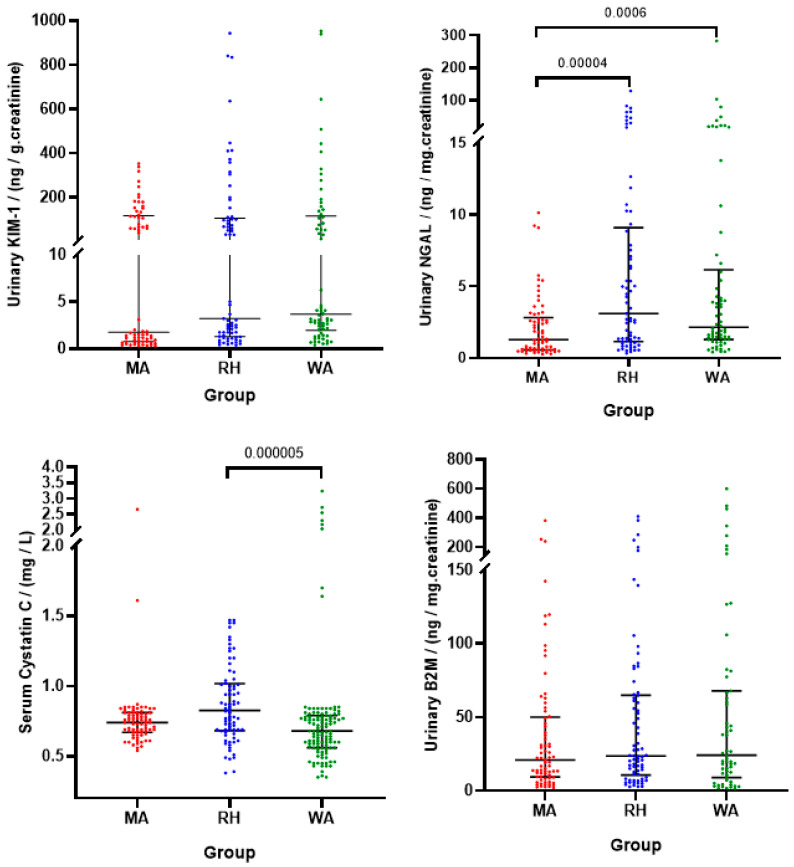
Extensive use of herbicides is common among rural agricultural workers in Sri Lanka. Recent studies have postulated their role in the development of chronic kidney disease of unknown etiology (CKDu). Paraquat and glyphosate are leading herbicides used by sugarcane farmers (SF), hence occupational exposure is inevitable. This study examined the expression of urinary paraquat, glyphosate and biomarkers among residential SF in CKDu emerging regions, Warunagama (WA) and Rahathangama (RH), in the Uva Province with non-endemic Matara (MA) in the Southern Province of Sri Lanka. Urinary glyphosate, Paraquat, kidney injury molecule -1 (KIM-1), neutrophil gelatinase-associated lipocalin (NGAL) and β2-microglobulin (B2M) were determined using enzyme-linked immunosorbent assays (ELISA). Urinary creatinine, microalbumin, serum creatinine (SCr), serum cystatin C, estimated glomerular filtration rate (eGFR), and albumin creatinine ratio (ACR) were also assessed. Generally, herbicide residues and kidney injury biomarkers were higher in SF compared to the non-endemic MA. Creatinine-adjusted urinary glyphosate and paraquat levels were significantly higher in WA compared to MA. ACR in RH (median 14.9; IQR 5.4-393.1 mg/g) and WA (23.7; 11.5-64.6) was significantly higher than MA (4.3; 2.2-6.7). This study reports 39 individuals with impaired kidney function among SF in Sri Lanka for the first time. Urinary NGAL levels were significantly higher in both WA (median 2.14; IQR 1.28-6.15 ng/mg Cr) and RH (3.09; 1.15-9.09) compared to MA (1.28; 0.56-2.81). However, urinary KIM-1 levels in RH (3.2; 1.29-106.1 ng/g Cr) and WA (3.6; 1.94-115.1) were not significantly higher in MA (1.74; 0.76-116.9). Urinary NGAL (r = 0.493), eGFR (r = -0.147) and ACR (r = 0.171) significantly correlated with urinary glyphosate, but not with urinary paraquat levels. Urinary KIM-1 levels did not correlate with either urinary glyphosate or paraquat, while urinary B2M and serum cystatin C levels showed significant correlation with urinary glyphosate levels. The current study reports higher urinary herbicide levels among sugarcane farmers in WA and RH, and that is potentially linked to the subsequent decline in kidney function, as indicated by ACR, eGFR, and NGAL. We posit that these indicators may serve as markers to detect renal injury among herbicide-exposed SF in Rural Sri Lanka.
在斯里兰卡,农村农业工人广泛使用除草剂。最近的研究推测它们在不明病因慢性肾脏病(CKDu)的发病过程中发挥作用。百草枯和草甘膦是甘蔗种植农户(SF)使用的主要除草剂,因此职业暴露不可避免。本研究检测了斯里兰卡乌瓦省CKDu高发地区瓦鲁纳加马(WA)和拉哈坦加马(RH)以及南部省份非疫区马特勒(MA)的居住型甘蔗种植农户尿液中百草枯、草甘膦及生物标志物的表达情况。采用酶联免疫吸附测定(ELISA)法测定尿液中的草甘膦、百草枯、肾损伤分子-1(KIM-1)、中性粒细胞明胶酶相关脂质运载蛋白(NGAL)和β2-微球蛋白(B2M)。同时评估尿肌酐、微量白蛋白、血清肌酐(SCr)、血清胱抑素C、估计肾小球滤过率(eGFR)和白蛋白肌酐比值(ACR)。一般来说,与非疫区的马特勒相比,甘蔗种植农户体内的除草剂残留和肾损伤生物标志物水平更高。与马特勒相比,瓦鲁纳加马经肌酐校正的尿草甘膦和百草枯水平显著更高。拉哈坦加马(中位数14.9;四分位间距5.4 - 393.1 mg/g)和瓦鲁纳加马(23.7;11.5 - 64.6)的ACR显著高于马特勒(4.3;2.2 - 6.7)。本研究首次报告了斯里兰卡甘蔗种植农户中有39人肾功能受损。与马特勒(1.28;0.56 - 2.81)相比,瓦鲁纳加马(中位数2.14;四分位间距1.28 - 6.15 ng/mg Cr)和拉哈坦加马(3.09;1.15 - 9.09)的尿NGAL水平显著更高。然而,拉哈坦加马(3.2;1.29 - 106.1 ng/g Cr)和瓦鲁纳加马(3.6;1.94 - 115.1)的尿KIM-1水平与马特勒(1.74;0.76 - 116.9)相比并无显著升高。尿NGAL(r = 0.493)、eGFR(r = -0.147)和ACR(r = 0.171)与尿草甘膦显著相关,但与尿百草枯水平无关。尿KIM-1水平与尿草甘膦或百草枯均无相关性,而尿B2M和血清胱抑素C水平与尿草甘膦水平显著相关。本研究报告称,瓦鲁纳加马和拉哈坦加马的甘蔗种植农户尿中除草剂水平较高,且这可能与随后ACR、eGFR和NGAL所示的肾功能下降有关。我们认为这些指标可作为检测斯里兰卡农村地区接触除草剂的甘蔗种植农户肾损伤的标志物。