
新型噻二唑修饰壳聚糖衍生物可控制人体致病微生物和癌细胞系的生长。
New thiadiazole modified chitosan derivative to control the growth of human pathogenic microbes and cancer cell lines.
机构信息
Department of Chemistry, Faculty of Science, Al-Azhar University, Nasr City, Cairo, Egypt.
Department of Botany and Microbiology, Faculty of Science, Al-Azhar University, Nasr City, Cairo, Egypt.
出版信息
Sci Rep. 2022 Dec 11;12(1):21423. doi: 10.1038/s41598-022-25772-4.
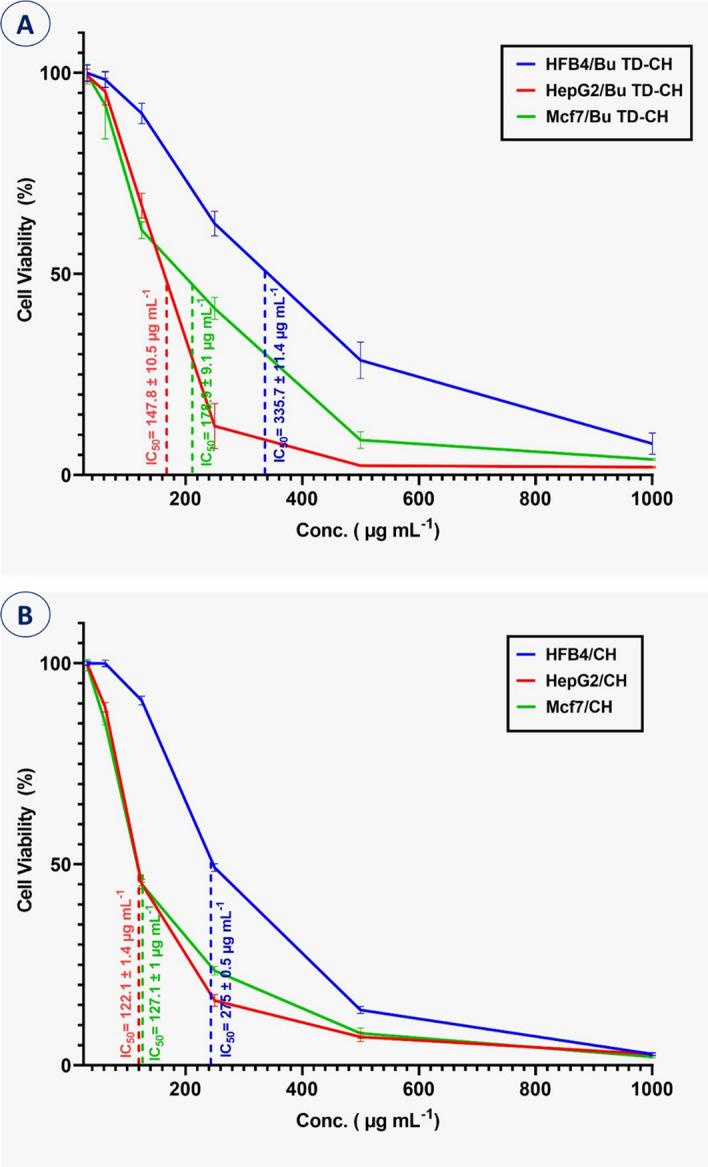
The emergence of multidrug-resistant microbes and the propagation of cancer cells are global health issues. The unique properties of chitosan and its derivatives make it an important candidate for therapeutic applications. Herein, a new thiadiazole derivative, 4-((5-(butylthio)-1,3,4-thiadiazol-2-yl) amino)-4-oxo butanoic acid (BuTD-COOH) was synthesized and used to modify the chitosan through amide linkages, forming a new thiadiazole chitosan derivative (BuTD-CH). The formation of thiadiazole and the chitosan derivative was confirmed by FT-IR, H/C-NMR, GC-MS, TGA, Elemental analysis, and XPS. The BuTD-CH showed a high antimicrobial effect against human pathogens Escherichia coli, Pseudomonas aeruginosa, Bacillus subtilis, Staphylococcus aureus, and Candida albicans with low MIC values of 25-50 μg ml compared to unmodified chitosan. The in-vitro cytotoxicity of BuTD-CH was evaluated against two cancer cell lines (MCF-7 and HepG2) and one normal cell (HFB4) using the MTT method. The newly synthesized derivatives showed high efficacy against cancerous cells and targeted them at low concentrations (IC was 178.9 ± 9.1 and 147.8 ± 10.5 μg ml for MCF-7 and HepG2, respectively) compared with normal HFB4 cells (IC was 335.7 ± 11.4 μg ml). Thus, low concentrations of newly synthesized BuTD-CH could be safely used as an antimicrobial and pharmacological agent for inhibiting the growth of human pathogenic microbes and hepatocellular and adenocarcinoma therapy.
多药耐药微生物的出现和癌细胞的传播是全球健康问题。壳聚糖及其衍生物的独特性质使其成为治疗应用的重要候选物。在这里,合成了一种新的噻二唑衍生物,4-((5-(丁基硫代)-1,3,4-噻二唑-2-基)氨基)-4-氧代丁酸(BuTD-COOH),并通过酰胺键将其用于修饰壳聚糖,形成一种新的噻二唑壳聚糖衍生物(BuTD-CH)。噻二唑和壳聚糖衍生物的形成通过 FT-IR、H/C-NMR、GC-MS、TGA、元素分析和 XPS 得到证实。BuTD-CH 对人类病原体大肠杆菌、铜绿假单胞菌、枯草芽孢杆菌、金黄色葡萄球菌和白色念珠菌表现出高抗菌效果,与未修饰的壳聚糖相比,MIC 值为 25-50μg/ml。通过 MTT 法评估 BuTD-CH 对两种癌细胞系(MCF-7 和 HepG2)和一种正常细胞(HFB4)的体外细胞毒性。新合成的衍生物对癌细胞表现出高功效,并且在低浓度下靶向它们(对 MCF-7 和 HepG2 的 IC 分别为 178.9±9.1 和 147.8±10.5μg/ml),与正常 HFB4 细胞(IC 为 335.7±11.4μg/ml)相比。因此,新合成的 BuTD-CH 的低浓度可以安全地用作抗菌和药理学制剂,用于抑制人类致病微生物和肝细胞癌和腺癌的生长。


 Zotero 插件