Trinh Nhung T H, Nordeng Hedvig M E, Bandoli Gretchen, Palmsten Kristin, Eberhard-Gran Malin, Lupattelli Angela
PharmacoEpidemiology and Drug Safety Research Group, Department of Pharmacy, PharmaTox Strategic Research Initiative, Faculty of Mathematics and Natural Sciences, University of Oslo, Oslo, Norway.
Department of Child Health and Development, Norwegian Institute of Public Health, Oslo, Norway.
Clin Epidemiol. 2022 Dec 5;14:1439-1451. doi: 10.2147/CLEP.S379370. eCollection 2022.
Few studies investigated longitudinal antidepressant exposure during pregnancy and included dosage in the assessment.
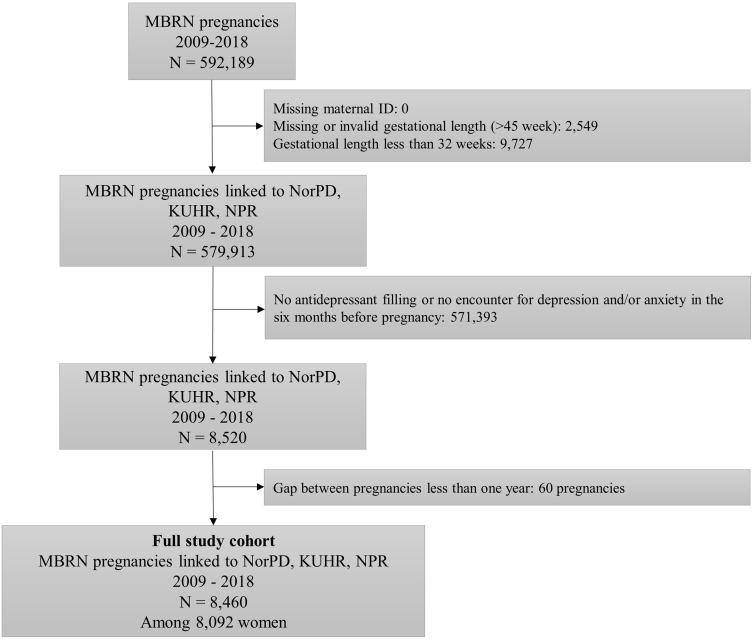
We conducted a nationwide, registry-linkage study in Norway using data on antidepressant prescription fills in pregnancies lasting ≥32 weeks in women with a delivery between 2009 and 2018 who had a depression/anxiety diagnosis and antidepressant fills prior to pregnancy. Information on antidepressant exposure by week (measured by filled prescriptions) and prescribed average daily dose was used in longitudinal k-means trajectory modelling for a 108-week time window from six months prior to pregnancy to one year after delivery. Factors associated with trajectory group membership were examined using multinomial logistic regression models.
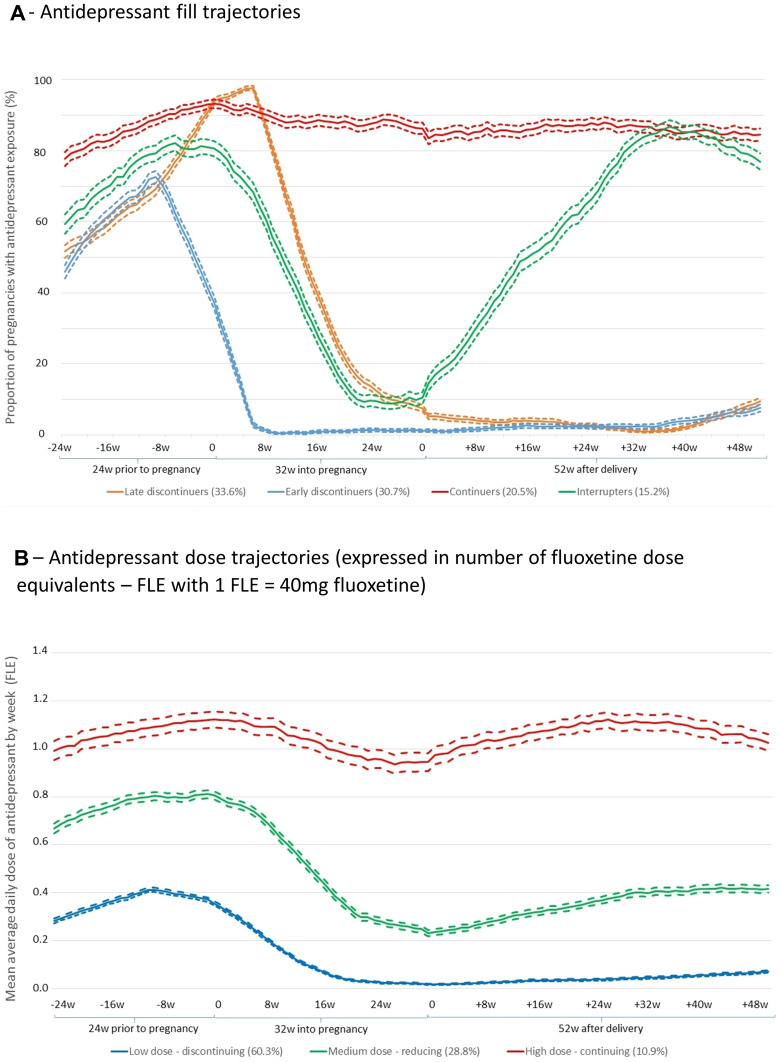
We included 8,460 pregnancies in 8,092 women. Four antidepressant fill trajectories were identified based on filled antidepressant prescriptions: two distinct discontinuing patterns, one at around the start of pregnancy (30.4%) and one around the end of pregnancy (33.8%); one continuing pattern (20.6%); and one interrupting pattern (15.2%). Using average usual daily dose, we identified low dose discontinuing (60.3%), medium dose reducing (20.6%) and high dose continuing (15.2%) patterns. The multinomial logistic regressions showed that the fill trajectory group membership was strongly associated with: antidepressant type and dose prior to pregnancy and co-medication prior to pregnancy, maternal age, marital status, parity, previous pregnancy loss, and pregnancy planning.
Longitudinal trajectory modelling revealed distinct antidepressant fill and dosage patterns in the period around pregnancy. Knowledge about factors associated with utilization trajectories might be useful for health-care personnel counselling women about antidepressant use in pregnancy.
很少有研究调查孕期长期使用抗抑郁药的情况,且评估中未纳入剂量因素。
我们在挪威开展了一项全国性的登记联动研究,使用了2009年至2018年期间分娩的、患有抑郁症/焦虑症且在怀孕前有抗抑郁药配药记录的女性中,持续时间≥32周的孕期抗抑郁药处方配药数据。通过每周的抗抑郁药暴露信息(以配药处方衡量)和规定的平均每日剂量,对从怀孕前六个月到产后一年的108周时间窗口进行纵向k均值轨迹建模。使用多项逻辑回归模型检查与轨迹组成员相关的因素。
我们纳入了8092名女性的8460次怀孕。根据抗抑郁药配药处方确定了四种抗抑郁药配药轨迹:两种不同的停药模式,一种在怀孕初期左右(30.4%),一种在怀孕末期左右(33.8%);一种持续模式(20.6%);一种中断模式(15.2%)。使用平均每日常用剂量,我们确定了低剂量停药(60.3%)、中等剂量减少(20.6%)和高剂量持续(15.2%)模式。多项逻辑回归显示,配药轨迹组成员与以下因素密切相关:怀孕前的抗抑郁药类型和剂量以及怀孕前的联合用药、产妇年龄、婚姻状况、产次、既往流产史和怀孕计划。
纵向轨迹建模揭示了孕期前后不同的抗抑郁药配药和剂量模式。了解与使用轨迹相关的因素可能有助于医护人员为孕期使用抗抑郁药的女性提供咨询。