Department of Pediatrics, University of California, San Diego, 9500 Gilman Drive, La Jolla, CA, 92093, USA.
Skaggs School of Pharmacy and Pharmaceutical Sciences and Department of Family Medicine and Public Health, University of California, San Diego, 9500 Gilman Drive, La Jolla, CA, 92093, USA.
Arch Womens Ment Health. 2018 Aug;21(4):411-419. doi: 10.1007/s00737-018-0809-2. Epub 2018 Jan 16.
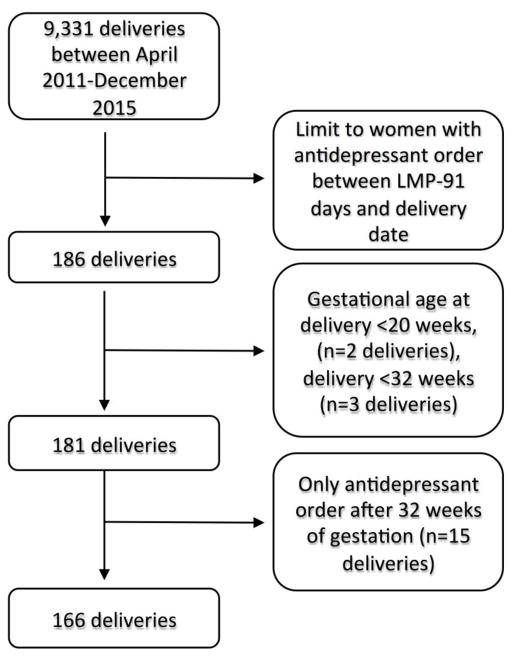
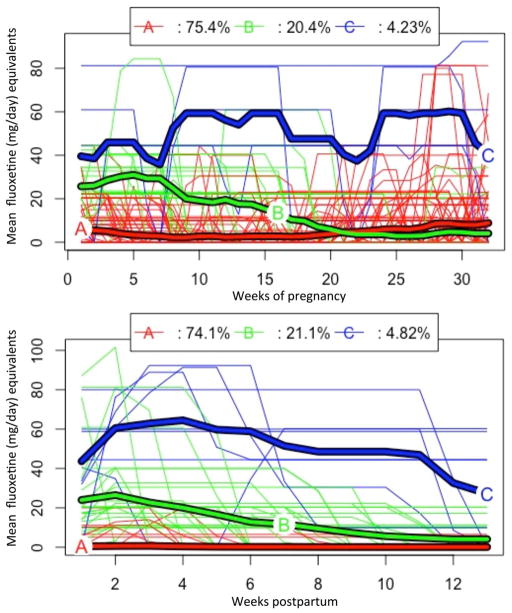
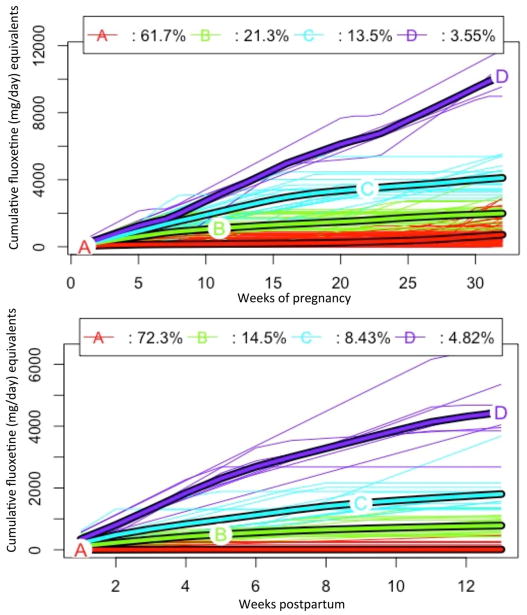
Studies of antidepressant safety in pregnancy typically do not address complex patterns of use throughout pregnancy. We performed longitudinal trajectory modeling to describe patterns of antidepressant use in the first 32 weeks of pregnancy, and test whether these trajectories are associated with a reduction in birth weight or gestational age at delivery. Our study included 166 pregnant women with deliveries between 2011 and 2015 who were prescribed an antidepressant between 91 days prior to last menstrual period and 32 weeks of gestation. From electronic medical records, we estimated average daily dose and cumulative dose per week for the first 32 weeks of gestation and for the first 13 weeks postnatal. We clustered women with similar utilization patterns using k-means longitudinal modeling and assessed the associations between trajectory group and birth weight and gestational age at delivery. We identified four cumulative dose trajectory groups and three average daily dose trajectory groups in each period. Relative to the lowest trajectory group, the highest trajectory group during pregnancy was associated with reduced birth weight in multivariable analysis (average daily highest trajectory vs. lowest trajectory β - 314.1 g, 95% CI - 613.7, - 15.5) adjusted for depression severity score, maternal age, race, and pregnancy smoking. Trajectory groups were not associated with gestational age at delivery. The highest trajectory group of antidepressant use in pregnancy was associated with a modest reduction in birth weight but not with gestational age at delivery. Longitudinal trajectories allow for a dynamic visualization and quantification of medication use among pregnant women.
研究表明,在怀孕期间使用抗抑郁药通常不能解决整个孕期复杂的使用模式问题。我们进行了纵向轨迹建模,以描述怀孕前 32 周的抗抑郁药使用模式,并测试这些轨迹是否与降低出生体重或分娩时的胎龄有关。我们的研究包括 166 名在 2011 年至 2015 年间分娩的孕妇,她们在末次月经前 91 天至妊娠 32 周期间被处方了抗抑郁药。从电子病历中,我们估算了前 32 周和产后 13 周的每周平均日剂量和每周累积剂量。我们使用 k-均值纵向建模对具有相似利用模式的女性进行聚类,并评估轨迹组与出生体重和分娩时胎龄之间的关联。在每个时期,我们都确定了四个累积剂量轨迹组和三个平均日剂量轨迹组。与最低轨迹组相比,怀孕期间最高轨迹组与出生体重较低相关(平均每日最高轨迹与最低轨迹 β-314.1g,95%CI-613.7,-15.5),调整了抑郁严重程度评分、母亲年龄、种族和怀孕吸烟状况。轨迹组与分娩时的胎龄无关。怀孕期间抗抑郁药使用的最高轨迹组与出生体重的适度降低有关,但与分娩时的胎龄无关。纵向轨迹允许对孕妇的药物使用进行动态可视化和量化。