Jamari J, Ammarullah Muhammad Imam, Santoso Gatot, Sugiharto S, Supriyono Toto, Permana Muki Satya, Winarni Tri Indah, van der Heide Emile
Department of Mechanical Engineering, Faculty of Engineering, Diponegoro University, Semarang 50275, Central Java, Indonesia.
Undip Biomechanics Engineering & Research Centre (UBM-ERC), Diponegoro University, Semarang 50275, Central Java, Indonesia.
Heliyon. 2022 Dec 5;8(12):e12050. doi: 10.1016/j.heliyon.2022.e12050. eCollection 2022 Dec.
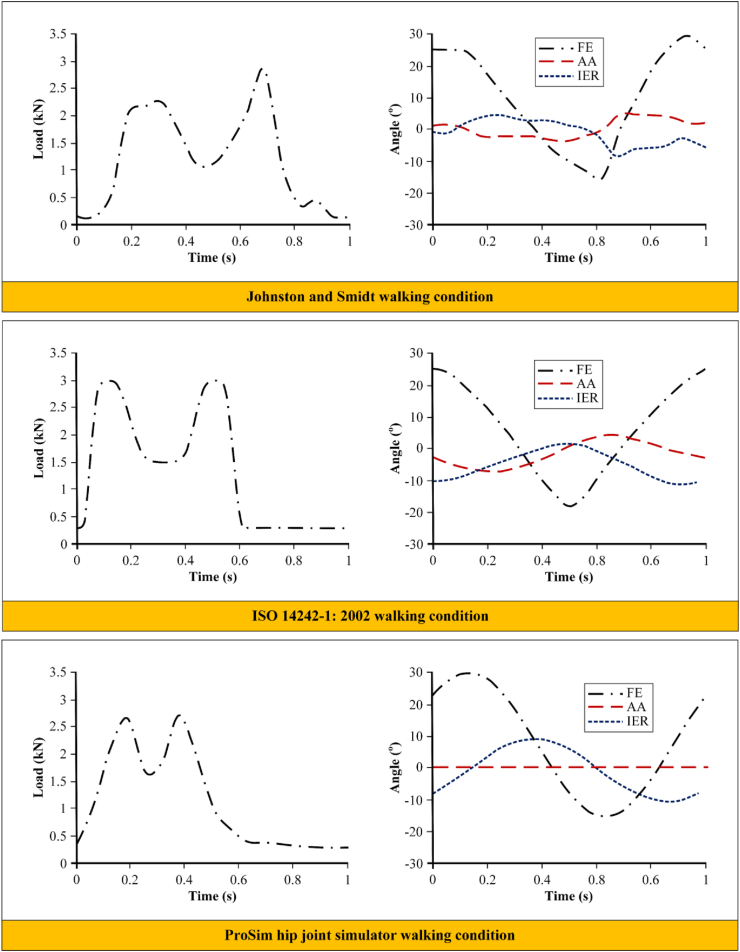
Bearing on artificial hip joint experiences friction, wear, and surface damage that impact on overall performance and leading to failure at a particular time due to continuous contact that endangers the user. Assessing bearing hip joint using clinical study, experimental testing, and mathematical formula approach is challenging because there are some obstacles from each approach. Computational simulation is an effective alternative approach that is affordable, relatively fast, and more accessible than other approaches in examining various complex conditions requiring extensive resources and several different parameters. In particular, different gait cycles affect the sliding distance and distribution of gait loading acting on the joints. Appropriate selection and addition of gait cycles in computation modelling are crucial for accurate and reliable prediction and analysis of bearing performance such as wear a failure of implants. However, a wide spread of gait cycles and loading data are being considered and studied by researchers as reported in literature. The current article describes a comprehensive literature review adopted walking condition that has been carried out to study bearing using computational simulation approach over the past 30 years. Many knowledge gaps related to adoption procedures, simplification, and future research have been identified to obtain bearing analysis results with more realistic computational simulation approach according to physiological human hip joints.
人工髋关节会经历摩擦、磨损和表面损伤,这些会影响其整体性能,并由于持续接触危及使用者,导致在特定时间失效。使用临床研究、实验测试和数学公式方法评估髋关节轴承具有挑战性,因为每种方法都存在一些障碍。计算模拟是一种有效的替代方法,在检查需要大量资源和几个不同参数的各种复杂条件时,它比其他方法更经济、相对更快且更容易实现。特别是,不同的步态周期会影响作用在关节上的滑动距离和步态负荷分布。在计算建模中适当选择和添加步态周期对于准确可靠地预测和分析轴承性能(如植入物的磨损和失效)至关重要。然而,正如文献报道的那样,研究人员正在考虑和研究广泛的步态周期和负荷数据。本文描述了过去30年为使用计算模拟方法研究轴承而采用步行条件进行的全面文献综述。为了根据生理人体髋关节以更现实的计算模拟方法获得轴承分析结果,已经确定了许多与采用程序、简化和未来研究相关的知识空白。