Belay Alemayehu Sayih, Negese Ketemaw, Manaye Gizachew Ayele, Debebe Shibihon
Department of Nursing, Mizan Tepi University, College of Medicine and Health Sciences, Mizan Aman, Ethiopia.
Department of Midwifery, Mizan Tepi University, College of Medicine and Health Sciences, Mizan Aman, Ethiopia.
Front Pediatr. 2022 Nov 24;10:1052396. doi: 10.3389/fped.2022.1052396. eCollection 2022.
Neonatal birth injury is the functional or structural damage of the new-born during child birth. Fetal related factors such as macrosomia, fetal height, fetal weight, and prematurity; maternal related factors such as overly young and old maternal age, parity, poor maternal health, and pelvic anomalies contribute to neonatal birth injury. Labor and delivery related factors including prolonged labor, fetal mal-presentation and mal-position, cesarean and instrumental deliveries also predispose the neonate to birth injury. This study was conducted to assess the prevalence and associated factors of birth injury among neonates admitted to the neonatal intensive care unit (NICU) in Governmental Hospitals of Southwest Ethiopia.
To assess the prevalence and associated factors of birth injury among neonates admitted to the neonatal intensive care unit (NICU) in governmental hospitals in Southwest Ethiopia.
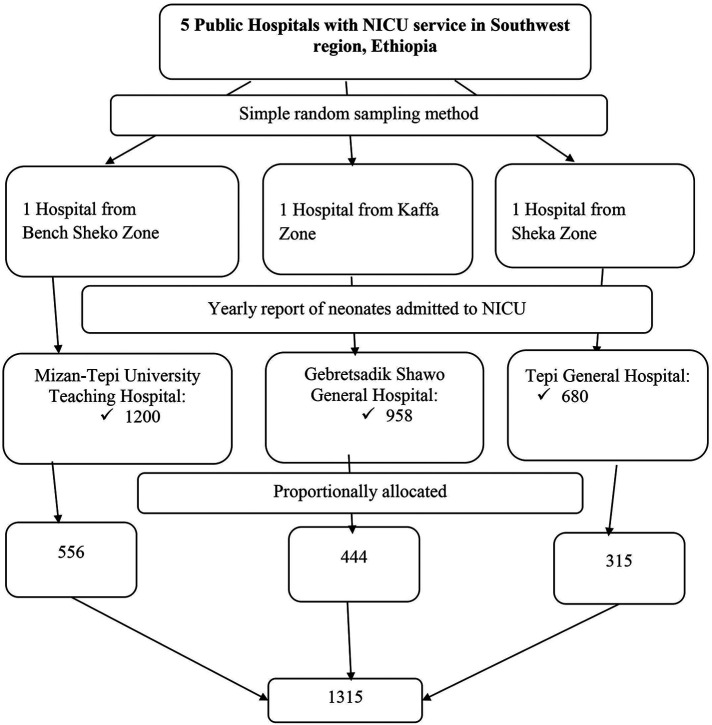
Hospital-based cross-sectional study design was implemented at Mizan-Tepi University Teaching Hospital, Bonga Gebretsadik Shawo General Hospital, and Tepi General Hospital. A total of 1,315 neonates were included in the study using systematic random sampling techniques. Data was entered using Epi-Data version 4.2 and exported to SPSS version 21 for analysis. Logistic regression analysis was conducted to see the association between the dependent and independent variable.
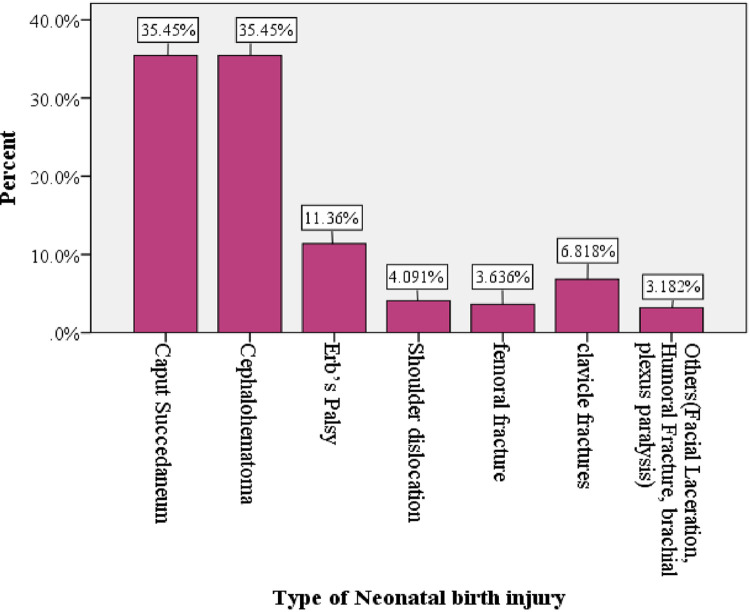
The prevalence of neonatal birth injury was 16.7%. Predictors such as primipara, no formal education, mothers with no antenatal care, and mothers whose occupational status were unemployed were 12.27, 2.52, 2.40, and 4.26 times more likely to develop neonatal birth injuries than their counterparts, respectively. Whereas, maternal age within the age range of 25-34 years, and neonates delivered instrumental delivery were 6.68, and 2.81 times more likely to develop neonatal birth injury compared to those whose age was greater than 34 years and neonates delivered through Cesarean section, respectively.
The magnitude of birth injury in the current study was significantly high. Primiparity, mothers with no history of antenatal care follow up, uneducated women, unemployed women, mode of delivery, and maternal age between 25 and 34 years were strong predictors associated with neonatal birth injury. Therefore, comprehensive maternal health care such as antenatal care follow up and health institution delivery should be promoted and well addressed to all reproductive age women and special attention should be given particularly to pregnant women in order to mitigate problems related to childbirth.
新生儿出生损伤是指新生儿在分娩过程中发生的功能或结构损害。与胎儿相关的因素,如巨大儿、胎儿身高、胎儿体重和早产;与母亲相关的因素,如母亲年龄过小或过大、产次、母亲健康状况差和骨盆异常,都会导致新生儿出生损伤。与分娩相关的因素,包括产程延长、胎儿先露异常和胎位异常、剖宫产和器械助产,也会使新生儿易发生出生损伤。本研究旨在评估埃塞俄比亚西南部政府医院新生儿重症监护病房(NICU)收治的新生儿中出生损伤的患病率及相关因素。
评估埃塞俄比亚西南部政府医院新生儿重症监护病房(NICU)收治的新生儿中出生损伤的患病率及相关因素。
在米赞-特皮大学教学医院、邦加·格布雷萨迪克·沙沃综合医院和特皮综合医院实施基于医院的横断面研究设计。采用系统随机抽样技术,共纳入1315名新生儿作为研究对象。数据使用Epi-Data 4.2版本录入,并导出至SPSS 21版本进行分析。进行逻辑回归分析以观察因变量和自变量之间的关联。
新生儿出生损伤的患病率为16.7%。初产妇、未接受过正规教育、未进行产前检查的母亲以及职业为无业的母亲发生新生儿出生损伤的可能性分别是其对应人群的12.27倍、2.52倍、2.40倍和4.26倍。然而,年龄在25 - 34岁之间的母亲以及通过器械助产分娩的新生儿发生新生儿出生损伤的可能性分别是年龄大于34岁的母亲以及通过剖宫产分娩的新生儿的6.68倍和2.81倍。
本研究中出生损伤的发生率显著较高。初产、无产前检查史的母亲、未受过教育的女性、无业女性、分娩方式以及年龄在25至34岁之间的母亲是与新生儿出生损伤相关的重要预测因素。因此,应推广并妥善解决针对所有育龄妇女的全面孕产妇保健措施,如产前检查随访和在医疗机构分娩,尤其应特别关注孕妇,以减轻与分娩相关的问题。