Department of Biosciences, Centre for Ecological and Evolutionary Synthesis, University of Oslo, Oslo 0316, Norway.
Department of Earth System Science, Ministry of Education Key Laboratory for Earth System Modeling, Tsinghua University, Beijing 100084, China.
Proc Natl Acad Sci U S A. 2022 Dec 20;119(51):e2209816119. doi: 10.1073/pnas.2209816119. Epub 2022 Dec 12.
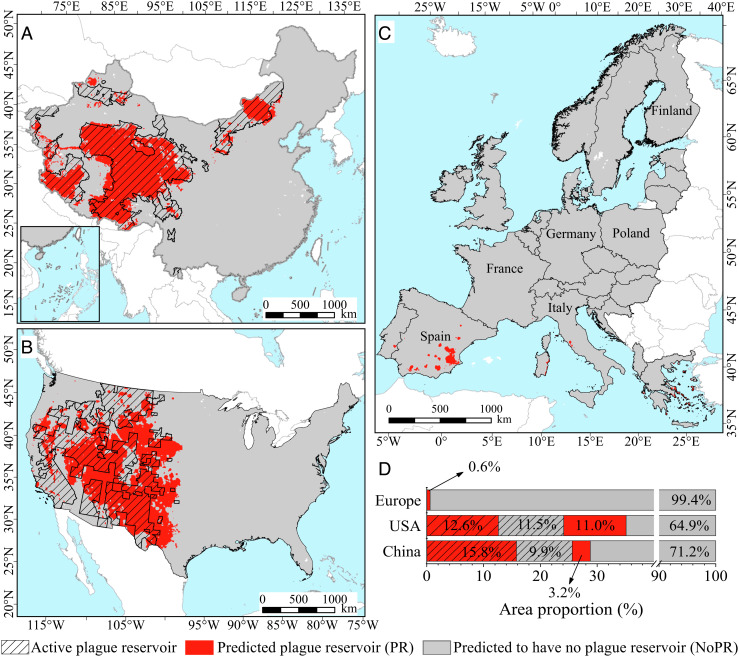
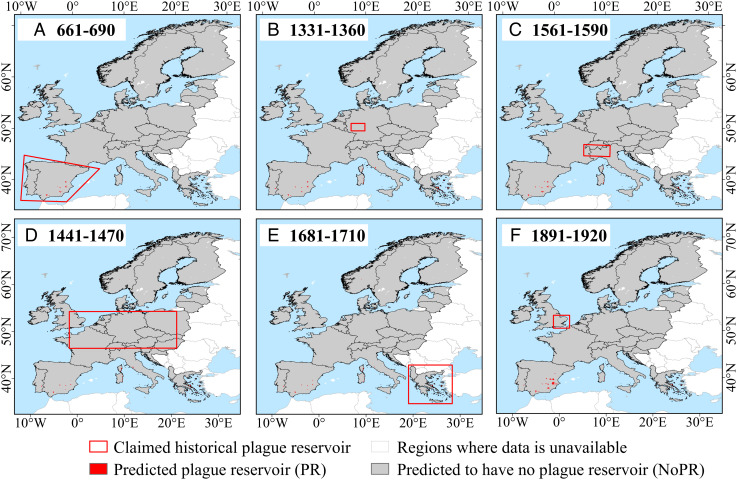
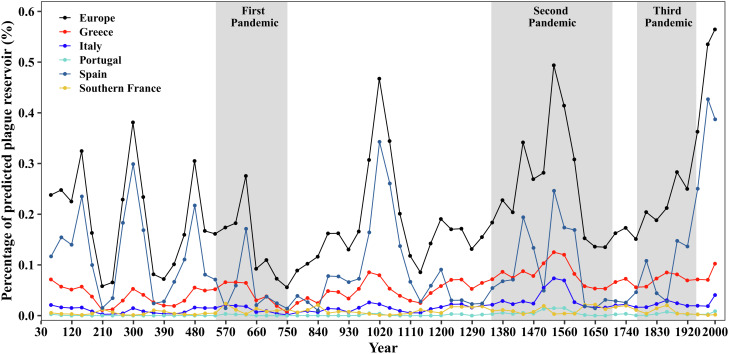
Caused by , plague ravaged the world through three known pandemics: the First or the Justinianic (6th-8th century); the Second (beginning with the Black Death during c.1338-1353 and lasting until the 19th century); and the Third (which became global in 1894). It is debatable whether persisted in European wildlife reservoirs or was repeatedly introduced from outside Europe (as covered by European Union and the British Isles). Here, we analyze environmental data (soil characteristics and climate) from active Chinese plague reservoirs to assess whether such environmental conditions in Europe had ever supported "natural plague reservoirs". We have used new statistical methods which are validated through predicting the presence of modern plague reservoirs in the western United States. We find no support for persistent natural plague reservoirs in either historical or modern Europe. Two factors make Europe unfavorable for long-term plague reservoirs: 1) Soil texture and biochemistry and 2) low rodent diversity. By comparing rodent communities in Europe with those in China and the United States, we conclude that a lack of suitable host species might be the main reason for the absence of plague reservoirs in Europe today. These findings support the hypothesis that long-term plague reservoirs did not exist in Europe and therefore question the importance of wildlife rodent species as the primary plague hosts in Europe.
第一次大流行(6 世纪至 8 世纪的查士丁尼鼠疫);第二次(始于 1338-1353 年间的黑死病,并持续到 19 世纪);第三次(1894 年开始在全球流行)。目前仍存在争议的是,鼠疫是否在欧洲野生动物中持续存在,还是从欧洲以外的地方反复传入(如欧盟和不列颠群岛所涵盖的范围)。在这里,我们分析了中国活跃的鼠疫疫源地的环境数据(土壤特征和气候),以评估欧洲是否曾存在过支持“自然鼠疫疫源地”的环境条件。我们使用了新的统计方法,该方法通过预测现代鼠疫疫源地在美国西部的存在情况得到了验证。我们在历史上或现代欧洲都没有发现持续存在自然鼠疫疫源地的证据。有两个因素使欧洲不利于长期存在鼠疫疫源地:1)土壤质地和生物化学特性,以及 2)啮齿动物多样性低。通过比较欧洲、中国和美国的啮齿动物群落,我们得出结论,缺乏合适的宿主物种可能是当今欧洲鼠疫疫源地缺失的主要原因。这些发现支持了鼠疫疫源地在欧洲长期不存在的假设,并质疑了野生动物啮齿动物作为欧洲主要鼠疫宿主的重要性。