Service de Parasitologie et des Maladies Vectorielles, Institut Pasteur du Maroc, Casablanca, Morocco.
Biochemistry, Biotechnology and Immunophysiopathology Research Team, Health and Environment Laboratory, Aïn Chock Faculty of Sciences, University of Hassan II Casablanca, Casablanca, Morocco.
Am J Trop Med Hyg. 2022 Dec 12;108(1):145-154. doi: 10.4269/ajtmh.22-0448. Print 2023 Jan 11.
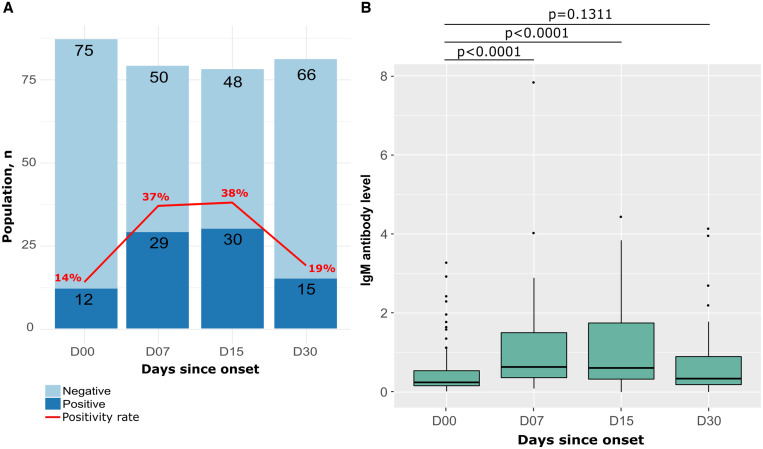
Coronavirus disease (COVID-19) caused by severe acute respiratory syndrome coronavirus 2 (SARS-CoV-2) poses serious global public health problems. Characterization of the immune response, particularly antibodies to SARS-CoV-2, is important for establishing vaccine strategies. The purpose of this study was to evaluate longitudinally the kinetics of anti-SARS-CoV-2 antibodies against spike protein (S1) for up to 3 months in a cohort of 169 COVID-19 patients. We enrolled COVID-19 patients at two regional hospitals in Casablanca, Morocco, between March and September 2021. Blood samples were collected and N-specific IgM and S-specific IgG levels were measured by a commercial Euroimmun ELISA. IgM antibodies were assessed 2-5 (D00), 9-12 (D07), 17-20 (D15), and 32-37 (D30) days after symptom onset; IgG antibodies were assessed at these time points plus 60 (D60) and 90 (D90) days after symptom onset. We found that at 3 months after symptom onset, 79% of patients had detectable SARS-CoV-2-specific IgG antibodies, whereas their IgM seropositivity was 19% by 1 month after symptom onset. The IgM level decreased to 0.34 (interquartile range [IQR] 0.19-0.92) at 1 month after symptom onset, whereas the IgG level peaked at D30 (3.10; IQR 1.83-5.64) and remained almost stable at D90 (2.95; IQR 1.52-5.19). IgG levels were significantly higher in patients older than 50 years than in those younger than 50 at all follow-up time points (P < 0.05). Statistical analysis showed no significant difference in median anti-S1 antibody levels among infected patients based on gender or comorbidities. This study provides information on the longevity of anti-SARS-CoV-2 IgM and IgG antibodies in COVID-19 patients.
由严重急性呼吸系统综合征冠状病毒 2(SARS-CoV-2)引起的冠状病毒疾病(COVID-19)对全球公共卫生构成严重威胁。对免疫反应,特别是对 SARS-CoV-2 的抗体进行特征描述,对于制定疫苗策略很重要。本研究旨在对 169 名 COVID-19 患者长达 3 个月的时间内,针对尖峰蛋白(S1)的抗 SARS-CoV-2 抗体的动力学进行纵向评估。我们在摩洛哥卡萨布兰卡的两家地区医院招募了 COVID-19 患者,招募时间为 2021 年 3 月至 9 月。采集血样,并通过商业 Euroimmun ELISA 测量 N 特异性 IgM 和 S 特异性 IgG 水平。IgM 抗体在症状出现后 2-5 天(D00)、9-12 天(D07)、17-20 天(D15)和 32-37 天(D30)进行评估;IgG 抗体在这些时间点外加症状出现后 60 天(D60)和 90 天(D90)进行评估。我们发现,在症状出现后 3 个月时,79%的患者可检测到 SARS-CoV-2 特异性 IgG 抗体,而在症状出现后 1 个月时,IgM 的血清阳性率为 19%。IgM 水平在症状出现后 1 个月时下降至 0.34(四分位距 [IQR] 0.19-0.92),而 IgG 水平在 D30 时达到峰值(3.10;IQR 1.83-5.64),并在 D90 时基本稳定(2.95;IQR 1.52-5.19)。在所有随访时间点,50 岁以上患者的 IgG 水平均显著高于 50 岁以下患者(P < 0.05)。统计分析显示,根据性别或合并症,感染患者的抗 S1 抗体中位水平无显著差异。本研究提供了 COVID-19 患者抗 SARS-CoV-2 IgM 和 IgG 抗体的持久性信息。