Department of Pediatric Critical Care Medicine, University of California, San Francisco, Calif.
Department of Biochemistry and Biophysics, University of California, San Francisco, Calif; Diabetes Center, School of Medicine, University of California, San Francisco, Calif.
J Allergy Clin Immunol. 2023 Apr;151(4):926-930.e2. doi: 10.1016/j.jaci.2022.11.020. Epub 2022 Dec 9.
Autoantibodies against type I IFNs occur in approximately 10% of adults with life-threatening coronavirus disease 2019 (COVID-19). The frequency of anti-IFN autoantibodies in children with severe sequelae of severe acute respiratory syndrome coronavirus 2 (SARS-CoV-2) infection is unknown.
We quantified anti-type I IFN autoantibodies in a multicenter cohort of children with severe COVID-19, multisystem inflammatory syndrome in children (MIS-C), and mild SARS-CoV-2 infections.
Circulating anti-IFN-α2 antibodies were measured by a radioligand binding assay. Whole-exome sequencing, RNA sequencing, and functional studies of peripheral blood mononuclear cells were used to study any patients with levels of anti-IFN-α2 autoantibodies exceeding the assay's positive control.
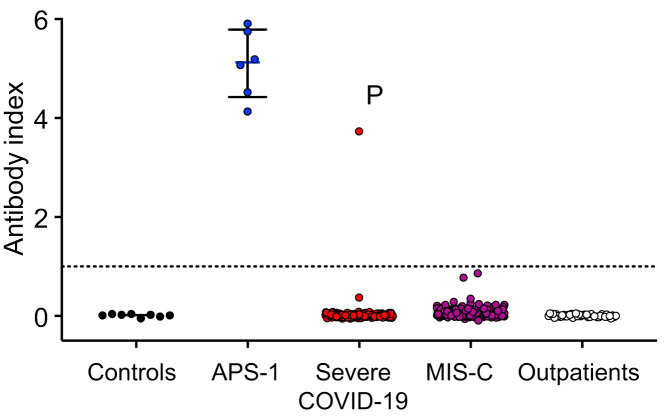
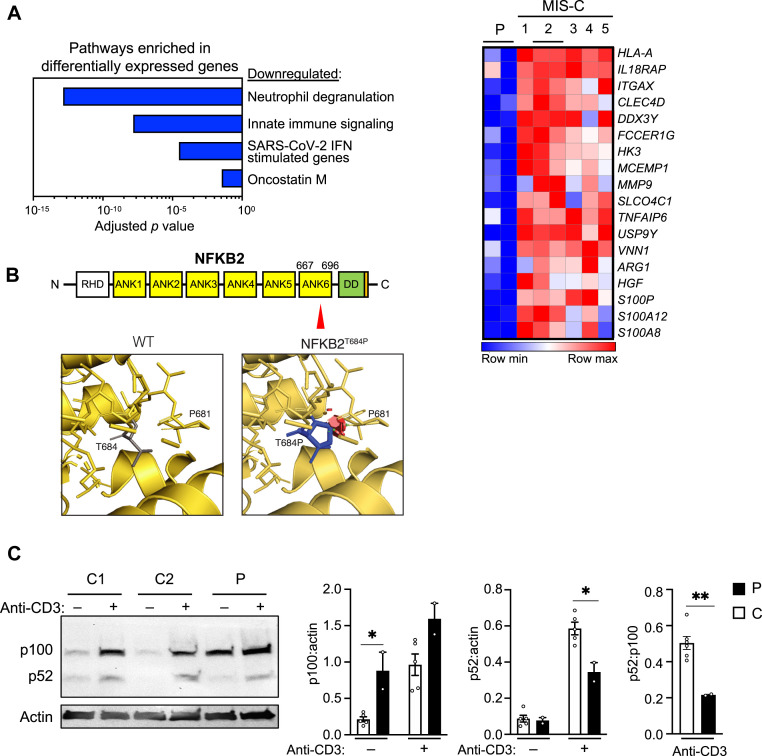
Among 168 patients with severe COVID-19, 199 with MIS-C, and 45 with mild SARS-CoV-2 infections, only 1 had high levels of anti-IFN-α2 antibodies. Anti-IFN-α2 autoantibodies were not detected in patients treated with intravenous immunoglobulin before sample collection. Whole-exome sequencing identified a missense variant in the ankyrin domain of NFKB2, encoding the p100 subunit of nuclear factor kappa-light-chain enhancer of activated B cells, aka NF-κB, essential for noncanonical NF-κB signaling. The patient's peripheral blood mononuclear cells exhibited impaired cleavage of p100 characteristic of NFKB2 haploinsufficiency, an inborn error of immunity with a high prevalence of autoimmunity.
High levels of anti-IFN-α2 autoantibodies in children and adolescents with MIS-C, severe COVID-19, and mild SARS-CoV-2 infections are rare but can occur in patients with inborn errors of immunity.
约有 10%的危及生命的 2019 年冠状病毒病(COVID-19)成年患者体内存在针对 I 型干扰素的自身抗体。严重急性呼吸综合征冠状病毒 2(SARS-CoV-2)感染后出现严重后遗症的儿童中抗 IFN 自身抗体的频率尚不清楚。
我们在一个多中心队列中对患有严重 COVID-19、儿童多系统炎症综合征(MIS-C)和轻度 SARS-CoV-2 感染的儿童定量检测了抗 I 型 IFN 自身抗体。
通过放射性配体结合测定法检测循环中的 IFN-α2 抗体。对全外显子组测序、RNA 测序以及外周血单核细胞的功能研究用于研究任何抗 IFN-α2 自身抗体水平超过检测法阳性对照的患者。
在 168 例严重 COVID-19 患者、199 例 MIS-C 患者和 45 例轻度 SARS-CoV-2 感染患者中,仅有 1 例存在高水平的抗 IFN-α2 抗体。在采集样本前接受静脉注射免疫球蛋白治疗的患者中未检测到抗 IFN-α2 自身抗体。全外显子组测序发现,编码 NF-κB 激活 B 细胞的κ轻链增强子核因子 NFKB2 的 p100 亚单位的锚蛋白结构域存在错义变异,这对非经典 NF-κB 信号转导至关重要。该患者的外周血单核细胞表现出 p100 切割受损,这是一种先天免疫缺陷疾病,其特征为 NFKB2 杂合不足,自身免疫病的患病率很高。
MIS-C、严重 COVID-19 和轻度 SARS-CoV-2 感染的儿童和青少年中高水平的抗 IFN-α2 自身抗体很少见,但可发生于先天免疫缺陷病患者中。