Chen Chenglong, Shi Qianyu, Xu Jiuhui, Ren Tingting, Huang Yi, Guo Wei
Department of Orthopedics, Beijing Jishuitan Hospital, Beijing, People's Republic of China.
Beijing Key Laboratory of Musculoskeletal Tumor, Peking University People's Hospital, Beijing, People's Republic of China.
Cell Death Discov. 2022 Dec 12;8(1):488. doi: 10.1038/s41420-022-01252-6.
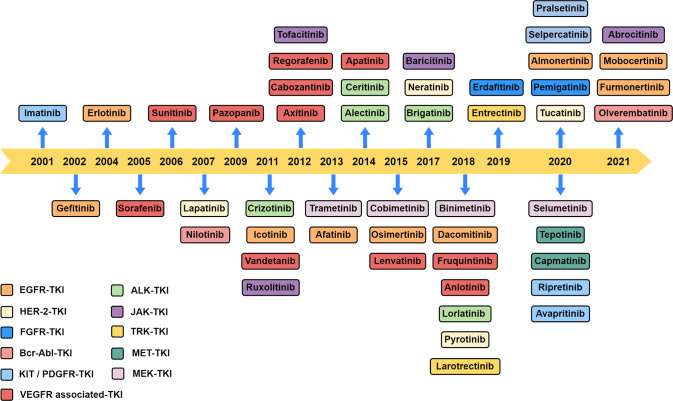
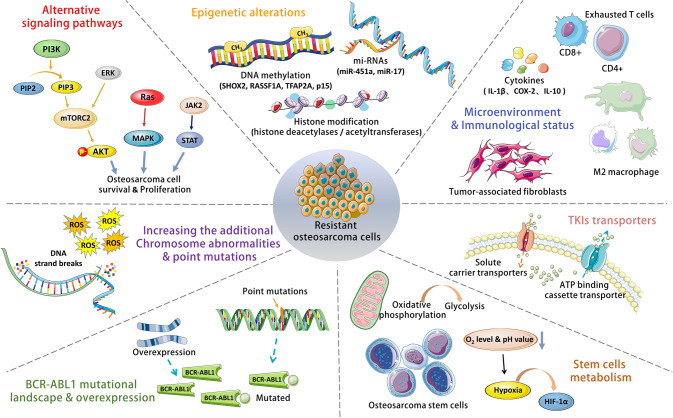
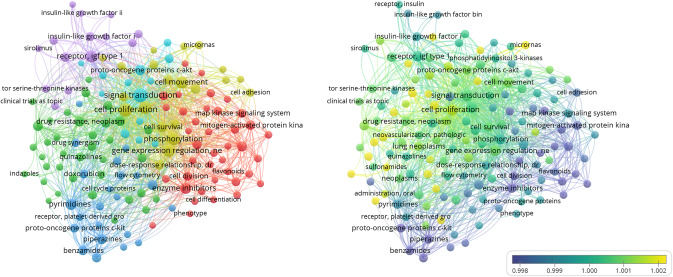
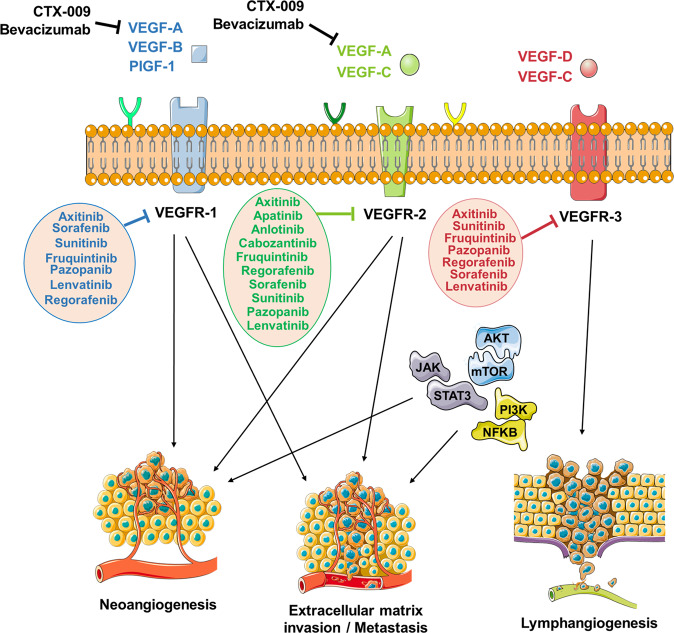
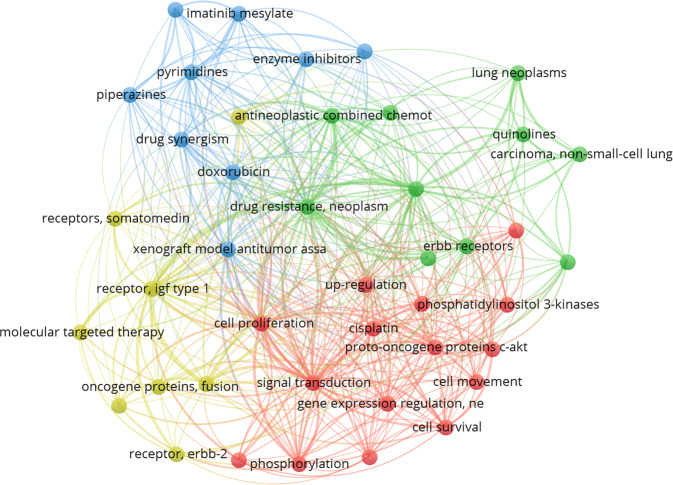
Osteosarcoma (OS) is a mesenchymal-origin tumor that constitutes the most common primary malignant bone tumor. The survival rate of the patients has significantly improved since the introduction of neoadjuvant chemotherapy and extensive resection, but it has stagnated in recent 40 years. Tyrosine kinase inhibitors (TKIs) have played a key part in the treatment of malignant tumors. In advanced OS, TKIs including anlotinib, apatinib, sorafenib, etc. have significantly improved the progression-free survival of patients, while the overall survival remains unchanged. The main reason is the rapid and inevitable progress of acquired drug resistance of OS. However, as the application of TKIs in OS and other tumors is still in the exploratory phase, its drug resistance mechanism and corresponding solutions are rarely reported. Hence, in this review, we summarize knowledge of the applications of TKIs, the mechanism of TKIs resistance, and the attempts to overcome TKIs resistance in OS, which are the three potentially novel insights of TKIs in OS. Because most evidence is derived from studies using animal and cell models, we also reviewed clinical trials and related bioinformatics data available in public databases, which partially improved our understanding of TKIs applications.
骨肉瘤(OS)是一种间充质起源的肿瘤,是最常见的原发性恶性骨肿瘤。自引入新辅助化疗和广泛切除术后,患者的生存率有了显著提高,但在最近40年一直停滞不前。酪氨酸激酶抑制剂(TKIs)在恶性肿瘤治疗中发挥了关键作用。在晚期骨肉瘤中,包括安罗替尼、阿帕替尼、索拉非尼等在内的酪氨酸激酶抑制剂显著提高了患者的无进展生存期,而总生存期保持不变。主要原因是骨肉瘤获得性耐药的快速且不可避免的进展。然而,由于酪氨酸激酶抑制剂在骨肉瘤和其他肿瘤中的应用仍处于探索阶段,其耐药机制及相应解决方案鲜有报道。因此,在本综述中,我们总结了酪氨酸激酶抑制剂的应用知识、耐药机制以及在骨肉瘤中克服耐药的尝试,这是酪氨酸激酶抑制剂在骨肉瘤中的三个潜在新见解。由于大多数证据来自使用动物和细胞模型的研究,我们还回顾了公开数据库中可用的临床试验和相关生物信息学数据,这部分增进了我们对酪氨酸激酶抑制剂应用的理解。