Division of Endocrinology, Metabolism and Molecular Medicine, Feinberg School of Medicine, Northwestern University, Chicago, IL, USA.
Department of Preventive Medicine, Feinberg School of Medicine, Northwestern University, Chicago, IL, 60611, USA.
J Expo Sci Environ Epidemiol. 2023 Nov;33(6):855-864. doi: 10.1038/s41370-022-00511-z. Epub 2022 Dec 13.
Variations in dietary intake and environmental exposure patterns of essential and non-essential trace metals influence many aspects of human health throughout the life span.
To examine the relationship between urine profiles of essential and non-essential metals in mother-offspring pairs and their association with early dysglycemia.
Herein, we report findings from an ancillary study to the international Hyperglycemia and Adverse Pregnancy Outcome Follow-Up Study (HAPO-FUS) that examined urinary essential and non-essential metal profiles from mothers and offspring ages 10-14 years (1012 mothers, 1013 offspring, 968 matched pairs) from 10 international sites.
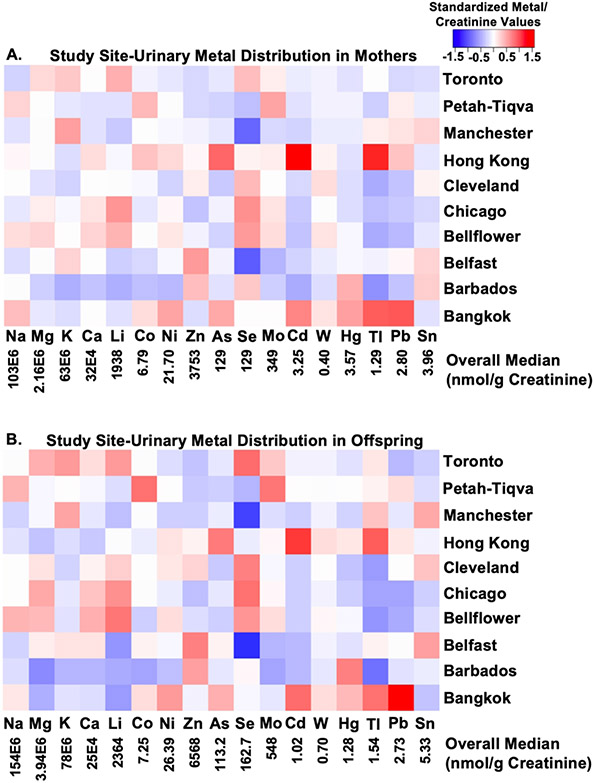
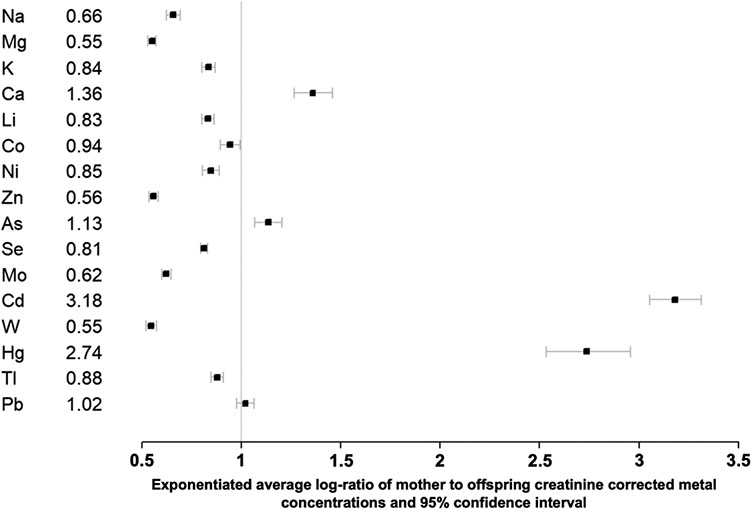
Our analysis demonstrated a diverse exposure pattern across participating sites. In multiple regression modelling, a positive association between markers of early dysglycemia and urinary zinc was found in both mothers and offspring after adjustment for common risk factors for diabetes. The analysis showed weaker, positive, and negative associations of the 2-h glucose value with urinary selenium and arsenic respectively. A positive association between 2-h glucose values and cadmium was found only in mothers in the fully adjusted model when participants with established diabetes were excluded. There was a high degree of concordance between mother and offspring urinary metal profiles. Mother-to-offspring urinary metal ratios were unique for each metal, providing insights into changes in their homeostasis across the lifespan.
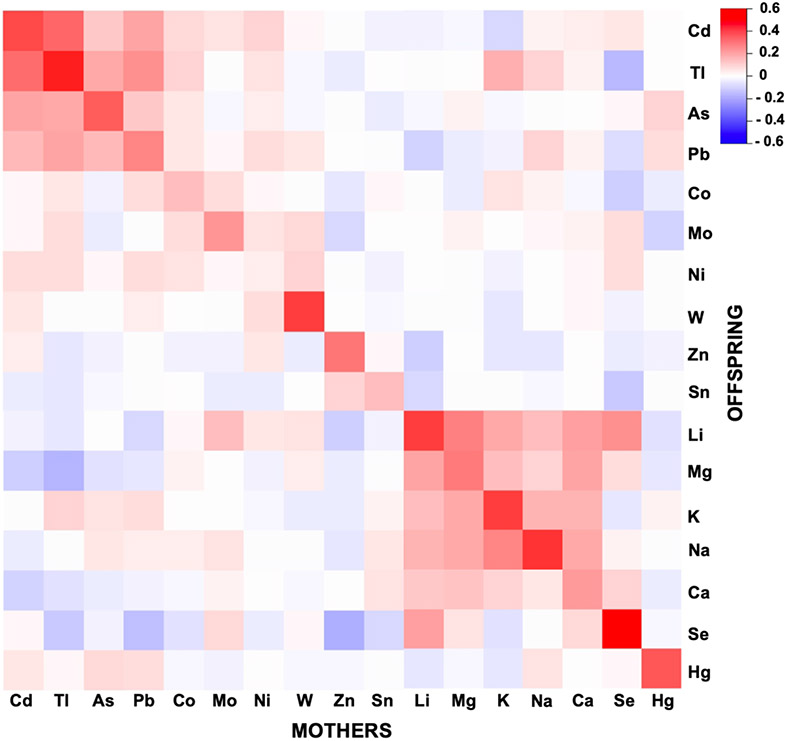
Urinary levels of essential and non-essential metals are closely correlated between mothers and their offspring in an international cohort. Urinary levels of zinc, selenium, arsenic, and cadmium showed varying degrees of association with early dysglycemia in a comparatively healthy cohort with a low rate of preexisting diabetes.
Our data provides novel evidence for a strong correlation between mother and offspring urinary metal patterns with a unique mother-to-offspring ratio for each metal. The study also provides new evidence for a strong positive association between early dysglycemia and urinary zinc, both in mothers and offspring. Weaker positive associations with urinary selenium and cadmium and negative associations with arsenic were also found. The low rate of preexisting diabetes in this population provides the unique advantage of minimizing the confounding effect of preexisting, diabetes related renal changes that would alter the relationship between dysglycemia and renal metal excretion.
饮食摄入和环境暴露模式的变化会影响必需和非必需微量元素在整个生命周期中对人类健康的许多方面。
检查母婴对子尿液中必需和非必需金属的特征,并将其与早期糖代谢异常联系起来。
本文报告了国际高血糖与不良妊娠结局随访研究(HAPO-FUS)的一个辅助研究的结果,该研究检查了来自 10 个国际地点的 1012 名母亲、1013 名后代和 968 对匹配对子的 10-14 岁母亲和后代的尿液必需和非必需金属特征。
我们的分析表明,参与的地点之间存在多样化的暴露模式。在多元回归模型中,在调整了糖尿病常见危险因素后,我们发现母亲和后代的早期糖代谢异常标志物与尿锌呈正相关。分析显示,在 2 小时血糖值与尿硒和砷分别呈较弱的正相关和负相关。在排除已确诊糖尿病的参与者后,只有在完全调整模型中,母亲的 2 小时血糖值与镉呈正相关。母亲和后代尿液金属特征之间具有高度一致性。每种金属的母子尿液金属比值都是独特的,为其整个生命周期中的内稳态变化提供了见解。
在一个国际队列中,母亲和其后代的尿液中必需和非必需金属的水平密切相关。在一个患有糖尿病的比例较低的相对健康的队列中,锌、硒、砷和镉的尿液水平与早期糖代谢异常有不同程度的关联。
我们的数据为母子尿液金属模式之间的强烈相关性提供了新的证据,并且每种金属都具有独特的母子比值。该研究还为早期糖代谢异常与母亲和后代尿液中的锌之间的强烈正相关提供了新的证据。我们还发现与尿液硒和镉呈较弱的正相关,与砷呈负相关。该人群中糖尿病前期的发生率较低,这提供了一个独特的优势,可以最大程度地减少糖尿病相关肾脏变化对糖代谢异常与肾脏金属排泄之间关系的混杂影响。