Koszewicz Magdalena, Markowska Katarzyna, Waliszewska-Prosol Marta, Poreba Rafał, Gac Paweł, Szymanska-Chabowska Anna, Mazur Grzegorz, Wieczorek Malgorzata, Ejma Maria, Slotwinski Krzysztof, Budrewicz Slawomir
Department of Neurology, Wroclaw Medical University, Borowska 213, 50-556, Wroclaw, Poland.
Department of Internal Medicine, Occupational Diseases, Hypertension and Clinical Oncology, Wroclaw Medical University, Borowska 213, 50-550, Wroclaw, Poland.
J Occup Med Toxicol. 2021 Apr 15;16(1):12. doi: 10.1186/s12995-021-00302-6.
Chronic exposure to heavy metals affects various organs, among them the brain and peripheral nerves. Polyneuropathy is mainly length-dependent with predominantly sensory symptoms. There have been few studies on small fiber neuropathy due to heavy metal intoxication.
We investigated 41 metal industry workers, mean age 51.3 ± 10.5 years, with at least 5 years' professional exposure to heavy metals, and 36 age- and sex-matched healthy controls. We performed neurological examinations, and assessed blood levels of cadmium, lead, and zinc protoporphyrin, urine levels of arsenic, standard, sensory and motor electrophysiological tests in the ulnar and peroneal nerves, sympathetic skin responses from the palm and foot, and quantitative sensation testing from dermatomes C8 and S1.
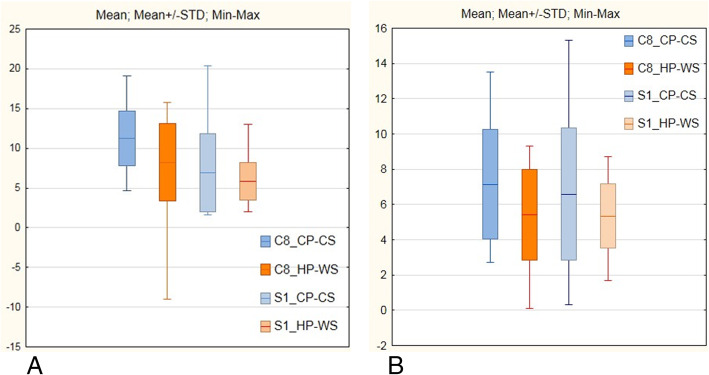
The results of standard conduction tests of all nerves significantly differed between groups. The latency of sympathetic skin responses achieved from the foot was also statistically significantly prolonged in the study group. Significant differences were seen in both C8 and S1 regions for temperature and pain thresholds, and for vibratory threshold only in the S1 region, while the dispersions of low and high temperatures were important exclusively in the C8 region.
We can conclude that co-exposure to many heavy metals results in explicit impairment of peripheral nerves. The lesion is more pronounced within small fibers and is predominantly connected with greater impairment of temperature-dependent pain thresholds. The evaluation of small fiber function should be considered in the early diagnosis of toxic polyneuropathy or in low-dose exposure to heavy metals.
长期接触重金属会影响多个器官,其中包括大脑和周围神经。多发性神经病主要呈长度依赖性,以感觉症状为主。关于重金属中毒所致小纤维神经病的研究较少。
我们调查了41名金属行业工人,平均年龄51.3±10.5岁,至少有5年的重金属职业暴露史,以及36名年龄和性别匹配的健康对照者。我们进行了神经学检查,评估了血液中镉、铅和锌原卟啉的水平、尿液中砷的水平、尺神经和腓总神经的标准、感觉和运动电生理测试、手掌和足部的交感皮肤反应,以及C8和S1皮节的定量感觉测试。
所有神经的标准传导测试结果在两组之间有显著差异。研究组中足部交感皮肤反应的潜伏期在统计学上也显著延长。在C8和S1区域,温度和疼痛阈值均有显著差异,仅在S1区域振动阈值有显著差异,而低温和高温的离散度仅在C8区域有重要意义。
我们可以得出结论,同时接触多种重金属会导致周围神经明显受损。病变在小纤维中更为明显,主要与温度依赖性疼痛阈值的更大损伤有关。在中毒性多发性神经病的早期诊断或低剂量重金属暴露中,应考虑对小纤维功能进行评估。