Department of Psychiatric Research, Diakonhjemmet Hospital, Oslo, Norway.
Norwegian Centre for Mental Disorders Research (NORMENT), Institute of Clinical Medicine, University of Oslo, Oslo, Norway.
Mol Psychiatry. 2023 Mar;28(3):1159-1169. doi: 10.1038/s41380-022-01901-3. Epub 2022 Dec 12.
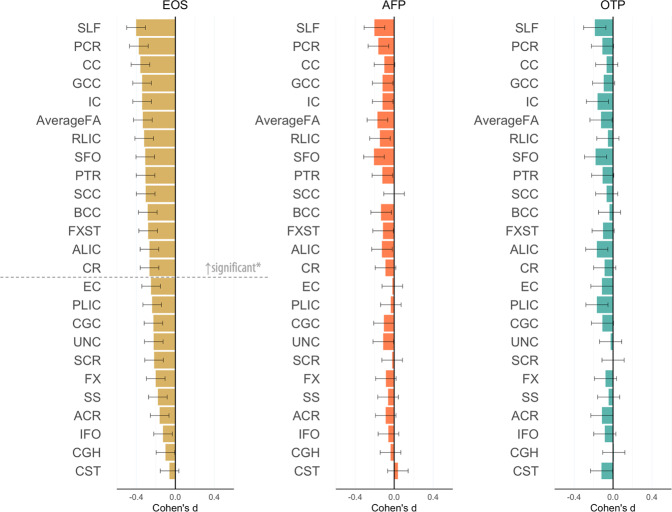
Emerging evidence suggests brain white matter alterations in adolescents with early-onset psychosis (EOP; age of onset <18 years). However, as neuroimaging methods vary and sample sizes are modest, results remain inconclusive. Using harmonized data processing protocols and a mega-analytic approach, we compared white matter microstructure in EOP and healthy controls using diffusion tensor imaging (DTI). Our sample included 321 adolescents with EOP (median age = 16.6 years, interquartile range (IQR) = 2.14, 46.4% females) and 265 adolescent healthy controls (median age = 16.2 years, IQR = 2.43, 57.7% females) pooled from nine sites. All sites extracted mean fractional anisotropy (FA), mean diffusivity (MD), radial diffusivity (RD), and axial diffusivity (AD) for 25 white matter regions of interest per participant. ComBat harmonization was performed for all DTI measures to adjust for scanner differences. Multiple linear regression models were fitted to investigate case-control differences and associations with clinical variables in regional DTI measures. We found widespread lower FA in EOP compared to healthy controls, with the largest effect sizes in the superior longitudinal fasciculus (Cohen's d = 0.37), posterior corona radiata (d = 0.32), and superior fronto-occipital fasciculus (d = 0.31). We also found widespread higher RD and more localized higher MD and AD. We detected significant effects of diagnostic subgroup, sex, and duration of illness, but not medication status. Using the largest EOP DTI sample to date, our findings suggest a profile of widespread white matter microstructure alterations in adolescents with EOP, most prominently in male individuals with early-onset schizophrenia and individuals with a shorter duration of illness.
新出现的证据表明,早期发病的精神病(EOP;发病年龄<18 岁)青少年的大脑白质发生改变。然而,由于神经影像学方法的不同以及样本量较小,结果仍不确定。我们使用协调的数据处理方案和大型分析方法,通过弥散张量成像(DTI)比较了 EOP 和健康对照组的大脑白质微观结构。我们的样本包括来自 9 个地点的 321 名 EOP 青少年(中位年龄=16.6 岁,四分位距(IQR)=2.14,46.4%为女性)和 265 名健康对照组青少年(中位年龄=16.2 岁,IQR=2.43,57.7%为女性)。所有地点均从每个参与者中提取了 25 个感兴趣的白质区域的平均各向异性分数(FA)、平均弥散度(MD)、径向弥散度(RD)和轴向弥散度(AD)。对所有 DTI 指标进行了 ComBat 协调,以调整扫描仪差异。拟合多元线性回归模型,以研究区域性 DTI 指标的病例对照差异和与临床变量的关联。我们发现 EOP 组的 FA 值普遍低于健康对照组,其中上纵束(Cohen's d=0.37)、后放射冠(d=0.32)和上额枕束(d=0.31)的效应量最大。我们还发现 RD 值普遍升高,MD 和 AD 值更局限于局部升高。我们检测到诊断亚组、性别和疾病持续时间的显著影响,但未检测到药物状态的影响。使用迄今为止最大的 EOP DTI 样本,我们的发现表明 EOP 青少年存在广泛的白质微观结构改变,在男性早发性精神分裂症患者和疾病持续时间较短的患者中最为明显。