PhD Program, School of Public Health, University of Chile, Av. Independencia 939, Independencia, Santiago, Chile.
Department of Family Medicine and Public Health, University of California at San Diego, California, # 9500 Gilman Drive, La Jolla, CA 92093, USA.
Public Health. 2023 Jan;214:61-68. doi: 10.1016/j.puhe.2022.11.001. Epub 2022 Nov 8.
To assess the impact of the addition of 12 maternity leave (ML) weeks (2011), a pay for performance (P4P) exclusive breastfeeding (EBF) promotion strategy (2015), and the COVID-19 pandemic in EBF inequalities in Chile.
Interrupted time-series analyses (ITSAs).
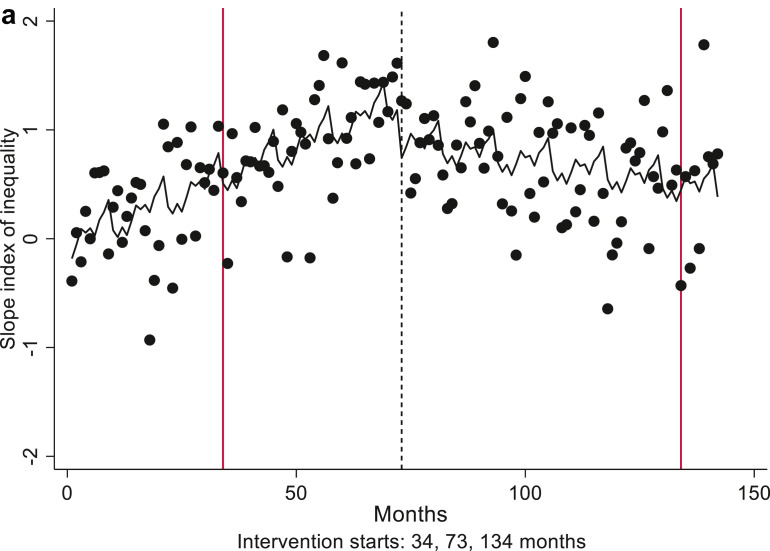
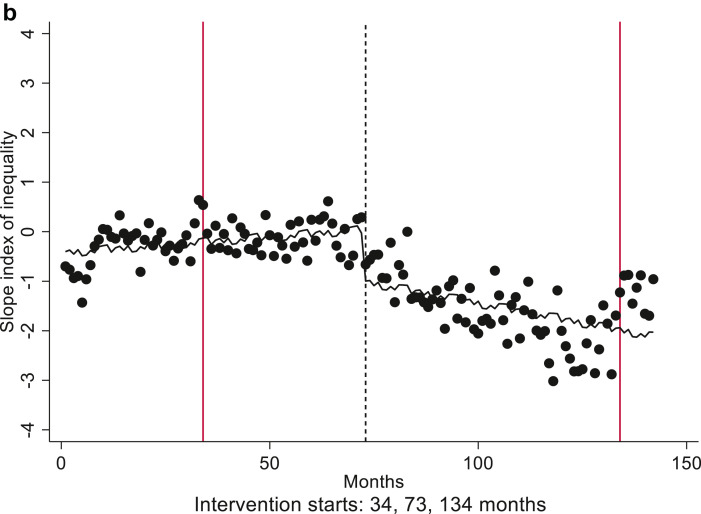
Aggregated national EBF data by municipality and month were collected from 2009 to 2020. We assess the impact of the three events in EBF inequalities using two procedures: 1. ITSA stratified by municipal SES quintiles (Q1-Q5); 2. Calculating the EBF slope index of inequality (SII).
The EBF prevalence was higher in lower SES municipalities before and after the three time-events. No impact in EBF inequalities was observed after the extended ML. The P4P strategy increased EBF at six months in all SES quintiles (effect size between 4% and 5%), but in a higher level in poorer municipalities (SII: -0.36% and -1.05%). During COVID-19, wealthier municipalities showed a slightly higher EBF at six months prevalence (SII: 1.44%).
The null impact of the extended ML in EBF inequalities could be explained by a low access to ML among affiliated to the public health system (20%). The P4P strategy includes multiple interventions that seemed effective in increasing EBF across all SES quintiles, but further in lower quintiles. The restrictions in healthcare access in poorer municipalities could explain EBF inequalities during COVID-19.
评估在智利,增加 12 周产假(2011 年)、实施按绩效付费(P4P)纯母乳喂养(EBF)促进策略(2015 年)以及新冠肺炎疫情对 EBF 不平等的影响。
中断时间序列分析(ITSAs)。
我们收集了 2009 年至 2020 年按市和月份汇总的全国 EBF 数据。我们使用以下两种程序评估这三个事件对 EBF 不平等的影响:1. 按城市社会经济地位五分位数(Q1-Q5)分层的 ITSA;2. 计算 EBF 不平等斜率指数(SII)。
在三个时间事件之前和之后,社会经济地位较低的城市 EBF 普及率较高。延长产假并未对 EBF 不平等产生影响。P4P 策略在所有五分位数中均在六个月时提高了 EBF(效应量在 4%至 5%之间),但在较贫穷的城市中效果更高(SII:-0.36%和-1.05%)。在 COVID-19 期间,较富裕的城市在六个月时的 EBF 普及率略高(SII:1.44%)。
延长产假对 EBF 不平等的影响为零,这可能是由于公共卫生系统中获得产假的机会较低(20%)所致。P4P 策略包括多项干预措施,这些措施似乎在提高所有社会经济地位五分位数的 EBF 方面都很有效,但在较低五分位数中的效果更大。在较贫穷的城市中,医疗保健机会受限可能解释了 COVID-19 期间 EBF 不平等的原因。