Department of Microbiology and Cell Biology, Montana State University, Bozeman, MT, 59717, USA.
Department of Chemistry, University of Michigan, Ann Arbor, MI, 48105, USA.
Nat Commun. 2022 Dec 15;13(1):7762. doi: 10.1038/s41467-022-35445-5.
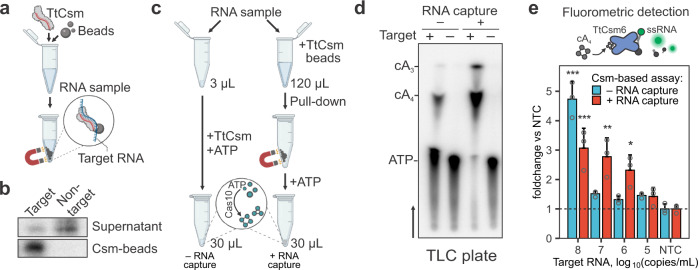
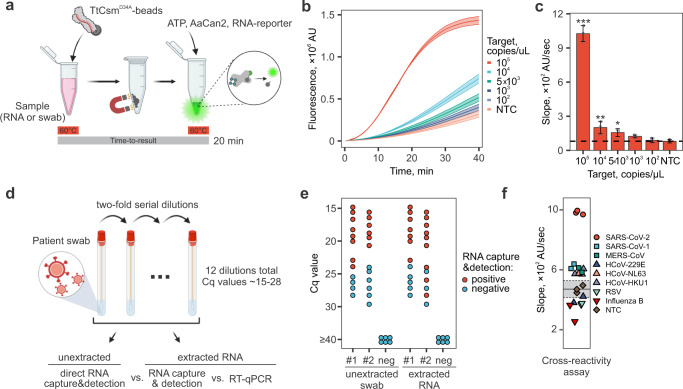
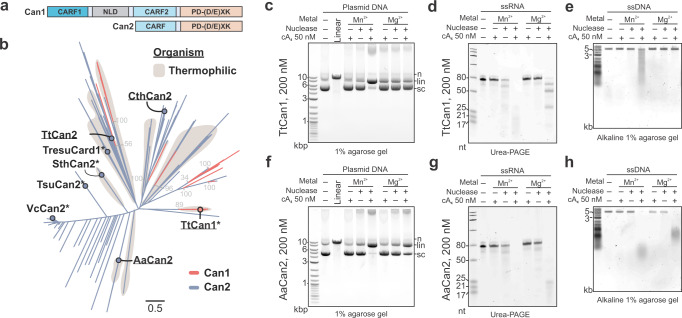
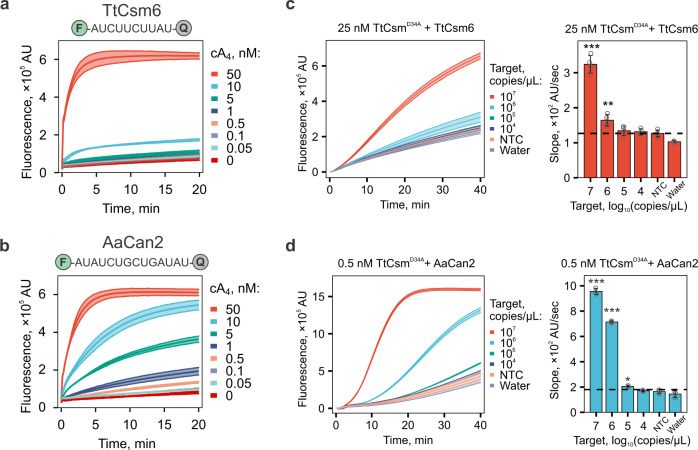
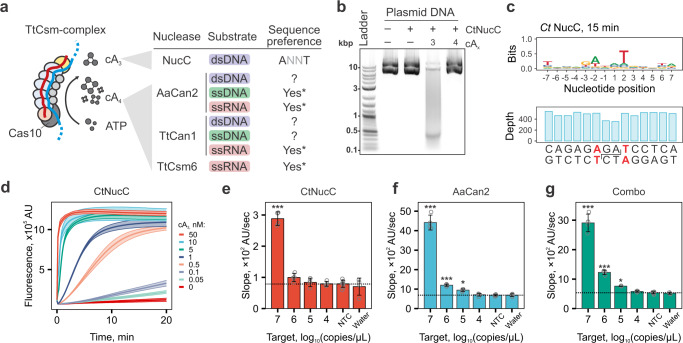
Type-III CRISPR-Cas systems have recently been adopted for sequence-specific detection of SARS-CoV-2. Here, we repurpose the type III-A CRISPR complex from Thermus thermophilus (TtCsm) for programmable capture and concentration of specific RNAs from complex mixtures. The target bound TtCsm complex generates two cyclic oligoadenylates (i.e., cA and cA) that allosterically activate ancillary nucleases. We show that both Can1 and Can2 nucleases cleave single-stranded RNA, single-stranded DNA, and double-stranded DNA in the presence of cA. We integrate the Can2 nuclease with type III-A RNA capture and concentration for direct detection of SARS-CoV-2 RNA in nasopharyngeal swabs with 15 fM sensitivity. Collectively, this work demonstrates how type-III CRISPR-based RNA capture and concentration simultaneously increases sensitivity, limits time to result, lowers cost of the assay, eliminates solvents used for RNA extraction, and reduces sample handling.
III 型 CRISPR-Cas 系统最近被用于 SARS-CoV-2 的序列特异性检测。在这里,我们重新利用嗜热栖热菌(TtCsm)的 III-A 型 CRISPR 复合物,用于从复杂混合物中可编程捕获和浓缩特定的 RNA。靶标结合的 TtCsm 复合物产生两种环状寡腺苷酸(即 cA 和 cA),别构激活辅助核酸酶。我们表明,在 cA 存在的情况下,Can1 和 Can2 核酸酶都可以切割单链 RNA、单链 DNA 和双链 DNA。我们将 Can2 核酸酶与 III-A 型 RNA 捕获和浓缩集成,用于直接检测鼻咽拭子中的 SARS-CoV-2 RNA,灵敏度为 15 fM。总的来说,这项工作展示了如何基于 III 型 CRISPR 的 RNA 捕获和浓缩同时提高灵敏度、缩短结果时间、降低检测成本、消除用于 RNA 提取的溶剂以及减少样本处理。