Lau Bryan, Wentz Eryka, Ni Zhanmo, Yenokyan Karine, Coggiano Candelaria, Mehta Shruti H, Duggal Priya
Department of Epidemiology, Johns Hopkins Bloomberg School of Public Health, Baltimore, MD.
These authors contributed equally.
medRxiv. 2022 Dec 7:2022.12.07.22283203. doi: 10.1101/2022.12.07.22283203.
Persistent symptoms after SARS-COV-2 infection, or long-COVID, may occur in anywhere from 10-55% of those who have had COVID-19, but the extent of impact on daily functioning and disability remains unquantified.
To characterize physical and mental disability associated with long-COVID.
Cross-sectional analysis of baseline data from a cohort study.
Online US nationwide survey.
Adults 18 years of age and older who live in the US who either report a history of COVID-19 illness (n=8,874) or report never having had COVID-19 (n=633).
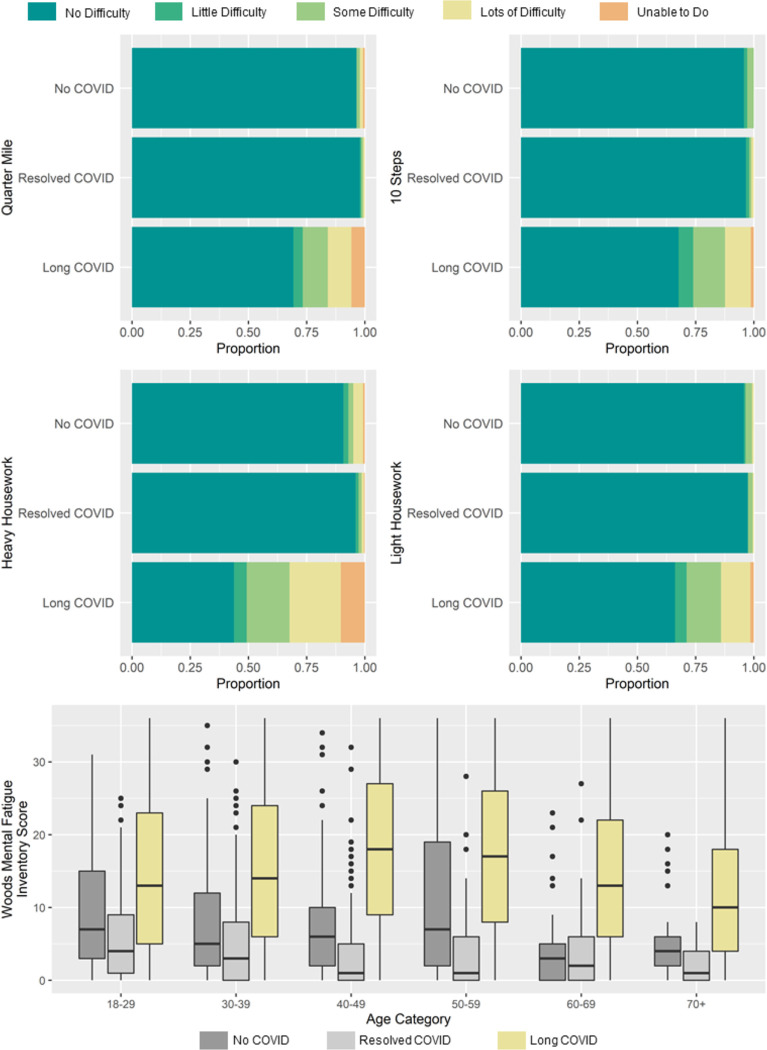
Self-reported mobility disability (difficulty walking a quarter of a mile and/or up 10 stairs, instrumental activities of daily living [IADL] disability (difficulty doing light or heavy housework), and mental fatigue as measured by the Wood Mental Fatigue Inventory (WMFI).
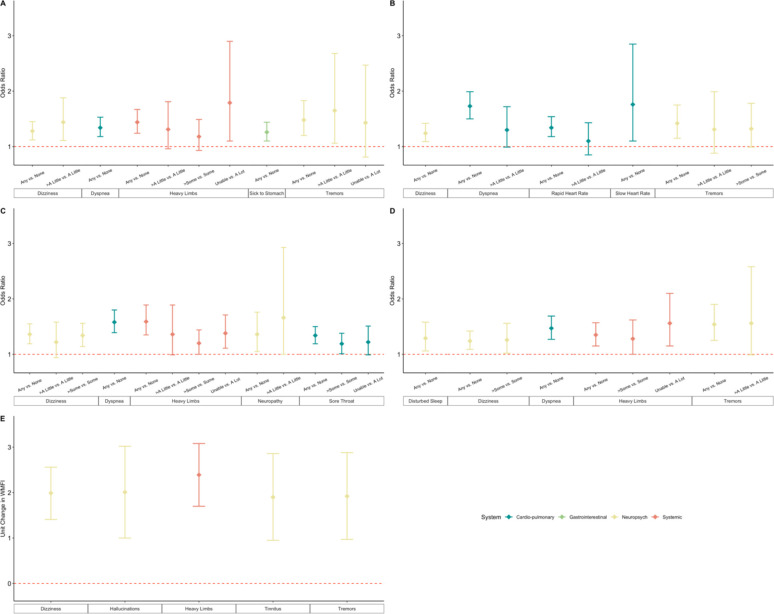
Of 7,926 participants with long-COVID, the median age was 45 years, 84% were female, 89% self-reported white race, and 7.4% self-reported Hispanic/Latino ethnicity. Sixty-five percent of long-COVID participants were classified as having at least one disability, compared to 6% of those with resolved-COVID (n=948) and 14% of those with no-COVID (n=633). Of long-COVID participants, about 1% and 5% were classified as critically physically disabled or mentally fatigued, respectively. Age, prior comorbidity, increased BMI, female gender, hospitalization for COVID-19, non-white race, and multi-race were all associated with significantly higher disability burden. Dizziness at the time of infection (33% non-hospitalized, 39% hospitalized) was associated with all five disability components in both hospitalized and non-hospitalized groups. Heavy limbs, dyspnea, and tremors were associated with four of the five components of disability in the non-hospitalized group, and heavy limbs was associated with four of the five components in the hospitalized group. Vaccination was protective against development of disability.
We observed a high burden of physical and mental disability associated with long-COVID which has serious implications for individual and societal health that may be partially mitigated by vaccination. Longitudinal characterization and evaluation of COVID-19 patients is necessary to identify patterns of recovery and treatment options.
新冠病毒感染后出现的持续症状,即长期新冠,可能在10%至55%的新冠患者中出现,但对日常功能和残疾的影响程度仍未得到量化。
描述与长期新冠相关的身体和精神残疾情况。
对一项队列研究的基线数据进行横断面分析。
美国全国性在线调查。
居住在美国的18岁及以上成年人,其中报告有新冠病史的(n = 8874)或报告从未感染过新冠的(n = 633)。
自我报告的行动能力残疾(行走四分之一英里和/或上10级楼梯困难)、日常生活工具性活动(IADL)残疾(做轻度或重度家务困难),以及通过伍德精神疲劳量表(WMFI)测量的精神疲劳。
在7926名患有长期新冠的参与者中,年龄中位数为45岁,84%为女性,89%自我报告为白人,7.4%自我报告为西班牙裔/拉丁裔。65%的长期新冠参与者被归类为至少有一种残疾,相比之下,新冠已康复者(n = 948)中有6%,未感染新冠者(n = 633)中有14%。在长期新冠参与者中,分别约有1%和5%被归类为严重身体残疾或精神疲劳。年龄、既往合并症、体重指数增加、女性、因新冠住院、非白人种族和多种族均与显著更高的残疾负担相关。感染时出现头晕(非住院患者中为33%,住院患者中为39%)在住院和非住院组中均与所有五个残疾组成部分相关。肢体沉重、呼吸困难和震颤在非住院组中与五个残疾组成部分中的四个相关,肢体沉重在住院组中与五个组成部分中的四个相关。接种疫苗可预防残疾的发生。
我们观察到与长期新冠相关的身体和精神残疾负担较重,这对个人和社会健康具有严重影响,接种疫苗可能会部分减轻这种影响。对新冠患者进行纵向特征描述和评估对于确定康复模式和治疗选择是必要的。