Division of Nephrology, Department of Internal Medicine, University of Groningen, University Medical Center Groningen, Groningen, The Netherlands.
Division of Pharmacology and Therapy, Department of Anatomy, Histology, and Pharmacology, Faculty of Medicine Universitas Airlangga, Surabaya, Indonesia.
Nephrol Dial Transplant. 2023 Mar 31;38(4):1041-1052. doi: 10.1093/ndt/gfac332.
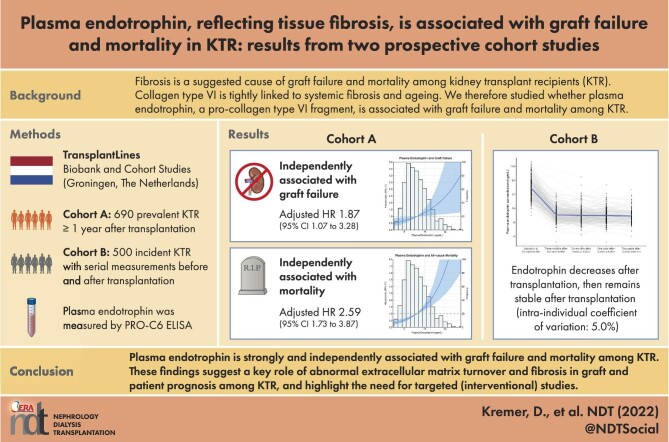
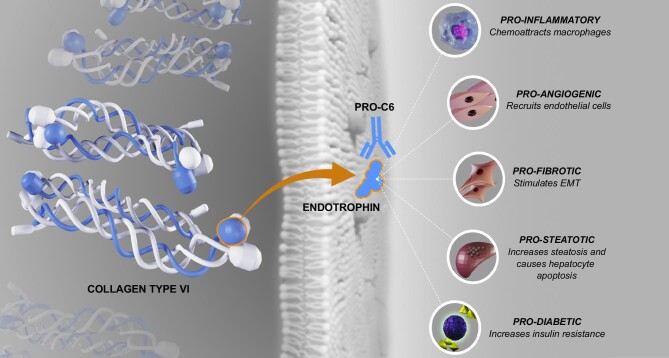
Fibrosis is a suggested cause of graft failure and mortality among kidney transplant recipients (KTRs). Accumulating evidence suggests that collagen type VI is tightly linked to fibrosis and may be a marker of systemic fibrosis and ageing. We studied whether plasma endotrophin, a pro-collagen type VI fragment, is associated with graft failure and mortality among KTRs.
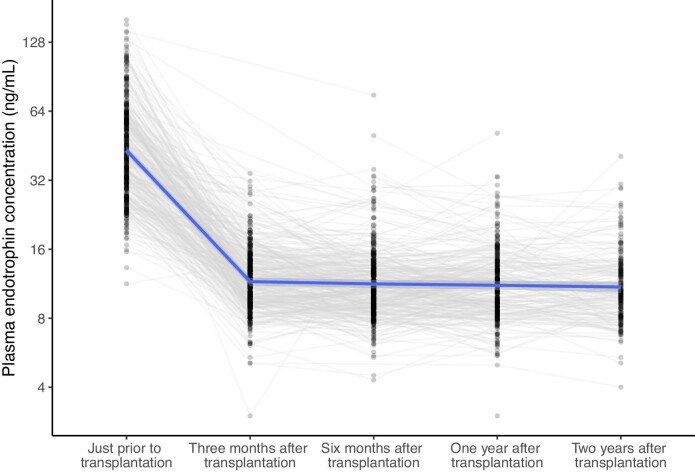
In cohort A (57% male, age 53 ± 13 years), we measured plasma endotrophin in 690 prevalent KTRs ≥1 year after transplantation. The non-overlapping cohort B included 500 incident KTRs with serial endotrophin measurements before and after kidney transplantation to assess trajectories and intra-individual variation of endotrophin.
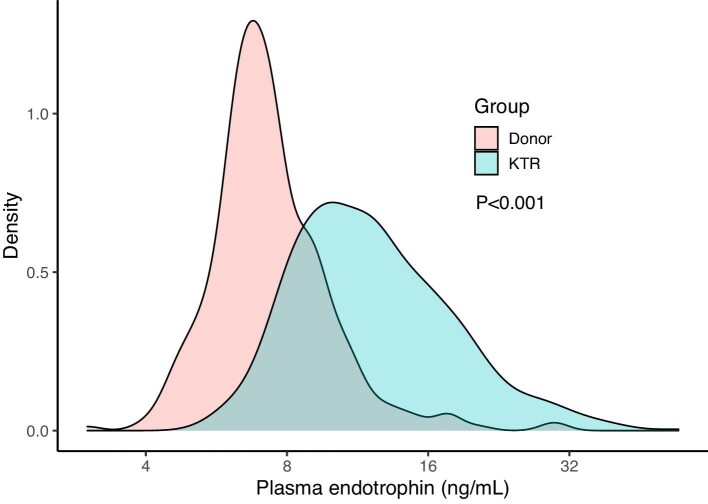
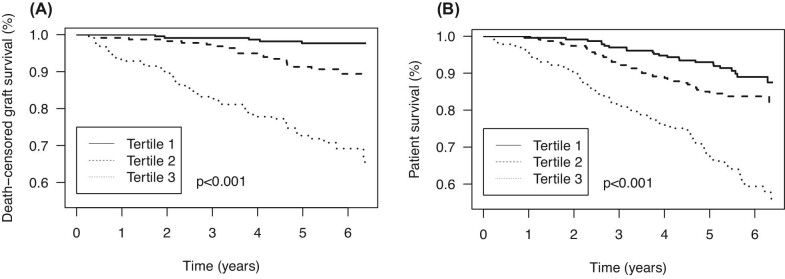
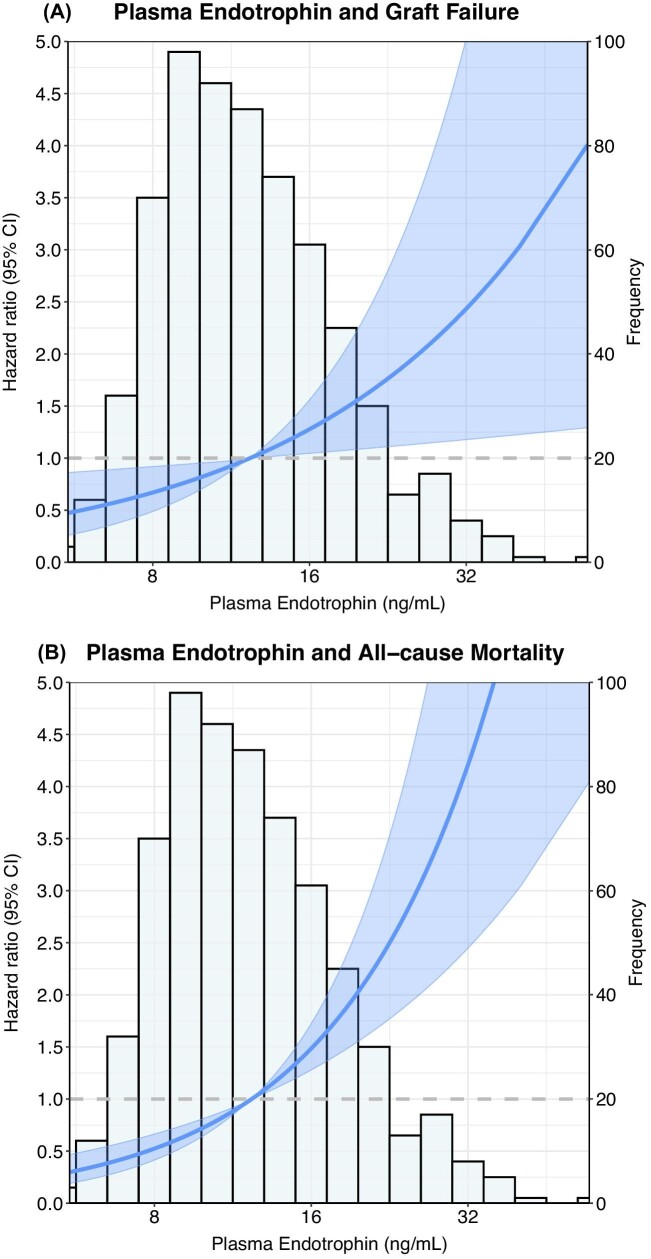
In cohort A, endotrophin was higher in KTRs compared with healthy controls. Concentrations were positively associated with female sex, diabetes, cardiovascular disease, markers of inflammation and kidney injury. Importantly, endotrophin was associated with graft failure {hazard ratio [HR] per doubling 1.87 [95% confidence interval (CI) 1.07-3.28]} and mortality [HR per doubling 2.59 (95% CI 1.73-3.87)] independent of potential confounders. Data from cohort B showed that endotrophin concentrations strongly decrease after transplantation and remain stable during post-transplantation follow-up [intra-individual coefficient of variation 5.0% (95% CI 3.7-7.6)].
Plasma endotrophin is strongly associated with graft failure and mortality among KTRs. These findings suggest a key role of abnormal extracellular matrix turnover and fibrosis in graft and patient prognosis among KTRs and highlight the need for (interventional) studies targeting the profibrotic state of KTRs. The intra-individual stability after transplantation indicates potential use of endotrophin as a biomarker and outcome measure of fibrosis.
ClinicalTrials.gov NCT02811835.
纤维化是导致肾移植受者(KTR)移植物失败和死亡的一个原因。越来越多的证据表明,胶原 VI 型与纤维化密切相关,可能是系统性纤维化和衰老的标志物。我们研究了血浆内毒素,一种胶原 VI 型前片段,是否与 KTR 的移植物失败和死亡有关。
在队列 A(57%为男性,年龄 53±13 岁)中,我们测量了 690 名移植后 1 年以上的现患 KTR 的血浆内毒素。非重叠队列 B 包括 500 名新发病例 KTR,在肾移植前后进行了连续的内毒素测量,以评估内毒素的轨迹和个体内变异。
在队列 A 中,KTR 的内毒素水平高于健康对照者。浓度与女性、糖尿病、心血管疾病、炎症和肾脏损伤标志物呈正相关。重要的是,内毒素与移植物失败相关[每倍增风险比(HR)1.87(95%可信区间(CI)1.07-3.28)]和死亡相关[每倍增 HR 2.59(95% CI 1.73-3.87)],独立于潜在的混杂因素。来自队列 B 的数据表明,内毒素浓度在移植后强烈下降,并在移植后随访期间保持稳定[个体内变异系数为 5.0%(95% CI 3.7-7.6)]。
血浆内毒素与 KTR 的移植物失败和死亡密切相关。这些发现表明,异常细胞外基质周转和纤维化在 KTR 的移植物和患者预后中起着关键作用,并强调了需要(干预性)研究针对 KTR 的纤维化状态。移植后个体内的稳定性表明,内毒素有可能作为纤维化的生物标志物和预后指标。
ClinicalTrials.gov NCT02811835。