• 文献检索
  • 文档翻译
  • 深度研究
  • 学术资讯
  • Suppr Zotero 插件Zotero 插件
  • 邀请有礼
  • 套餐&价格
  • 历史记录
应用&插件
Suppr Zotero 插件Zotero 插件浏览器插件Mac 客户端Windows 客户端微信小程序
定价
高级版会员购买积分包购买API积分包
服务
文献检索文档翻译深度研究API 文档MCP 服务
关于我们
关于 Suppr公司介绍联系我们用户协议隐私条款
关注我们

Suppr 超能文献

核心技术专利:CN118964589B侵权必究
粤ICP备2023148730 号-1Suppr @ 2026

文献检索

告别复杂PubMed语法,用中文像聊天一样搜索,搜遍4000万医学文献。AI智能推荐,让科研检索更轻松。

立即免费搜索

文件翻译

保留排版,准确专业,支持PDF/Word/PPT等文件格式,支持 12+语言互译。

免费翻译文档

深度研究

AI帮你快速写综述,25分钟生成高质量综述,智能提取关键信息,辅助科研写作。

立即免费体验

新冠疫情情绪与中国股票市场:来自官方新闻媒体的证据及…… (原文结尾不完整)

COVID-19 Sentiment and the Chinese Stock Market: Evidence from the Official News Media and .

作者信息

Duan Yuejiao, Liu Lanbiao, Wang Zhuo

机构信息

School of Finance, Nankai University, Tianjin, 300350, China.

出版信息

Res Int Bus Finance. 2021 Dec;58:101432. doi: 10.1016/j.ribaf.2021.101432. Epub 2021 Jun 2.

DOI:10.1016/j.ribaf.2021.101432
PMID:36540342
原文链接:https://pmc.ncbi.nlm.nih.gov/articles/PMC9756003/
Abstract

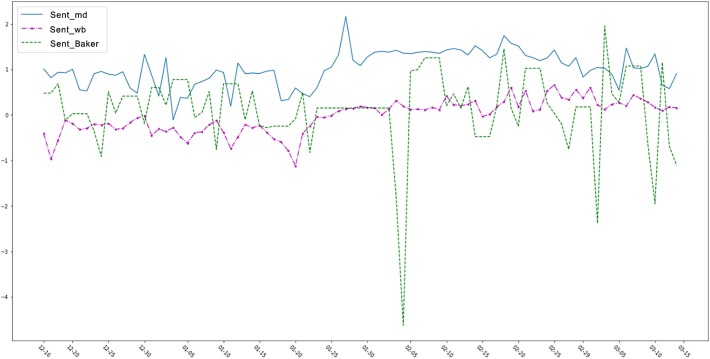
This study quantitatively measures the Chinese stock market's reaction to sentiments regarding the Novel Coronavirus 2019 (COVID-19). Using 6.3 million items of textual data extracted from the official news media and blogsite, we develop two COVID-19 sentiment indices that capture the moods related to COVID-19. Our sentiment indices are real-time and forward-looking indices in the stock market. We discover that stock returns and turnover rates were positively predicted by the COVID-19 sentiments during the period from December 17, 2019 to March 13, 2020. Consistent with this prediction, margin trading and short selling activities intensified proactively with growth sentiment. Overall, these results illustrate how the effects of the pandemic crisis were amplified by the sentiments.

摘要

本研究定量测度了中国股票市场对2019年新型冠状病毒(COVID-19)相关情绪的反应。利用从官方新闻媒体和博客网站提取的630万条文本数据,我们构建了两个捕捉与COVID-19相关情绪的COVID-19情绪指数。我们的情绪指数是股票市场的实时前瞻性指数。我们发现,在2019年12月17日至2020年3月13日期间,COVID-19情绪对股票回报率和换手率有正向预测作用。与这一预测一致,融资融券交易活动随着情绪的增长而积极加剧。总体而言,这些结果说明了大流行危机的影响是如何被情绪放大的。

https://cdn.ncbi.nlm.nih.gov/pmc/blobs/cc9c/9756003/7b991778aba7/gr2_lrg.jpg
https://cdn.ncbi.nlm.nih.gov/pmc/blobs/cc9c/9756003/3e2c4e1963de/ga1_lrg.jpg
https://cdn.ncbi.nlm.nih.gov/pmc/blobs/cc9c/9756003/32c6f238c256/gr1_lrg.jpg
https://cdn.ncbi.nlm.nih.gov/pmc/blobs/cc9c/9756003/7b991778aba7/gr2_lrg.jpg
https://cdn.ncbi.nlm.nih.gov/pmc/blobs/cc9c/9756003/3e2c4e1963de/ga1_lrg.jpg
https://cdn.ncbi.nlm.nih.gov/pmc/blobs/cc9c/9756003/32c6f238c256/gr1_lrg.jpg
https://cdn.ncbi.nlm.nih.gov/pmc/blobs/cc9c/9756003/7b991778aba7/gr2_lrg.jpg

相似文献

1
COVID-19 Sentiment and the Chinese Stock Market: Evidence from the Official News Media and .新冠疫情情绪与中国股票市场:来自官方新闻媒体的证据及…… (原文结尾不完整)
Res Int Bus Finance. 2021 Dec;58:101432. doi: 10.1016/j.ribaf.2021.101432. Epub 2021 Jun 2.
2
China public emotion analysis under normalization of COVID-19 epidemic: Using Sina Weibo.新冠疫情常态化下的中国公众情绪分析:基于新浪微博
Front Psychol. 2023 Jan 9;13:1066628. doi: 10.3389/fpsyg.2022.1066628. eCollection 2022.
3
The impact factors of social media users' forwarding behavior of COVID-19 vaccine topic: Based on empirical analysis of Chinese Weibo users.社交媒体用户转发新冠疫苗话题的影响因素:基于中国微博用户的实证分析。
Front Public Health. 2022 Sep 14;10:871722. doi: 10.3389/fpubh.2022.871722. eCollection 2022.
4
Financial market sentiment and stock return during the COVID-19 pandemic.新冠疫情期间的金融市场情绪与股票回报
Financ Res Lett. 2023 Jun;54:103709. doi: 10.1016/j.frl.2023.103709. Epub 2023 Feb 17.
5
Investor sentiments and stock markets during the COVID-19 pandemic.新冠疫情期间的投资者情绪与股票市场。
Financ Innov. 2022;8(1):69. doi: 10.1186/s40854-022-00375-0. Epub 2022 Jul 5.
6
Weibo sentiments and stock return: A time-frequency view.微博情绪与股票回报:时频视角
PLoS One. 2017 Jul 3;12(7):e0180723. doi: 10.1371/journal.pone.0180723. eCollection 2017.
7
Concerns Expressed by Chinese Social Media Users During the COVID-19 Pandemic: Content Analysis of Sina Weibo Microblogging Data.新冠疫情期间中国社交媒体用户表达的担忧:对新浪微博数据的内容分析
J Med Internet Res. 2020 Nov 26;22(11):e22152. doi: 10.2196/22152.
8
Effects of investor sentiment on stock volatility: new evidences from multi-source data in China's green stock markets.投资者情绪对股票波动性的影响:来自中国绿色股票市场多源数据的新证据
Financ Innov. 2022;8(1):77. doi: 10.1186/s40854-022-00381-2. Epub 2022 Aug 23.
9
Changes of the Public Attitudes of China to Domestic COVID-19 Vaccination After the Vaccines Were Approved: A Semantic Network and Sentiment Analysis Based on Sina Weibo Texts.疫苗获批后中国公众对国内 COVID-19 疫苗态度的变化:基于新浪微博文本的语义网络和情感分析。
Front Public Health. 2021 Nov 11;9:723015. doi: 10.3389/fpubh.2021.723015. eCollection 2021.
10
COVID-19, volatility dynamics, and sentiment trading.新冠病毒疾病、波动动态与情绪交易。
J Bank Financ. 2021 Dec;133:106162. doi: 10.1016/j.jbankfin.2021.106162. Epub 2021 May 1.

引用本文的文献

1
How does Chinese stock market react to breaking news about COVID-19? Evidence from event study.中国股票市场如何对有关新冠疫情的突发新闻做出反应?来自事件研究的证据。
Heliyon. 2024 May 9;10(10):e30949. doi: 10.1016/j.heliyon.2024.e30949. eCollection 2024 May 30.
2
Sentimental showdown: News media vs. social media in stock markets.情感对决:股票市场中的新闻媒体与社交媒体
Heliyon. 2024 Apr 25;10(9):e30211. doi: 10.1016/j.heliyon.2024.e30211. eCollection 2024 May 15.
3
A systematic literature survey on recent trends in stock market prediction.

本文引用的文献

1
Stock markets' reaction to COVID-19: Cases or fatalities?股票市场对新冠疫情的反应:病例还是死亡人数?
Res Int Bus Finance. 2020 Dec;54:101249. doi: 10.1016/j.ribaf.2020.101249. Epub 2020 May 23.
2
The impact of the SARS outbreak on Taiwanese hotel stock performance: An event-study approach.非典疫情对台湾酒店股股价表现的影响:一项事件研究法。
Int J Hosp Manag. 2007 Mar;26(1):200-212. doi: 10.1016/j.ijhm.2005.11.004. Epub 2006 Mar 23.
关于股票市场预测近期趋势的系统文献综述。
PeerJ Comput Sci. 2024 Jan 31;10:e1700. doi: 10.7717/peerj-cs.1700. eCollection 2024.
4
Does personal experience with COVID-19 impact investment decisions? Evidence from a survey of US retail investors.感染新冠病毒的个人经历会影响投资决策吗?来自美国散户投资者调查的证据。
Int Rev Financ Anal. 2023 Jul;88:102703. doi: 10.1016/j.irfa.2023.102703. Epub 2023 May 29.
5
Role of proliferation COVID-19 media chatter in predicting Indian stock market: Integrated framework of nonlinear feature transformation and advanced AI.新冠疫情相关媒体言论在预测印度股市中的作用:非线性特征变换与先进人工智能的综合框架
Expert Syst Appl. 2023 Jun 1;219:119695. doi: 10.1016/j.eswa.2023.119695. Epub 2023 Feb 11.
6
Does media sentiment affect stock prices? Evidence from China's STAR market.媒体情绪会影响股价吗?来自中国科创板市场的证据。
Front Psychol. 2022 Dec 1;13:1040171. doi: 10.3389/fpsyg.2022.1040171. eCollection 2022.
7
How does China's stock market react to supply chain disruptions from COVID-19?中国股市如何应对新冠疫情造成的供应链中断?
Int Rev Financ Anal. 2022 Jul;82:102168. doi: 10.1016/j.irfa.2022.102168. Epub 2022 Apr 26.
8
Cyber violence caused by the disclosure of route information during the COVID-19 pandemic.新冠疫情期间因行程信息泄露引发的网络暴力。
Humanit Soc Sci Commun. 2022;9(1):417. doi: 10.1057/s41599-022-01450-8. Epub 2022 Nov 25.
9
International taxation sentiment and COVID-19 crisis.国际税收情绪与新冠疫情危机
Res Int Bus Finance. 2022 Dec;63:101783. doi: 10.1016/j.ribaf.2022.101783. Epub 2022 Oct 7.
10
Effects of investor sentiment on stock volatility: new evidences from multi-source data in China's green stock markets.投资者情绪对股票波动性的影响:来自中国绿色股票市场多源数据的新证据
Financ Innov. 2022;8(1):77. doi: 10.1186/s40854-022-00381-2. Epub 2022 Aug 23.