Bai Chenjiang, Duan Yuejiao, Liu Congya, Qiu Leiju
School of Finance, Nankai University, 38 Tongyan Road, Jinnan District, Tianjin 300350, PR China.
China Center for Internet Economy Research, Central University of Finance and Economics, 39 South College Road, Haidian District, Beijing 100081, PR China.
Res Int Bus Finance. 2022 Dec;63:101783. doi: 10.1016/j.ribaf.2022.101783. Epub 2022 Oct 7.
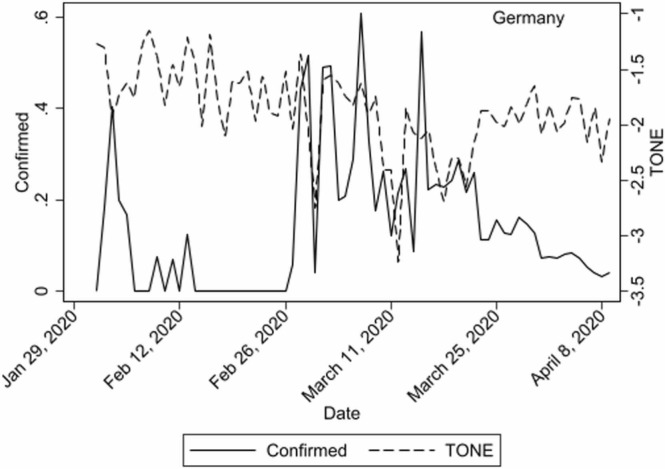
Investigating public sentiment regarding tax policy during the COVID-19 pandemic could be useful for understanding the experiences across societies. Using Linguistic Inquiry and Word Count to investigate and quantitatively measure the pandemic's effect-from January 25 to April 9, 2020-on the sentiment regarding possible tax policies throughout the world, thereby determining that, overall, taxation sentiment is reduced as the number of confirmed COVID-19 cases grows. Further investigation reveals that, as COVID-19 spreads, the sentiment for raising taxes decreases and that for reducing taxes increases, and this effect is mitigated by countries' democracy. We further find that news sentiment in unofficial media and in countries with low social trust is more significantly affected by COVID-19. Robustness tests performed using different subsamples of developed and developing countries and different pandemic circumstances validate our findings. This research has crucial implications for policy evaluation and development.
调查新冠疫情期间公众对税收政策的看法,有助于了解不同社会的经历。利用语言查询与字数统计方法,对2020年1月25日至4月9日期间疫情对全球可能税收政策看法的影响进行调查和定量测量,从而确定总体上随着新冠确诊病例数增加,税收情绪降低。进一步调查发现,随着新冠疫情蔓延,增税情绪下降,减税情绪上升,且这种影响因国家的民主程度而减轻。我们还发现,非官方媒体以及社会信任度较低国家的新闻情绪受新冠疫情影响更为显著。使用发达国家和发展中国家的不同子样本以及不同疫情情况进行的稳健性检验证实了我们的研究结果。本研究对政策评估与制定具有关键意义。