School of Pharmacy, University of Waterloo, Waterloo, Ontario, Canada.
Division of Pharmacotherapy and Experimental Therapeutics, UNC Eshelman School of Pharmacy, University of North Carolina at Chapel Hill, Chapel Hill, California, USA.
CPT Pharmacometrics Syst Pharmacol. 2023 Mar;12(3):320-332. doi: 10.1002/psp4.12908. Epub 2023 Jan 8.
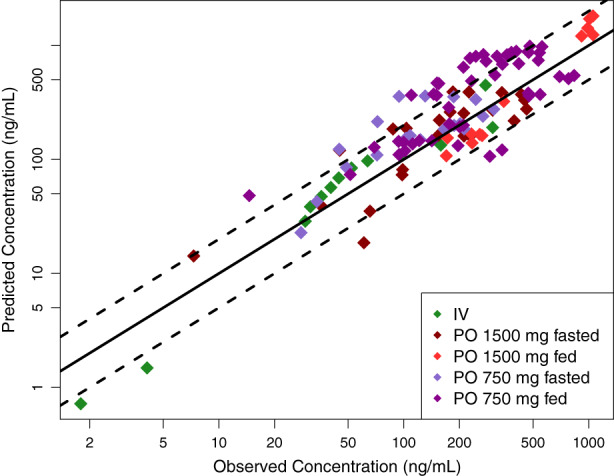
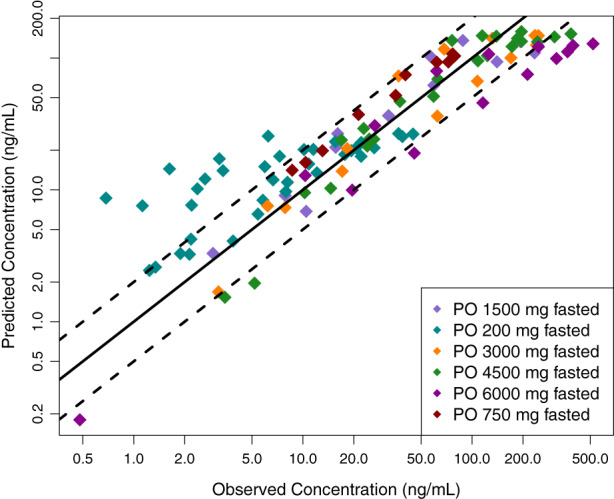
Cannabidiol (CBD) is approved for treatment of seizures associated with two forms of epilepsy that become apparent in infancy or early childhood. To consider an adult physiologically-based pharmacokinetic (PBPK) model for pediatric scaling, we assessed in vitro-derived cytochrome P450 (CYP) and uridine 5'-diphospho-glucuronosyltransferase (UGT) enzyme contributions to CBD clearance in human. An i.v. PBPK model was constructed using CBD physicochemical properties and knowledge of disposition. The i.v. datasets were used for model building and evaluation. Oral PBPK models for CBD administered in fasted and fed states were developed using single dose oral datasets and parameters optimized from the i.v. model and evaluated with multiple dose datasets. Relative contributions of CBD metabolizing enzymes were partitioned according to in vitro studies. Clinical drug-drug interaction (DDI) studies were simulated using CBD fed state, itraconazole, fluconazole, and rifampicin PBPK models. Linear mixed effect modeling was used to estimate area under the concentration-time curve from zero to infinity (AUC ) perpetrator + CBD versus CBD alone. The i.v. and oral datasets used in model evaluation produced acceptable average fold error (AFE) of 1.28 and absolute AFE of 1.65. Relative contributions of drug-metabolizing enzymes to CBD clearance were proposed from in vitro data: UGT1A7 4%, UGT1A9 16%, UGT2B7 10%, CYP3A4 38%, CYP2C19 21%, and CYP2C9 11%. The simulated DDI studies using the in vitro-derived values produced AUC treatment ratios comparable to observed: itraconazole 1.24 versus 1.07, fluconazole 1.45 versus 1.22, and rifampicin 0.49 versus 0.69. The constructed CBD PBPK models can predict adult exposures and have potential for use in pediatrics where exposure estimates are limited.
大麻二酚(CBD)已获准用于治疗婴儿期或幼儿期出现的两种癫痫发作相关的疾病。为了研究成人基于生理的药代动力学(PBPK)模型在儿科中的应用,我们评估了体外衍生的细胞色素 P450(CYP)和尿苷 5'-二磷酸葡萄糖醛酸基转移酶(UGT)对人类 CBD 清除率的贡献。使用 CBD 的物理化学特性和处置知识构建了静脉内 PBPK 模型。静脉内数据集用于模型构建和评估。使用单次口服剂量数据集和从静脉内模型优化的参数,为禁食和进食状态下口服 CBD 开发了口服 PBPK 模型,并使用多次剂量数据集进行了评估。根据体外研究,对 CBD 代谢酶的相对贡献进行了划分。使用 CBD 进食状态、伊曲康唑、氟康唑和利福平 PBPK 模型模拟临床药物相互作用(DDI)研究。使用线性混合效应模型估计从零到无穷大(AUC)的浓度-时间曲线下面积(AUC)加 CBD 与 CBD 单独给药的比值。模型评估中使用的静脉内和口服数据集产生了可接受的平均折叠误差(AFE)为 1.28 和绝对 AFE 为 1.65。从体外数据提出了对 CBD 清除率有贡献的药物代谢酶的相对贡献:UGT1A7 为 4%,UGT1A9 为 16%,UGT2B7 为 10%,CYP3A4 为 38%,CYP2C19 为 21%,CYP2C9 为 11%。使用体外衍生值进行的模拟 DDI 研究产生了与观察结果相当的 AUC 治疗比值:伊曲康唑为 1.24 与 1.07,氟康唑为 1.45 与 1.22,利福平为 0.49 与 0.69。构建的 CBD PBPK 模型可预测成人暴露量,并有可能在暴露量有限的儿科中使用。