Ying Zhong-Ming, Lv Qian-Kun, Yao Xiao-Yu, Dong An-Qi, Yang Ya-Ping, Cao Yu-Lan, Wang Fen, Gong Ai-Ping, Liu Chun-Feng
Department of Neurology and Clinical Research Center of Neurological Disease, The Second Affiliated Hospital of Soochow University, Suzhou, China.
Department of Neurology, Taizhou Hospital of Integrated Traditional Chinese and Western Medicine, Taizhou, China.
Ann Transl Med. 2022 Nov;10(22):1218. doi: 10.21037/atm-22-5159.
Neuroinflammation mediated by microglia plays a key role in the pathogenesis of Parkinson's disease (PD), and our previous studies showed this was significantly inhibited by enhanced autophagy. In the autophagy pathway, Bcl2-associated athanogene (BAG)3 is a prominent co-chaperone, and we have shown BAG3 can regulate autophagy to clear the PD pathogenic protein α-synuclein. However, the connection between BAG3 and microglia mediated neuroinflammation is not clear.
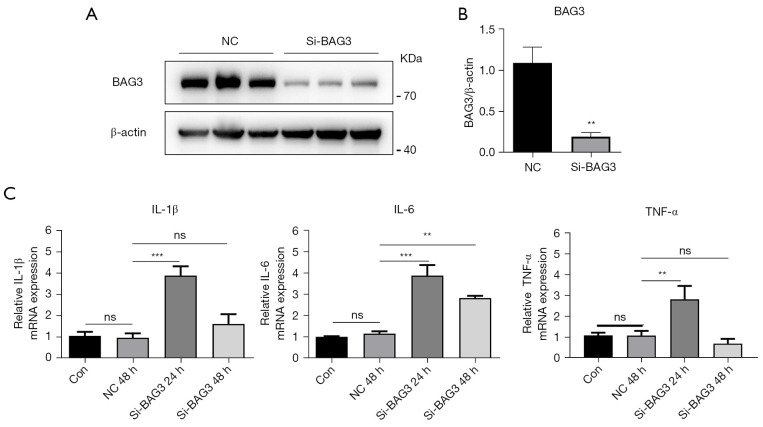
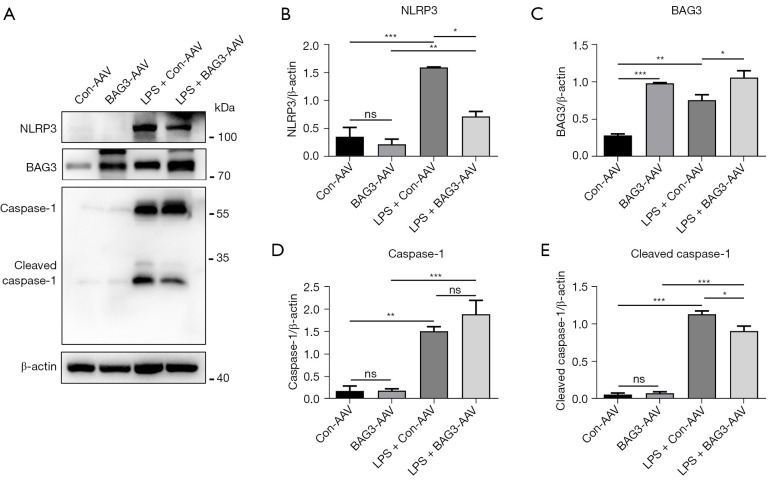
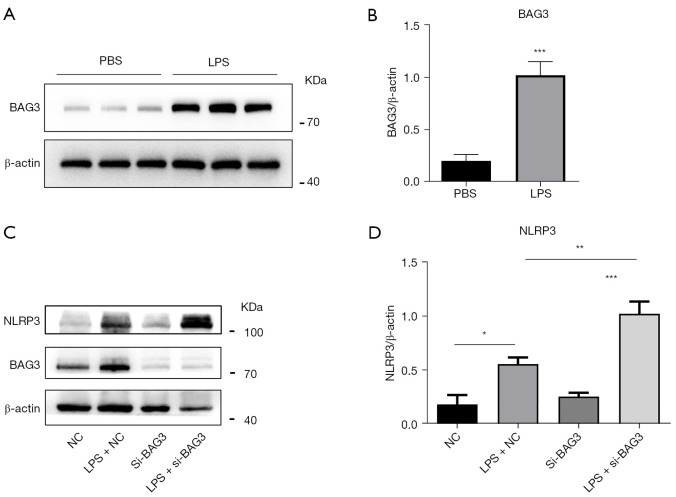
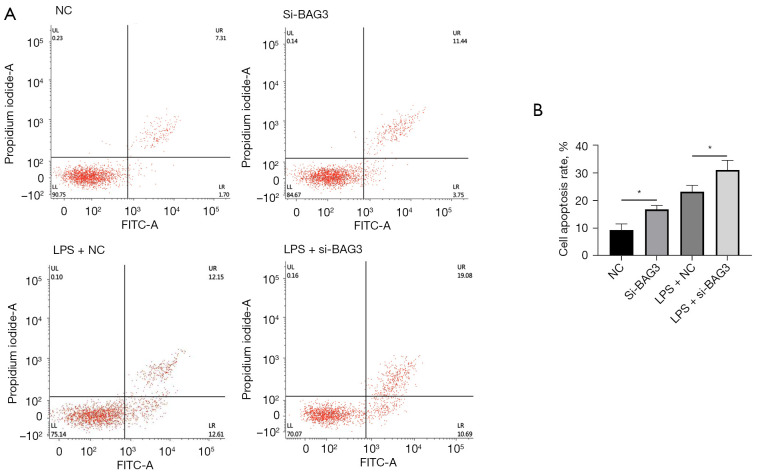
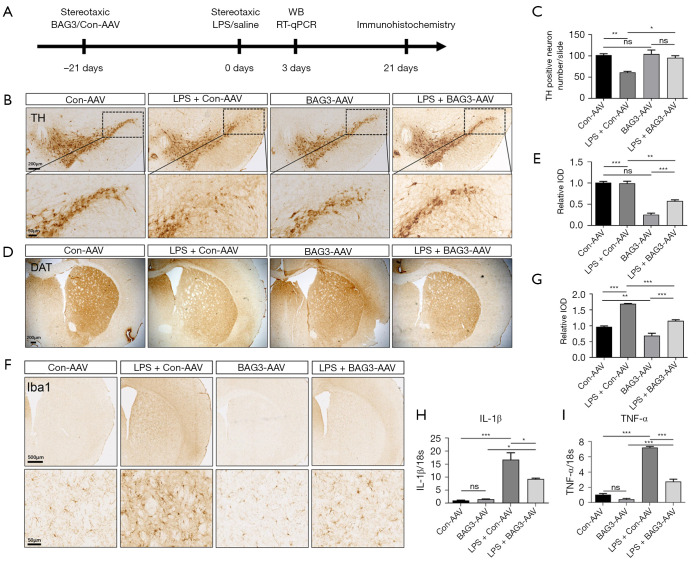
In this study, we explored whether BAG3 regulated related neuroinflammation and its original mechanism in PD. An inflammatory model of PD was established by injecting adeno-associated virus (AAV)-BAG3 into the bilateral striatum of C57BL/6 male mice to induce overexpression of BAG3, followed by injection of lipopolysaccharide (LPS). The striatum was extracted at 3 days after injection of LPS for Western blotting and reverse transcription quantitative polymerase chain reaction (RT-qPCR), and immunohistochemical staining was performed at 21 days after injection. At the same time, LPS was used to induce activation of BV2 cells to verify the effect of BAG3 .
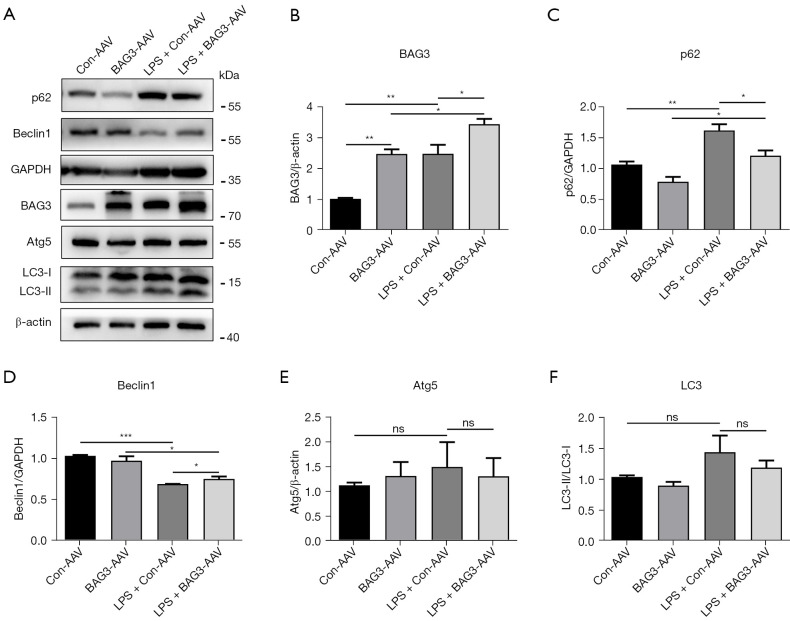
Overexpression of BAG3 reduced LPS-induced pyroptosis by reducing activation of caspase-1, the NOD-like receptor family, and the pyrin domain-containing 3 (NLRP3) inflammasome, and by release of interleukin (IL)-1β and tumor necrosis factor (TNF)-α. The LPS-induced inflammatory environment inhibits autophagy, and overexpression of BAG3 can restore autophagy, which may be the mechanism by which BAG3 reduces neuronal inflammation in PD.
Our results demonstrate BAG3 promotes autophagy and suppresses NLRP3 inflammasome formation in PD.
小胶质细胞介导的神经炎症在帕金森病(PD)的发病机制中起关键作用,我们之前的研究表明增强自噬可显著抑制这种炎症。在自噬途径中,Bcl2相关抗凋亡基因(BAG)3是一种重要的共伴侣蛋白,我们已经证明BAG3可以调节自噬以清除PD致病蛋白α-突触核蛋白。然而,BAG3与小胶质细胞介导的神经炎症之间的联系尚不清楚。
在本研究中,我们探讨了BAG3是否调节PD相关神经炎症及其原始机制。通过将腺相关病毒(AAV)-BAG3注射到C57BL/6雄性小鼠的双侧纹状体中以诱导BAG3过表达,随后注射脂多糖(LPS),建立PD炎症模型。在注射LPS后3天提取纹状体进行蛋白质免疫印迹和逆转录定量聚合酶链反应(RT-qPCR),并在注射后21天进行免疫组织化学染色。同时,使用LPS诱导BV2细胞活化以验证BAG3的作用。
BAG3过表达通过降低半胱天冬酶-1、NOD样受体家族和含pyrin结构域的3(NLRP3)炎性小体的活化,以及白细胞介素(IL)-1β和肿瘤坏死因子(TNF)-α的释放,减少了LPS诱导的细胞焦亡。LPS诱导的炎症环境抑制自噬,而BAG3过表达可以恢复自噬,这可能是BAG3减少PD神经元炎症的机制。
我们的结果表明BAG3在PD中促进自噬并抑制NLRP3炎性小体的形成。