Bao Jiandong, Wang Zhe, Chen Meilian, Chen Shijie, Chen Xiaomin, Xie Jiahui, Tang Wei, Zheng Huakun, Wang Zonghua
State Key Laboratory for Managing Biotic and Chemical Treats to the and Safety of Agro-Products, Institute of Plant Protection and Microbiology, Zhejiang Academy of Agricultural Sciences, Hangzhou 310021, China.
Fujian Universities Key Laboratory for Plant Microbe Interaction, College of Life Sciences, Fujian Agriculture and Forestry University, Fuzhou 350002, China.
J Fungi (Basel). 2022 Nov 23;8(12):1238. doi: 10.3390/jof8121238.
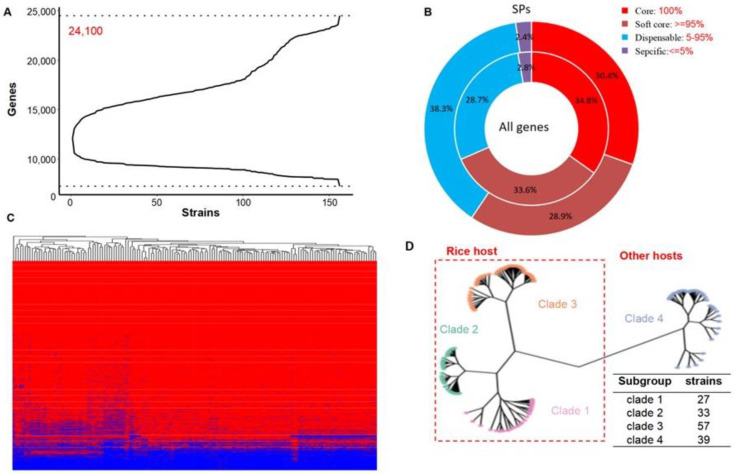
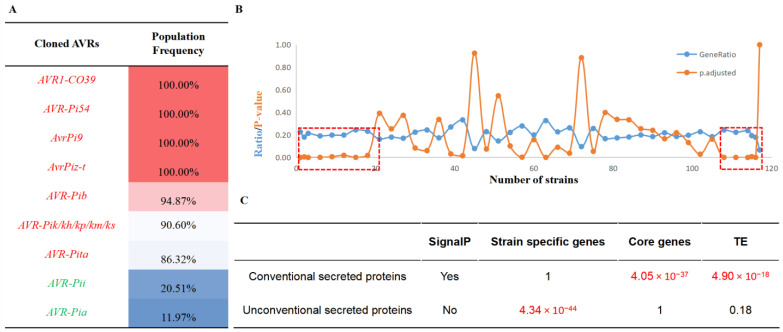
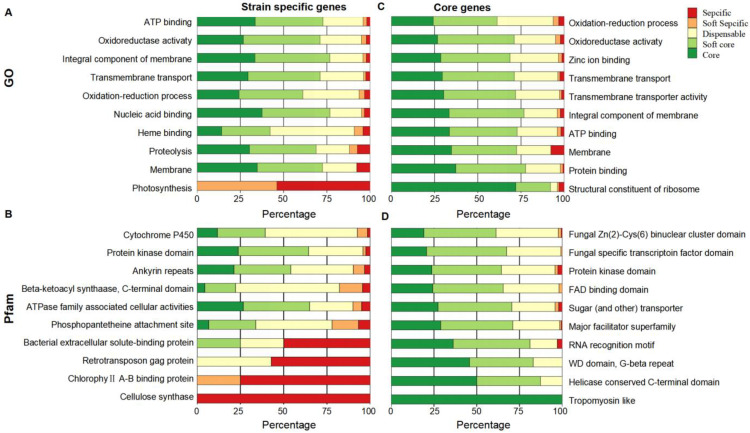
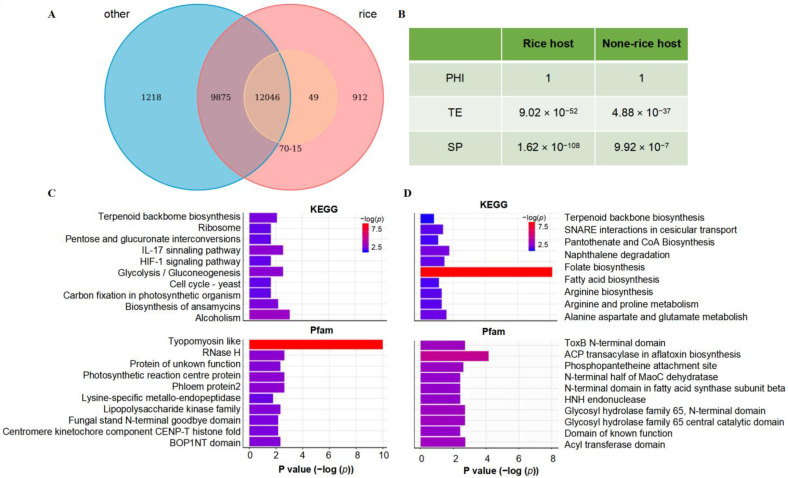
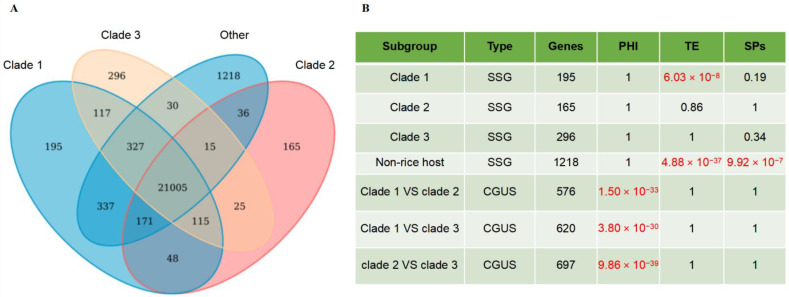
(1) Background: the causal agent of rice blast disease, is one of the major rice pathogens. The complex population structure of facilitates the rapid virulence variations, which make the blast disease a serious challenge for global food security. There is a large body of existing genomics research on , however the population structure at the pan-genome level is not clear, and the mechanism of genetic divergence and virulence variations of different sub-populations is also unknown. (2) Methods: Based on the genome data published in the NCBI, we constructed a pan-genome database of , which consisted of 156 strains (117 isolated from rice and 39 isolated from other hosts). (3) Results: The pan-genome contained a total of 24,100 genes (12,005 novel genes absent in the reference genome 70-15), including 16,911 (70%) core genes (population frequency ≥95%) and 1378 (5%) strain-specific genes (population frequency ≤5%). Gene presence-absence variation (PAV) based clustering analysis of the population structure of revealed four subgroups (three from rice and one from other hosts). Interestingly, the cloned avirulence genes and conventional secreted proteins (SPs, with signal peptides) were enriched in the high-frequency regions and significantly associated with transposable elements (TEs), while the unconventional SPs (without signal peptides) were enriched in the low-frequency regions and not associated significantly with TEs. This pan-genome will expand the breadth and depth of the rice blast fungus reference genome, and also serve as a new blueprint for scientists to further study the pathogenic mechanism and virulence variation of the rice blast fungus.
(1) 背景:稻瘟病菌是水稻的主要病原菌之一。其复杂的群体结构促进了毒力的快速变异,这使得稻瘟病对全球粮食安全构成严重挑战。目前已有大量关于稻瘟病菌的基因组学研究,然而,泛基因组水平的群体结构尚不清楚,不同亚群体的遗传分化和毒力变异机制也未知。(2) 方法:基于NCBI公布的基因组数据,我们构建了稻瘟病菌的泛基因组数据库,该数据库由156个菌株组成(117个从水稻中分离,39个从其他寄主中分离)。(3) 结果:泛基因组共包含24,100个基因(参考基因组70-15中不存在的12,005个新基因),其中包括16,911个(约70%)核心基因(群体频率≥95%)和1378个(约5%)菌株特异性基因(群体频率≤5%)。基于基因存在-缺失变异(PAV)的稻瘟病菌群体结构聚类分析揭示了四个亚组(三个来自水稻,一个来自其他寄主)。有趣的是,克隆的无毒基因和常规分泌蛋白(带有信号肽的SPs)在高频区域富集,并且与转座元件(TEs)显著相关,而非常规SPs(没有信号肽)在低频区域富集,并且与TEs没有显著关联。这个泛基因组将扩展稻瘟病菌参考基因组的广度和深度,也为科学家进一步研究稻瘟病菌的致病机制和毒力变异提供了新的蓝图。