Theoretical Biology and Bioinformatics Group, Department of Biology, Utrecht University, The Netherlands.
Laboratory of Phytopathology, Wageningen University and Research, The Netherlands.
Genome Biol Evol. 2021 Jul 6;13(7). doi: 10.1093/gbe/evab135.
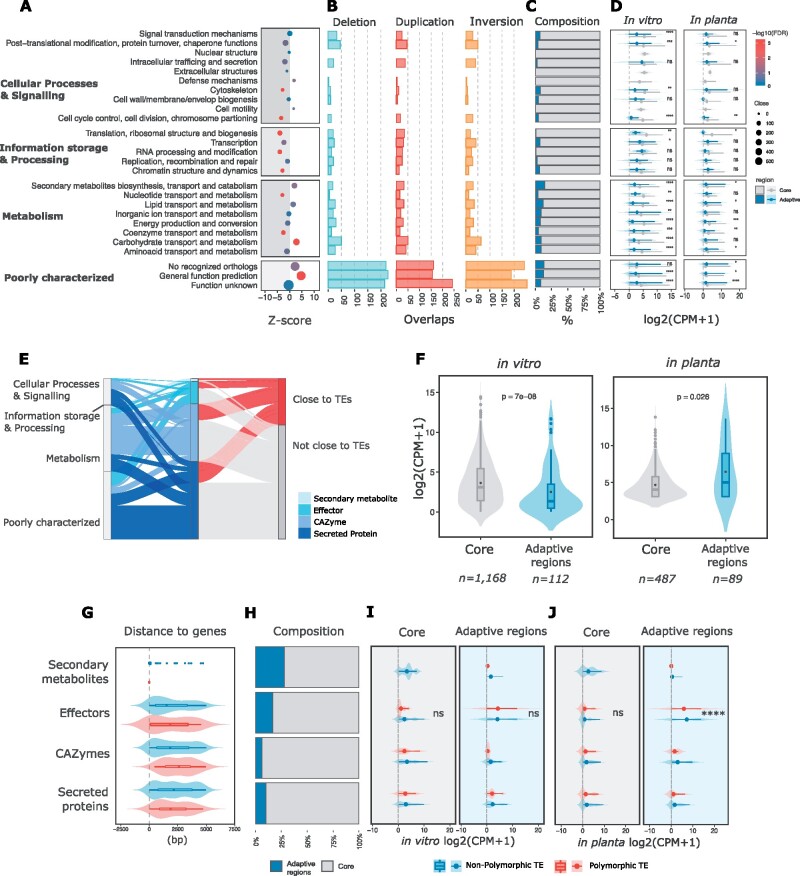
Transposable elements (TEs) are a major source of genetic and regulatory variation in their host genome and are consequently thought to play important roles in evolution. Many fungal and oomycete plant pathogens have evolved dynamic and TE-rich genomic regions containing genes that are implicated in host colonization and adaptation. TEs embedded in these regions have typically been thought to accelerate the evolution of these genomic compartments, but little is known about their dynamics in strains that harbor them. Here, we used whole-genome sequencing data of 42 strains of the fungal plant pathogen Verticillium dahliae to systematically identify polymorphic TEs that may be implicated in genomic as well as in gene expression variation. We identified 2,523 TE polymorphisms and characterize a subset of 8% of the TEs as polymorphic elements that are evolutionary younger, less methylated, and more highly expressed when compared with the remaining 92% of the total TE complement. As expected, the polyrmorphic TEs are enriched in the adaptive genomic regions. Besides, we observed an association of polymorphic TEs with pathogenicity-related genes that localize nearby and that display high expression levels. Collectively, our analyses demonstrate that TE dynamics in V. dahliae contributes to genomic variation, correlates with expression of pathogenicity-related genes, and potentially impacts the evolution of adaptive genomic regions.
转座元件 (TEs) 是其宿主基因组中遗传和调控变异的主要来源,因此被认为在进化中发挥着重要作用。许多真菌和卵菌植物病原体已经进化出动态的、富含 TE 的基因组区域,其中包含参与宿主定殖和适应的基因。这些区域中嵌入的 TE 通常被认为加速了这些基因组区室的进化,但对于携带它们的菌株中 TE 的动态知之甚少。在这里,我们使用了真菌植物病原体黄萎病菌 42 个菌株的全基因组测序数据,系统地鉴定了可能与基因组和基因表达变异有关的多态性 TE。我们鉴定了 2523 个 TE 多态性,并将一小部分 8%的 TE 特征化为多态性元件,与剩余的 92%的总 TE 补体相比,这些元件更年轻、甲基化程度更低、表达水平更高。正如预期的那样,多态性 TE 在适应性基因组区域中富集。此外,我们观察到多态性 TE 与附近定位并表现出高表达水平的致病性相关基因之间存在关联。总的来说,我们的分析表明,黄萎病菌中的 TE 动态有助于基因组变异,与致病性相关基因的表达相关,并且可能影响适应性基因组区域的进化。