Center for Development and Behavioral Neuroscience, Binghamton University, Binghamton, New York, United States of America.
Department of Psychology, Binghamton University, Binghamton, New York, United States of America.
PLoS One. 2022 Dec 22;17(12):e0279507. doi: 10.1371/journal.pone.0279507. eCollection 2022.
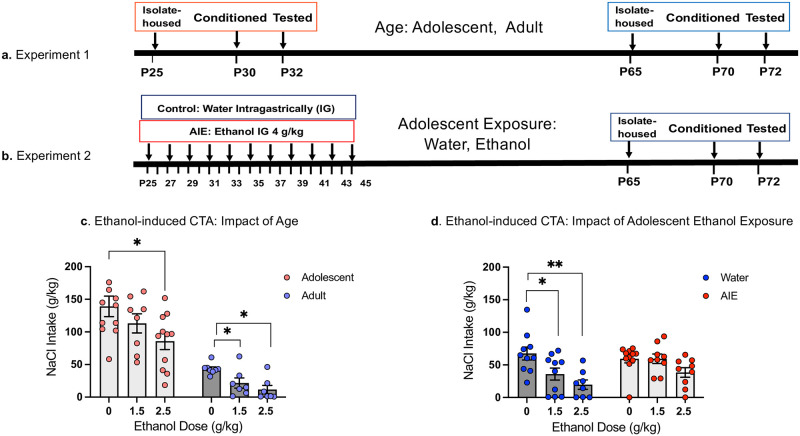
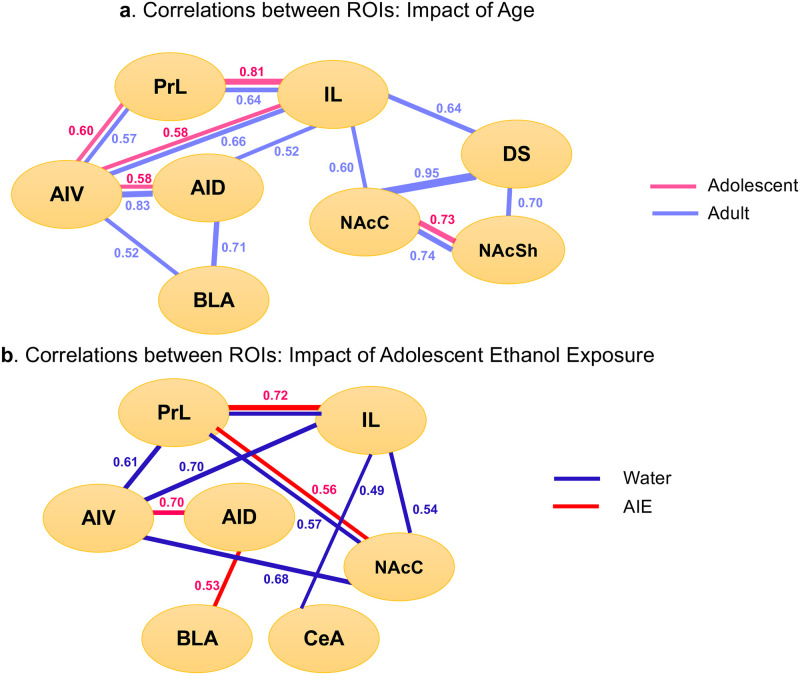
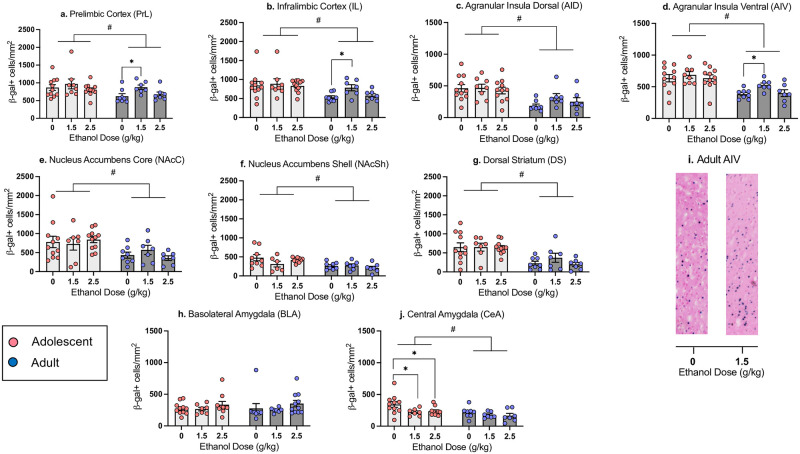
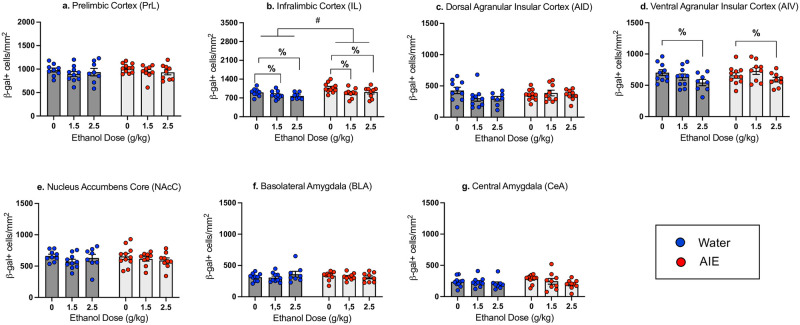
Individuals that initiate alcohol use at younger ages and binge drink during adolescence are more susceptible to developing alcohol use disorder. Adolescents are relatively insensitive to the aversive effects of alcohol and tend to consume significantly more alcohol per occasion than adults, an effect that is conserved in rodent models. Adolescent typical insensitivity to the aversive effects of alcohol may promote greater alcohol intake by attenuating internal cues that curb its consumption. Attenuated sensitivity to the aversive effects of alcohol is also retained into adulthood following protracted abstinence from adolescent intermittent ethanol (AIE) exposure. Despite these effects, much remains unknown regarding the neural contributors. In the present study, we used a conditioned taste aversion (CTA) paradigm to investigate neuronal activation in late-developing forebrain structures of male adolescents and adult cFos-LacZ transgenic rats as well as in AIE adults following consumption of 0.9% sodium chloride previously paired with an intraperitoneal injection of 0, 1.5 or 2.5 g/kg of ethanol. Adults that were non-manipulated or received water exposure during adolescence showed CTA to both ethanol doses, whereas adolescents displayed CTA only to the 2.5 g/kg ethanol dose. Adults who experienced AIE did not show CTA. Adults displayed increased neuronal activation indexed via number of β-galactosidase positive (β-gal+) cells in the prefrontal and insular cortex that was absent in adolescents, whereas adolescents but not adults had a reduced number of β-gal+ cells in the central amygdala. Adults also displayed greater cortical-insular functional connectivity than adolescents as well as insular-amygdalar and prefrontal cortex-accumbens core functional connectivity. Like adolescents, adults previously exposed to AIE displayed reduced prefrontal-insular cortex and prefrontal-accumbal core functional connectivity. Taken together, these results suggest that attenuated sensitivity to the aversive effects of ethanol is related to a loss of an insular-prefrontal cortex-accumbens core circuit.
个体在青少年时期越早开始饮酒、 binge drinking(即狂饮),越容易发展为酒精使用障碍。青少年对酒精的负面效应相对不敏感,而且每一次饮酒的量比成年人多得多,这种效应在啮齿动物模型中得到了保留。青少年对酒精的负面效应不敏感可能会通过减弱抑制其消费的内部线索,促进更多的酒精摄入。在长期戒断青少年间歇性乙醇(AIE)暴露后,对酒精负面效应的敏感性减弱也会持续到成年期。尽管有这些影响,但关于神经贡献者的许多问题仍然未知。在本研究中,我们使用条件味觉厌恶(CTA)范式,研究了雄性青少年和成年 cFos-LacZ 转基因大鼠的晚期发育前脑结构以及 AIE 成年大鼠在摄入 0.9%氯化钠后神经元的激活情况,该氯化钠先前与腹腔内注射 0、1.5 或 2.5 g/kg 的乙醇配对。在青少年时期未接受处理或接受水暴露的成年大鼠对两种乙醇剂量均表现出 CTA,而青少年仅对 2.5 g/kg 的乙醇剂量表现出 CTA。经历过 AIE 的成年大鼠没有表现出 CTA。成年大鼠的前额叶和岛叶皮层的 β-半乳糖苷酶阳性(β-gal+)细胞数量增加,而青少年大鼠则没有,而青少年大鼠的中央杏仁核的 β-gal+细胞数量减少。与青少年相比,成年大鼠的皮质-岛叶功能连接性也更强,岛叶-杏仁核和前额叶-伏隔核核心功能连接性也更强。与青少年一样,以前暴露于 AIE 的成年大鼠显示出前额叶-岛叶皮层和前额叶-伏隔核核心功能连接性降低。总之,这些结果表明,对乙醇负面效应的敏感性降低与岛叶-前额叶-伏隔核核心回路的丧失有关。