Kemler Ellen, Noteboom Lisa, van Beijsterveldt Anne-Marie
Team Sports Injury Prevention, Dutch Consumer Safety Institute (VeiligheidNL), Overschiestraat 65, 1062 XD Amsterdam, The Netherlands.
Faculty of Behavioral and Movement Sciences, Vrije Universiteit Amsterdam, De Boelelaan 1105, 1081 HV Amsterdam, The Netherlands.
Sports (Basel). 2022 Nov 22;10(12):187. doi: 10.3390/sports10120187.
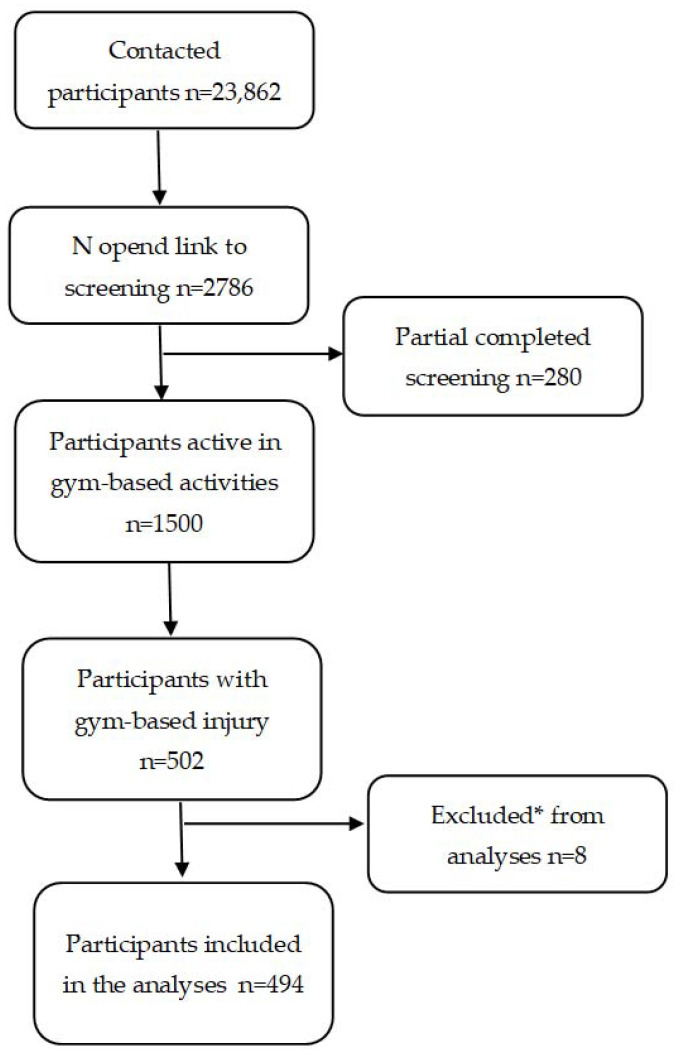
Although general information is available, specifically detailed information on gym-based fitness-related injuries in the general recreational fitness population is lacking. The aim of our study was to obtain more insight into injuries occurring as a result of gym-based fitness activities. A descriptive online epidemiological study was conducted in November 2020. The survey was distributed by a market research agency to members of their research panel. A total of 494 Dutch fitness participants aged ≥ 18 years (mean 38.9; 59% male) who had sustained a fitness-related injury in the preceding 12 months were included in the study. Most injuries occurred during strength training, individual cardio exercise, yoga/Pilates, cardio exercise in group lessons, and CrossFit. The shoulder, leg, and knee were the most common injured body parts; 73.1% of the injuries occurred during unsupervised gym-based fitness activities, and 46.2% of the injuries occurred during one specific exercise or when using a specific fitness device: running (e.g., on the treadmill) (22.8%); bench press (11.8%); or squats (9.6%). Overuse or overload ( = 119), missteps and sprains ( = 48), or an incorrect posture or movement ( = 43) were most often mentioned as causes of injury. Conclusions: Most self-reported gym-based fitness-related injuries occur during strength training and individual cardio exercise. Special attention should be given to the shoulder during strength training and to the lower extremities during cardio exercise. Injury prevention interventions should be able to be carried out without supervision.
虽然已有一些一般性信息,但针对普通休闲健身人群中与健身房健身相关损伤的具体详细信息却很缺乏。我们研究的目的是更深入了解因健身房健身活动而发生的损伤情况。2020年11月开展了一项描述性在线流行病学研究。该调查由一家市场研究机构分发给其研究小组的成员。共有494名年龄≥18岁的荷兰健身参与者(平均年龄38.9岁;男性占59%)被纳入研究,他们在过去12个月内遭受了与健身相关的损伤。大多数损伤发生在力量训练、个人有氧运动、瑜伽/普拉提、团体课有氧运动和CrossFit训练期间。肩部、腿部和膝盖是最常受伤的身体部位;73.1%的损伤发生在无人监督的健身房健身活动期间,46.2%的损伤发生在一项特定运动或使用特定健身器材时:跑步(如在跑步机上)(22.8%);卧推(11.8%);或深蹲(9.6%)。过度使用或负荷过重(n = 119)、失足和扭伤(n = 48)或姿势或动作不正确(n = 43)是最常被提及的损伤原因。结论:大多数自我报告的与健身房健身相关的损伤发生在力量训练和个人有氧运动期间。力量训练时应特别关注肩部,有氧运动时应特别关注下肢。损伤预防干预措施应能够在无人监督的情况下实施。