Galiano Natalia González, Eiro Noemi, Martín Arancha, Fernández-Guinea Oscar, Martínez Covadonga Del Blanco, Vizoso Francisco J
Department of Internal Medicine, Fundación Hospital de Jove, Av. Eduardo Castro, 161, 33290 Gijón, Spain.
Research Unit, Fundación Hospital de Jove, Av. Eduardo Castro, 161, 33290 Gijón, Spain.
Biomedicines. 2022 Dec 12;10(12):3227. doi: 10.3390/biomedicines10123227.
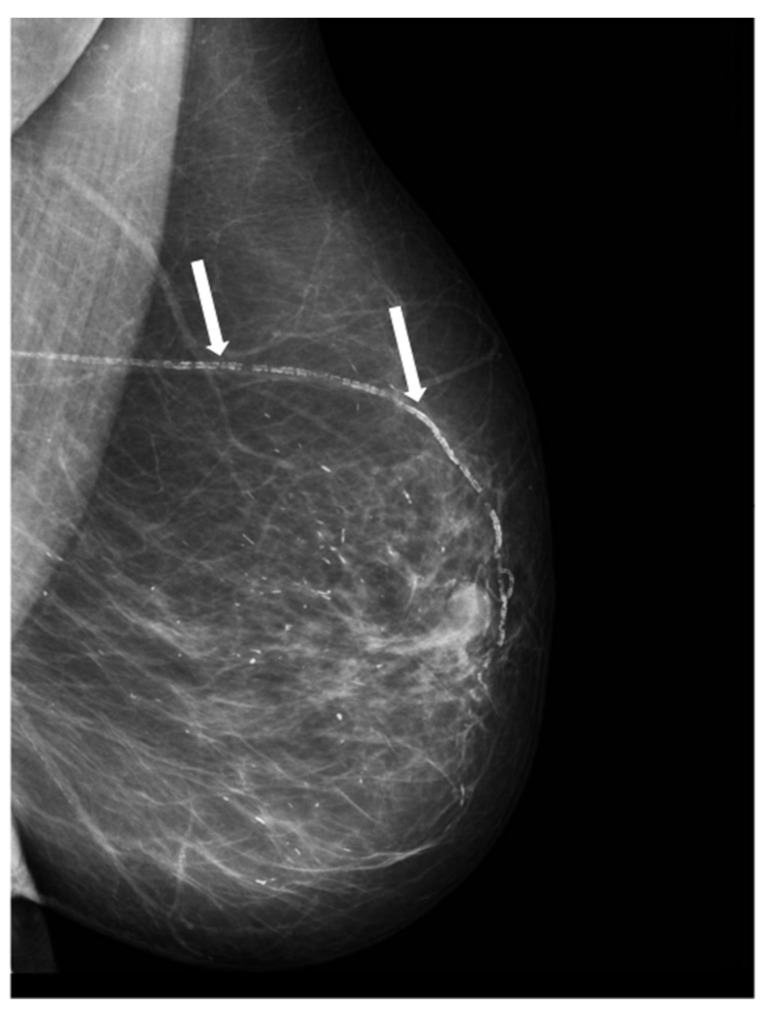
Breast arterial calcifications (BAC) have been associated with cardiovascular diseases. We aimed to examine whether the presence of BAC could predict the development of cardiovascular events in the very long term, as evidence has suggested.
We conducted a 23-year follow-up retrospective cohort study considering women specifically studied for breast cancer. After reviewing the mammograms of 1759 women, we selected 128 patients with BAC and an equal number of women without BAC.
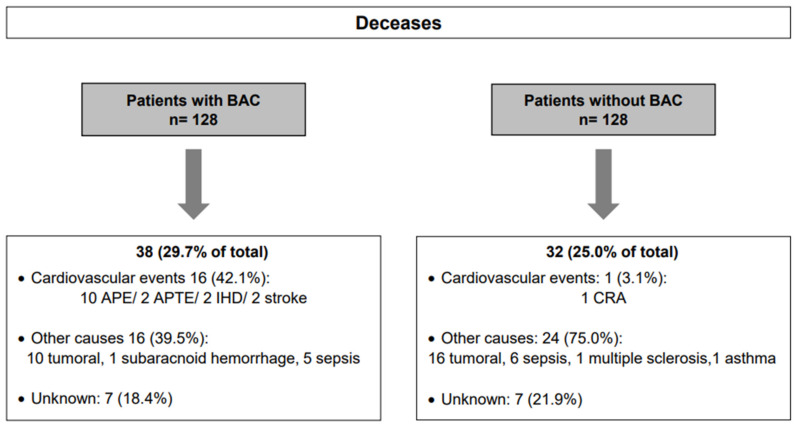
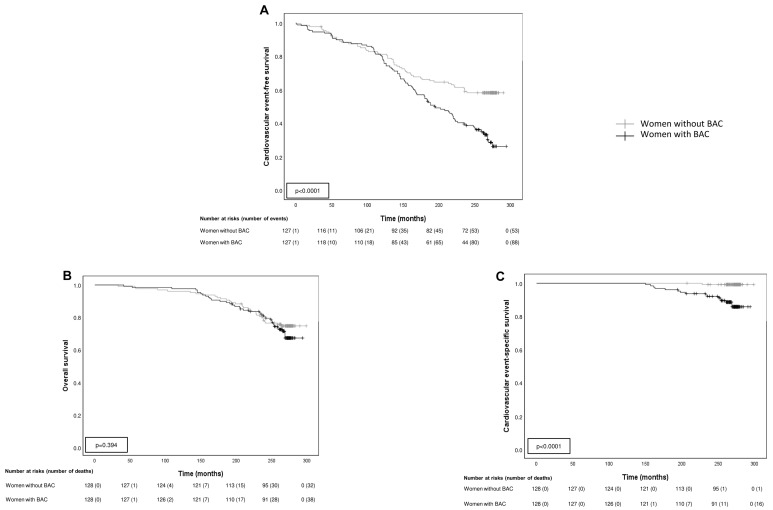
Women with BAC had higher relative risk (RR) for cardiovascular events, globally 1.66 (95% CI): 1.31-2.10 vs. 0.53 (0.39-0.72), and individually for ischemic heart disease 3.25 (1.53-6.90) vs. 0.85 (0.77-0.94), hypertensive heart disease 2.85 (1.59-5.09) vs. 0.79 (0.69-0.89), valvular heart disease 2.19 (1.28-3.75) vs. 0.83 (0.73-0.94), congestive heart failure 2.06 (1.19-3.56) vs. 0.85 (0.75-0.96), peripheral vascular disease 2.8 (1.42-5.52) vs. 0.85 (0.76-0.94), atrial fibrillation 1.83 (1.09-3.08) vs. 0.86 (0.76-0.98), and lacunar infarction 2.23 (1.21-4.09) vs. 0.86 (0.77-0.96). Cox's multivariate analysis, also considering classical risk factors, indicated that this BAC was significantly and independently associated with survival (both cardiovascular event-free and specific survival; 1.94 (1.38-2.73) and 6.6 (2.4-18.4)).
Our data confirm the strong association of BAC on mammograms and the development cardiovascular events, but also evidence the association of BAC with cardiovascular event-free and specific survival.
乳腺动脉钙化(BAC)与心血管疾病相关。正如已有证据所表明的,我们旨在研究BAC的存在是否能在长期内预测心血管事件的发生。
我们对专门针对乳腺癌进行研究的女性开展了一项为期23年的随访回顾性队列研究。在查看了1759名女性的乳房X光片后,我们挑选出128例有BAC的患者以及同等数量无BAC的女性。
有BAC的女性发生心血管事件的相对风险(RR)更高,总体为1.66(95%置信区间):1.31 - 2.10,而无BAC的女性为0.53(0.39 - 0.72);单独来看,缺血性心脏病的RR为3.25(1.53 - 6.90),无BAC的女性为0.85(0.77 - 0.94);高血压性心脏病的RR为2.85(1.59 - 5.09),无BAC的女性为0.79(0.69 - 0.89);瓣膜性心脏病的RR为2.19(1.28 - 3.75),无BAC的女性为0.83(0.73 - 0.94);充血性心力衰竭的RR为2.06(1.19 - 3.56),无BAC的女性为0.85(0.75 - 0.96);外周血管疾病的RR为2.8(1.42 - 5.52),无BAC的女性为0.85(0.76 - 0.94);心房颤动的RR为1.83(1.09 - 3.08),无BAC的女性为0.86(0.76 - 0.98);腔隙性脑梗死的RR为2.23(1.21 - 4.09),无BAC的女性为0.86(0.77 - 0.96)。Cox多变量分析(同时考虑经典风险因素)表明,这种BAC与生存(无心血管事件生存和特定生存)显著且独立相关(分别为1.94(1.38 - 2.73)和6.6(2.4 - 18.4))。
我们的数据证实了乳房X光片中BAC与心血管事件发生之间的强关联,同时也证明了BAC与无心血管事件生存和特定生存之间的关联。