
基于个体和连接性的实时功能磁共振成像神经反馈调节抑郁症患者情绪相关脑反应:一项初步研究。
Individual- and Connectivity-Based Real-Time fMRI Neurofeedback to Modulate Emotion-Related Brain Responses in Patients with Depression: A Pilot Study.
作者信息
Maywald Maximilian, Paolini Marco, Rauchmann Boris Stephan, Gerz Christian, Heppe Jan Lars, Wolf Annika, Lerchenberger Linda, Tominschek Igor, Stöcklein Sophia, Reidler Paul, Tschentscher Nadja, Ertl-Wagner Birgit, Pogarell Oliver, Keeser Daniel, Karch Susanne
机构信息
Department of Psychiatry and Psychotherapy, University Hospital LMU Munich, Nußbaumstr. 7, 80336 Munich, Germany.
Department of Radiology, University Hospital LMU Munich, Marchioninistraße 15, 81377 Munich, Germany.
出版信息
Brain Sci. 2022 Dec 14;12(12):1714. doi: 10.3390/brainsci12121714.
INTRODUCTION
Individual real-time functional magnetic resonance imaging neurofeedback (rtfMRI NF) might be a promising adjuvant in treating depressive symptoms. Further studies showed functional variations and connectivity-related changes in the dorsolateral prefrontal cortex (dlPFC) and the insular cortex.
OBJECTIVES
The aim of this pilot study was to investigate whether individualized connectivity-based rtfMRI NF training can improve symptoms in depressed patients as an adjunct to a psychotherapeutic programme. The novel strategy chosen for this was to increase connectivity between individualized regions of interest, namely the insula and the dlPFC.
METHODS
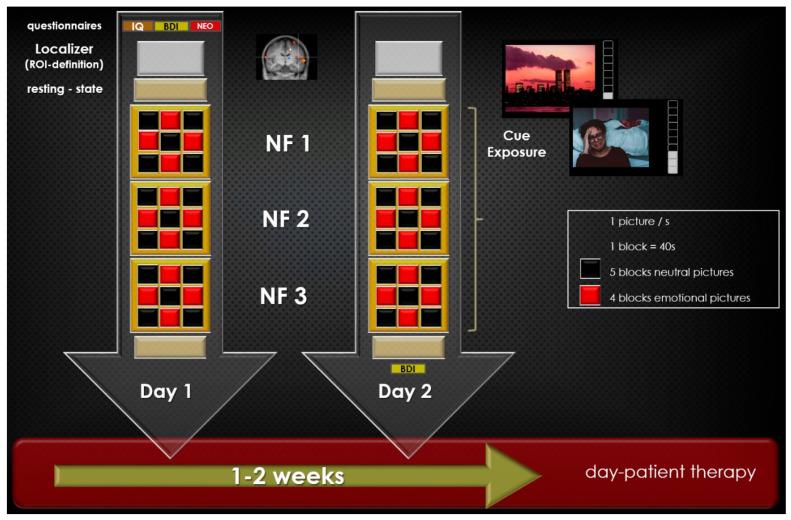
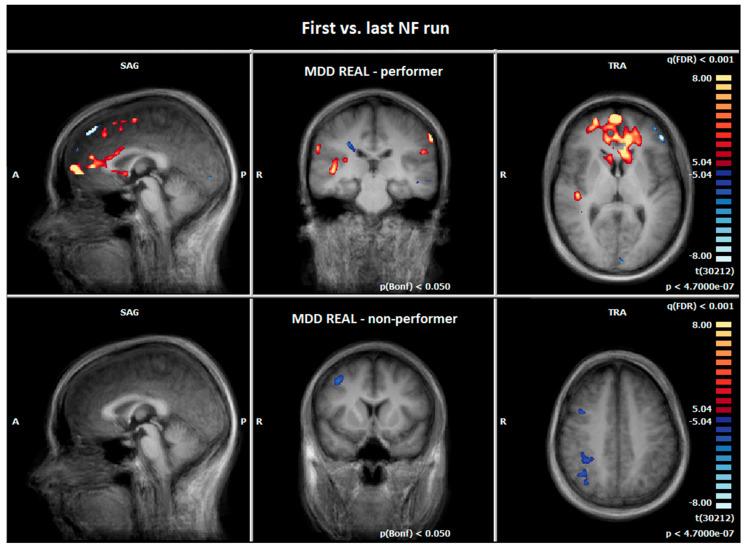
Sixteen patients diagnosed with major depressive disorder (MDD, ICD-10) and 19 matched healthy controls (HC) participated in a rtfMRI NF training consisting of two sessions with three runs each, within an interval of one week. RtfMRI NF was applied during a sequence of negative emotional pictures to modulate the connectivity between the dlPFC and the insula. The MDD REAL group was divided into a Responder and a Non-Responder group. Patients with an increased connectivity during the second NF session or during both the first and the second NF session were identified as "MDD REAL Responder" (N = 6). Patients that did not show any increase in connectivity and/or a decreased connectivity were identified as "MDD REAL Non-Responder" (N = 7).
RESULTS
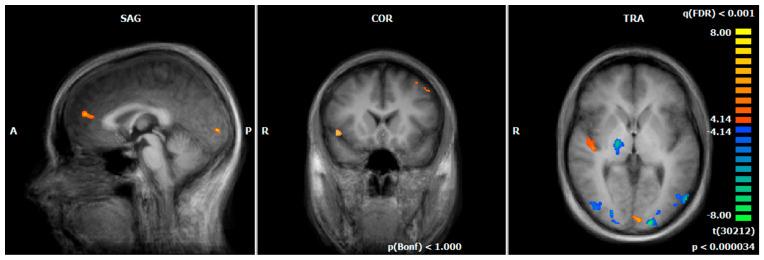
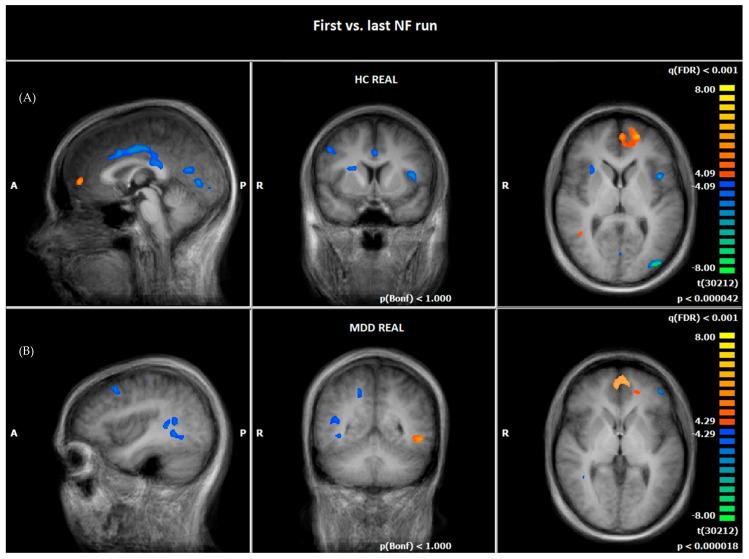
Before the rtfMRI sessions, patients with MDD showed higher neural activation levels in ventromedial PFC and the insula than HC; by contrast, HC revealed increased hemodynamic activity in visual processing areas (primary visual cortex and visual association cortex) compared to patients with MDD. The comparison of hemodynamic responses during the first compared to during the last NF session demonstrated significantly increased BOLD-activation in the medial orbitofrontal cortex (mOFC) in patients and HC, and additionally in the lateral OFC in patients with MDD. These findings were particularly due to the MDD Responder group, as the MDD Non-Responder group showed no increase in this region during the last NF run. There was a decrease of neural activation in emotional processing brain regions in both groups in the last NF run compared to the first: HC showed differences in the insula, parahippocampal gyrus, basal ganglia, and cingulate gyrus. Patients with MDD demonstrated deceased responses in the parahippocampal gyrus. There was no significant reduction of BDI scores after NF training in patients.
CONCLUSIONS
Increased neural activation in the insula and vmPFC in MDD suggests an increased emotional reaction in patients with MDD. The activation of the mOFC could be associated with improved control-strategies and association-learning processes. The increased lOFC activation could indicate a stronger sensitivity to failed NF attempts in MDD. A stronger involvement of visual processing areas in HC may indicate better adaptation to negative emotional stimuli after repeated presentation. Overall, the rtfMRI NF had an impact on neurobiological mechanisms, but not on psychometric measures in patients with MDD.
引言
个体实时功能磁共振成像神经反馈(rtfMRI NF)可能是治疗抑郁症状的一种有前景的辅助方法。进一步研究显示背外侧前额叶皮质(dlPFC)和岛叶皮质存在功能变化及与连接性相关的改变。
目的
本初步研究旨在调查基于个体连接性的rtfMRI NF训练作为心理治疗方案的辅助手段是否能改善抑郁症患者的症状。为此选择的新策略是增强感兴趣的个体区域(即岛叶和dlPFC)之间的连接性。
方法
16名被诊断为重度抑郁症(MDD,ICD - 10)的患者和19名匹配的健康对照者(HC)参加了一项rtfMRI NF训练,该训练包括两个阶段,每个阶段有三次扫描,间隔为一周。在一系列负面情绪图片呈现过程中应用rtfMRI NF来调节dlPFC和岛叶之间的连接性。MDD REAL组被分为反应者组和无反应者组。在第二次NF训练期间或第一次和第二次NF训练期间连接性增强的患者被确定为“MDD REAL反应者”(N = 6)。未显示任何连接性增加和/或连接性降低的患者被确定为“MDD REAL无反应者”(N = 7)。
结果
在rtfMRI训练前,MDD患者在腹内侧前额叶皮质和岛叶的神经激活水平高于HC;相比之下,与MDD患者相比,HC在视觉处理区域(初级视觉皮质和视觉联合皮质)显示出血流动力学活动增加。第一次与最后一次NF训练期间血流动力学反应的比较表明,患者和HC在内侧眶额皮质(mOFC)的BOLD激活显著增加,MDD患者在外侧眶额皮质也有增加。这些发现尤其归因于MDD反应者组,因为MDD无反应者组在最后一次NF扫描期间该区域没有增加。与第一次相比,两组在最后一次NF扫描时情绪处理脑区的神经激活均减少:HC在岛叶、海马旁回、基底神经节和扣带回有差异。MDD患者在海马旁回的反应减弱。NF训练后患者的BDI评分没有显著降低。
结论
MDD患者岛叶和腹内侧前额叶皮质神经激活增加表明MDD患者的情绪反应增强。mOFC的激活可能与改善控制策略和联想学习过程有关。外侧眶额皮质激活增加可能表明MDD患者对失败的NF尝试更敏感。HC中视觉处理区域更强的参与可能表明在反复呈现后对负面情绪刺激有更好的适应。总体而言,rtfMRI NF对MDD患者的神经生物学机制有影响,但对心理测量指标没有影响。

 Zotero 插件