Unit of Biostructure, Faculty of Physical Education and Sport, Wroclaw University of Health and Sport Sciences, Al. I.J. Paderewskiego 35, 51-612 Wroclaw, Poland.
Int J Environ Res Public Health. 2022 Dec 14;19(24):16816. doi: 10.3390/ijerph192416816.
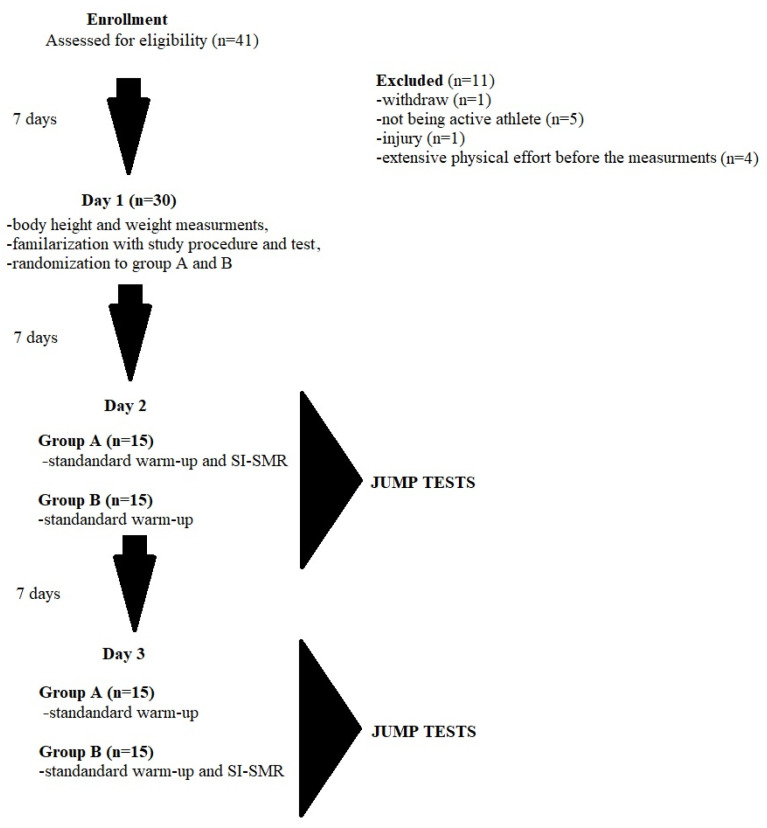
Searching for effective methods to maximize physical performance that can be utilized during warm-ups is challenging in modern sports. This study aimed to investigate the effect of a short and intensive self-myofascial release (SI-SMR) on jumps in amateur, collegiate athletes. The study sample consists of 30 subjects with an average age of 21.8 years. The tests conducted included a squat jump (SJ), countermovement jump (CMJ), and drop jump (DJ). In the first week, half of the participants performed a standardized warm-up with additional short (15 s per lower limb muscle group) and intensive (20 reps/15 s) SMR and then performed jump tests. The other half performed a standard warm-up. The following week the groups switched interventions. The results revealed a tendency for all jump test parameters (height, force, and power), the reactive strength index, and stiffness to improve with SI-SMR, but the differences were small and insignificant. A dependent t-test for paired samples revealed that only SJ height improvement (+0.96 ± 2.63 cm) reached statistical significance ( = 0.04), but the small ES (ES = 0.14) could have attenuated this result. When a two-way mixed ANOVA was applied, the differences were insignificant. SI-SMR was ineffective in the direct improvement of jump performance. Although SI-SMR had no adverse effects, athletes should focus on specific preparations for sports competitions instead of using an SI-SMR protocol.
在现代体育运动中,寻找能够在热身期间最大化身体表现的有效方法是具有挑战性的。本研究旨在探讨短时间、高强度自我肌筋膜松解(SI-SMR)对业余和大学生运动员跳跃能力的影响。研究样本由 30 名平均年龄为 21.8 岁的受试者组成。测试包括深蹲跳(SJ)、纵跳(CMJ)和跳深(DJ)。在第一周,一半的参与者进行了标准热身,另外还进行了短时间(每个下肢肌肉群 15 秒)和高强度(20 次/15 秒)的 SI-SMR,然后进行了跳跃测试。另一半参与者进行了标准热身。接下来的一周,两组参与者交换干预措施。结果表明,所有跳跃测试参数(高度、力量和功率)、反应力量指数和刚性都有改善的趋势,但差异较小且无统计学意义。配对样本的依赖 t 检验显示,只有 SJ 高度的提高(+0.96 ± 2.63 cm)达到统计学意义(=0.04),但小的 ES(ES=0.14)可能会减弱这一结果。当应用双向混合方差分析时,差异无统计学意义。SI-SMR 对跳跃表现的直接改善无效。尽管 SI-SMR 没有不良影响,但运动员应该专注于针对体育比赛的特定准备,而不是使用 SI-SMR 方案。