State Key Laboratory of Crop Biology, Key Laboratory of Crop Biology and Genetic Improvement of Horticultural Crops in Huanghuai Region, Collaborative Innovation Center of Fruit & Vegetable Quality and Efficient Production in Shandong, College of Horticulture Science and Engineering, Shandong Agricultural University, Tai'an 271018, China.
Tai'an Academy of Agricultural Sciences, Tai'an 271000, China.
Int J Mol Sci. 2022 Dec 16;23(24):16057. doi: 10.3390/ijms232416057.
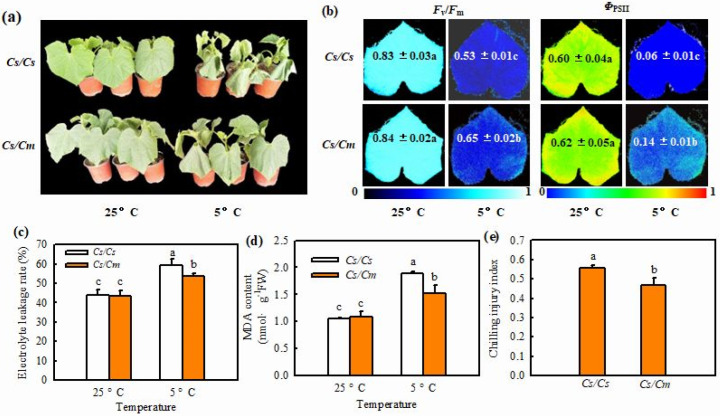
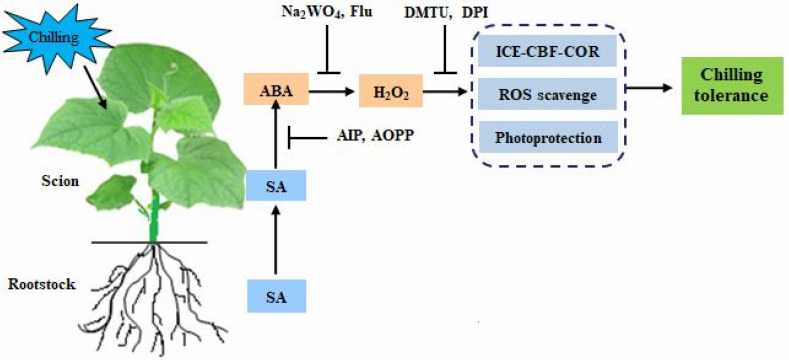
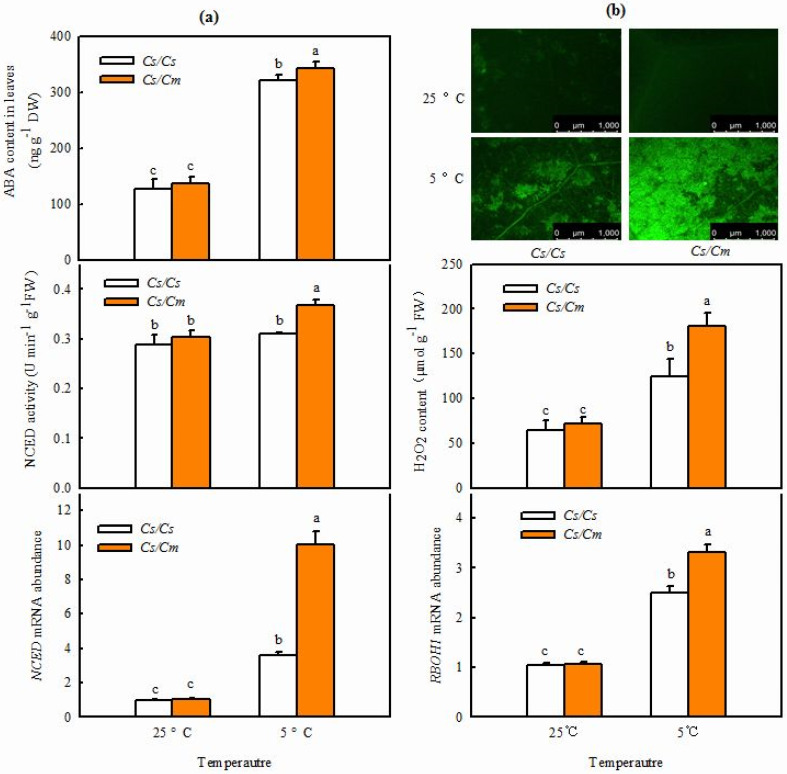
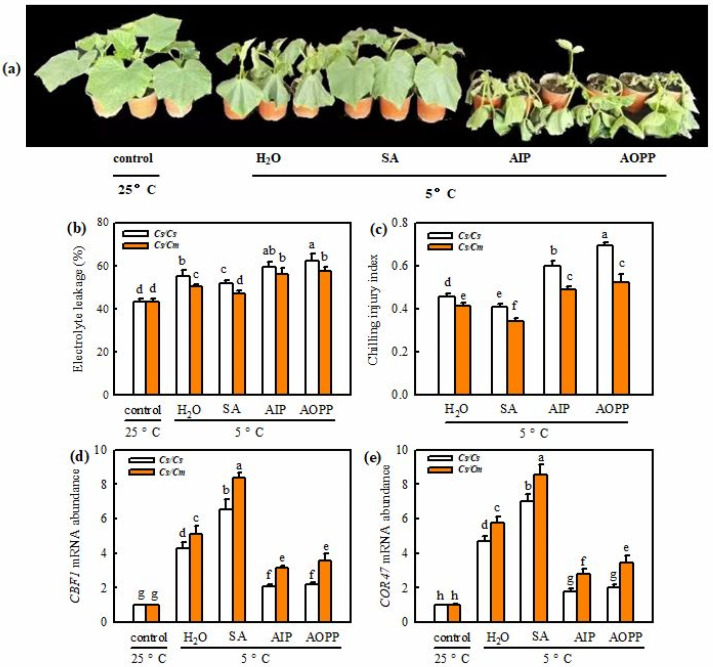
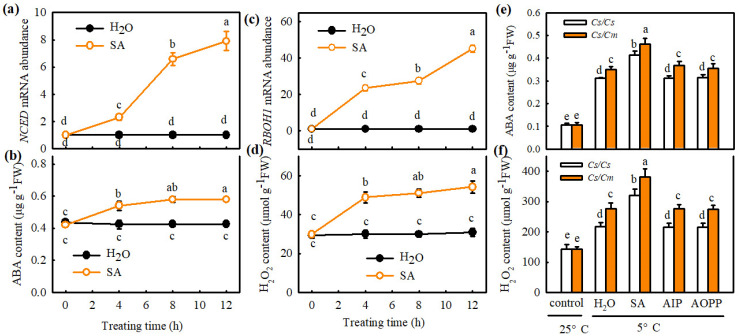
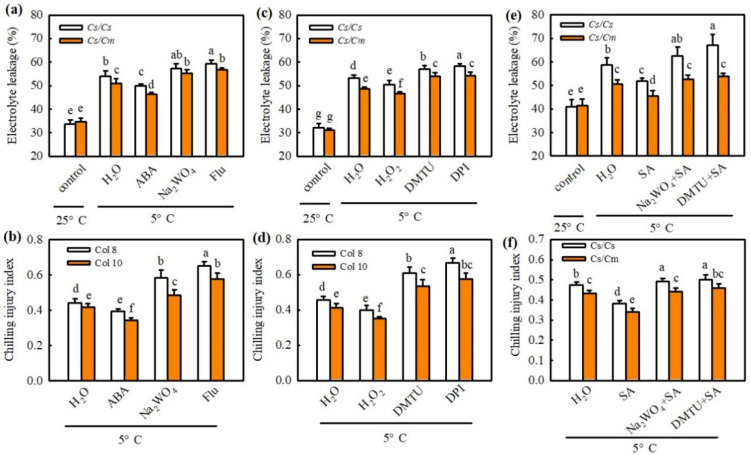
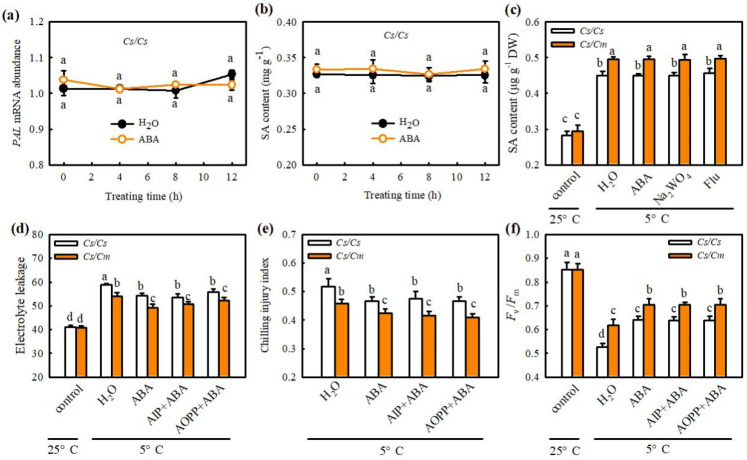
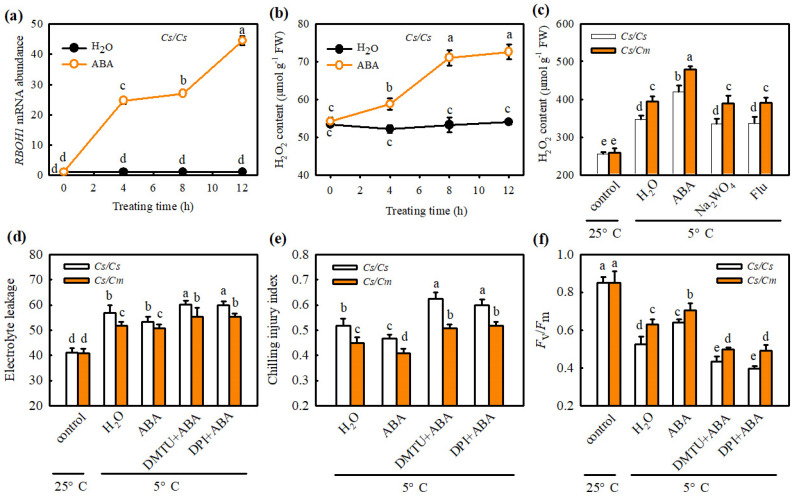
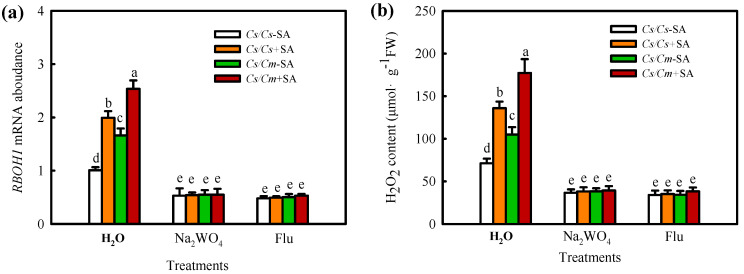
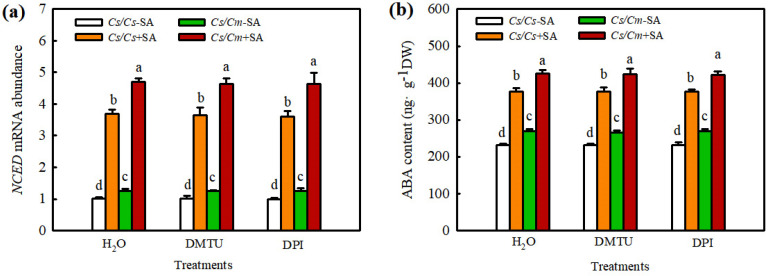
Grafting is widely applied to enhance the tolerance of some vegetables to biotic and abiotic stress. Salicylic acid (SA) is known to be involved in grafting-induced chilling tolerance in cucumber. Here, we revealed that grafting with pumpkin (, ) as a rootstock improved chilling tolerance and increased the accumulation of SA, abscisic acid (ABA) and hydrogen peroxide (HO) in grafted cucumber () leaves. Exogenous SA improved the chilling tolerance and increased the accumulation of ABA and HO and the mRNA abundances of , , , and . However, 2-aminoindan-2-phosphonic acid (AIP) and L-a-aminooxy-b-phenylpropionic acid (AOPP) (biosynthesis inhibitors of SA) reduced grafting-induced chilling tolerance, as well as the synthesis of ABA and HO, in cucumber leaves. ABA significantly increased endogenous HO production and the resistance to chilling stress, as proven by the lower electrolyte leakage (EL) and chilling injury index (CI). However, application of the ABA biosynthesis inhibitors sodium tungstate (NaWO) and fluridone (Flu) abolished grafting or SA-induced HO accumulation and chilling tolerance. SA-induced plant response to chilling stress was also eliminated by N,N'-dimethylthiourea (DMTU, an HO scavenger). In addition, ABA-induced chilling tolerance was attenuated by DMTU and diphenyleneiodonium (DPI, an HO inhibitor) chloride, but AIP and AOPP had little effect on the ABA-induced mitigation of chilling stress. NaWO and Flu diminished grafting- or SA-induced HO biosynthesis, but DMTU and DPI did not affect ABA production induced by SA under chilling stress. These results suggest that SA participated in grafting-induced chilling tolerance by stimulating the biosynthesis of ABA and HO. HO, as a downstream signaler of ABA, mediates SA-induced chilling tolerance in grafted cucumber plants.
嫁接被广泛应用于提高一些蔬菜对生物和非生物胁迫的耐受性。水杨酸(SA)被认为参与了黄瓜嫁接诱导的耐冷性。在这里,我们揭示了以南瓜()为砧木进行嫁接可以提高黄瓜的耐冷性,并增加嫁接黄瓜叶片中 SA、脱落酸(ABA)和过氧化氢(HO)的积累。外源 SA 提高了耐冷性,并增加了 ABA 和 HO 的积累以及、、和的 mRNA 丰度。然而,2-氨基茚-2-磷酸(AIP)和 L-a-氨基氧代-b-苯丙酸(AOPP)(SA 合成抑制剂)降低了嫁接诱导的黄瓜耐冷性,以及 ABA 和 HO 的合成。ABA 显著增加了内源 HO 的产生和对冷胁迫的抗性,这可以通过较低的电解质渗漏(EL)和冷害指数(CI)来证明。然而,ABA 生物合成抑制剂钨酸钠(NaWO)和氟啶酮(Flu)的应用消除了嫁接或 SA 诱导的 HO 积累和耐冷性。SA 诱导的植物对冷胁迫的反应也被 HO 清除剂 N,N'-二甲基硫脲(DMTU)消除。此外,ABA 诱导的耐冷性被 DMTU 和二苯基碘(DPI,HO 抑制剂)氯化物减弱,但 AIP 和 AOPP 对 ABA 诱导的减轻冷胁迫的影响很小。NaWO 和 Flu 减弱了嫁接或 SA 诱导的 HO 生物合成,但 DMTU 和 DPI 对冷胁迫下 SA 诱导的 ABA 产生没有影响。这些结果表明,SA 通过刺激 ABA 和 HO 的生物合成参与了嫁接诱导的耐冷性。HO 作为 ABA 的下游信号分子,介导了嫁接黄瓜植物中 SA 诱导的耐冷性。