Xin Chen, Wang Ningli, Wang Huaizhou
Glaucoma Department, Beijing Tongren Eye Center, Beijing Tongren Hospital, Capital Medical University, Beijing 100730, China.
J Clin Med. 2022 Dec 8;11(24):7279. doi: 10.3390/jcm11247279.
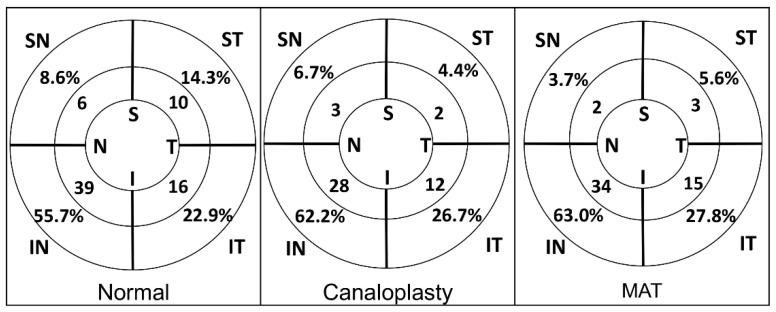
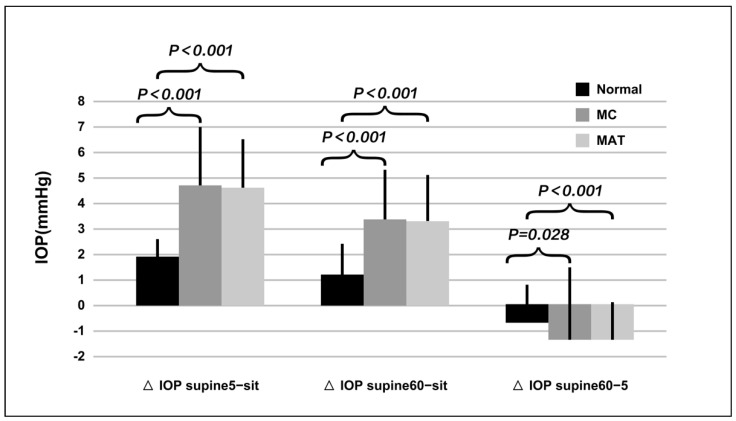
Background: Schlemm’s canal (SC) targeted procedures constitute a promising therapy for open angle glaucoma (POAG), safer and less invasive. However, little attention was paid to the intraocular pressure (IOP) variation in patients receiving these procedures, which is the risk factor for POAG progression. This study is to evaluate the IOP variation in eyes with POAG after modified canaloplasty (MC) and microcatheter assisted trabeculotomy (MAT). (2) Methods: POAG with good IOP in office hours after MC or MAT and age-matched normal subjects were recruited in this prospective coherent study. IOP in sitting and supine positions and 24-h IOP was measured. Aqueous vein and blood reflux into the SC were examined. (3) Results: Among 20 normal subjects, 25 eyes with MC eyes and 30 eyes with MAT were recruited in this study. Aqueous veins are frequently located in the inferior nasal quadrants in all groups. No pulsatile signs were observed in an aqueous vein in the MAT group but they were observed in 68% of the MC group. Blood reflux in the SC could be seen in all the operated eyes. The IOP in the sitting position was not significant different among groups (p = 0.419). Compared to normal, the IOP increased dramatically after lying down for 5 min in the MC and MAT groups (PMC vs. normal = 0.003, PMAT vs. normal = 0.004), which is similar for IOP change after lying down for 60 min (PMC vs. normal < 0.001, PMAT vs. normal < 0.001). In terms of diurnal IOP, subjects were stable in the MAT group (p < 0.01), variable in the normal group (p = 0.002), and most fluctuant in MC group (p < 0.001). (4) Conclusions: MC and MAT reduce the IOP but present aberrant short-term IOP regulation, which should be paid attention to in clinical settings.
针对施莱姆管(SC)的手术是开角型青光眼(POAG)一种有前景的治疗方法,更安全且侵入性更小。然而,接受这些手术的患者的眼压(IOP)变化却很少受到关注,而眼压变化是POAG进展的危险因素。本研究旨在评估改良小梁切开术(MC)和微导管辅助小梁切开术(MAT)后POAG患者的眼压变化。(2)方法:本前瞻性连贯研究招募了在MC或MAT术后办公时间眼压良好的POAG患者以及年龄匹配的正常受试者。测量坐位和平卧位眼压以及24小时眼压。检查房水静脉和血液反流至SC的情况。(3)结果:本研究纳入了20名正常受试者、25只接受MC手术的眼睛和30只接受MAT手术的眼睛。所有组的房水静脉常位于鼻下象限。MAT组的房水静脉未观察到搏动征,但MC组有68%观察到搏动征。所有手术眼均可见SC内血液反流。坐位眼压在各组间无显著差异(p = 0.419)。与正常组相比,MC组和MAT组躺下5分钟后眼压显著升高(PMC组与正常组比较 = 0.003,PMAT组与正常组比较 = 0.004),躺下60分钟后眼压变化情况相似(PMC组与正常组比较 < 0.001,PMAT组与正常组比较 < 0.001)。就昼夜眼压而言,MAT组受试者眼压稳定(p < 0.01),正常组眼压可变(p = 0.002),MC组眼压波动最大(p < 0.001)。(4)结论:MC和MAT可降低眼压,但存在异常的短期眼压调节,临床应予以关注。