Huang Jun-Wei, Fang Wen-Hui, Chen Wei-Liang
Division of Family Medicine, Department of Family and Community Medicine, Tri-Service General Hospital, School of Medicine, National Defense Medical Center, Taipei 114, Taiwan.
Division of Geriatric Medicine, Department of Family and Community Medicine, Tri-Service General Hospital, School of Medicine, National Defense Medical Center, Taipei 114, Taiwan.
J Clin Med. 2022 Dec 12;11(24):7376. doi: 10.3390/jcm11247376.
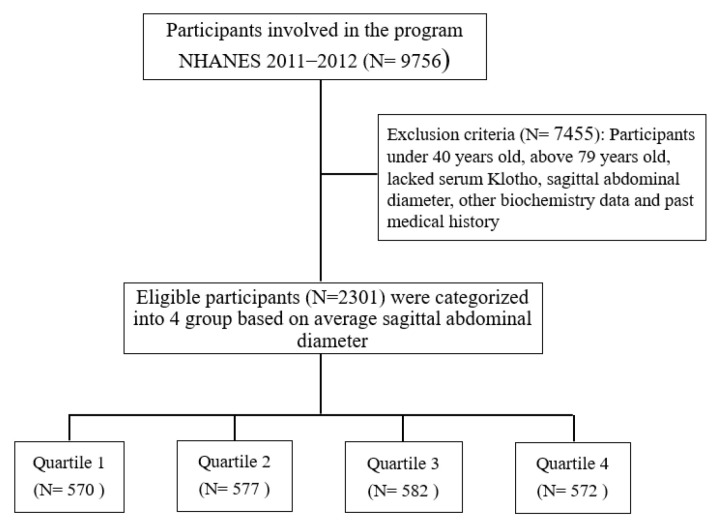
Klotho is an anti-aging gene. Studies have revealed its association with insulin resistance. Visceral fat is related to insulin resistance, and the sagittal abdominal diameter (SAD) can serve as a biomarker for visceral fat (VF). This study investigated the association between SAD and serum Klotho concentration (SKC). We enrolled 2301 participants from the 2011−2012 National Health and Nutrition Examination Survey (NHANES) dataset, and 49.2% of the enrolled individuals were male. Qualified participants were separated into four quartiles according to the SAD value. SKC values were obtained by ELISA. Demographic characteristics, body mass index (BMI), systolic blood pressure, and biochemistry parameters with significance were analyzed using multivariate linear regression models. The mean age of the study participants was 57.22 ± 10.53 years. The fully adjusted regression model showed a negative association between SAD and SKC (p < 0.05), with a β-coefficient of −12.02. We also analyzed subgroups of participants according to age and BMI. Participants with an age ≥65 and <65 years old were each negatively associated with SKC, and this association was significant for participants with a BMI ≥ 30 kg/m2 (p = 0.001, β-coefficient: −18.83). We also found a concentration-dependent relationship between SAD and SKC. In conclusion, VF and SKC are associated, and SAD can serve as a surrogate of VF and an indicator of SKC.
klotho是一种抗衰老基因。研究表明它与胰岛素抵抗有关。内脏脂肪与胰岛素抵抗相关,而腹矢状径(SAD)可作为内脏脂肪(VF)的生物标志物。本研究调查了SAD与血清klotho浓度(SKC)之间的关联。我们从2011 - 2012年国家健康和营养检查调查(NHANES)数据集中纳入了2301名参与者,其中49.2%为男性。合格参与者根据SAD值分为四个四分位数。通过酶联免疫吸附测定法(ELISA)获得SKC值。使用多元线性回归模型分析了具有统计学意义的人口统计学特征、体重指数(BMI)、收缩压和生化参数。研究参与者的平均年龄为57.22±10.53岁。完全调整后的回归模型显示SAD与SKC之间呈负相关(p<0.05),β系数为 - 12.02。我们还根据年龄和BMI对参与者亚组进行了分析。年龄≥65岁和<65岁的参与者与SKC均呈负相关,且这种关联在BMI≥30kg/m²的参与者中具有统计学意义(p = 0.001,β系数: - 18.83)。我们还发现SAD与SKC之间存在浓度依赖关系。总之,VF与SKC相关,SAD可作为VF的替代指标和SKC的指示指标。