Sandybayev Nurlan, Beloussov Vyacheslav, Strochkov Vitaliy, Solomadin Maxim, Granica Joanna, Yegorov Sergey
Kazakhstan-Japan Innovation Center, Kazakh National Agrarian Research University, Almaty 050010, Kazakhstan.
Molecular Genetics Laboratory TreeGene, Almaty 050009, Kazakhstan.
Microorganisms. 2022 Nov 24;10(12):2327. doi: 10.3390/microorganisms10122327.
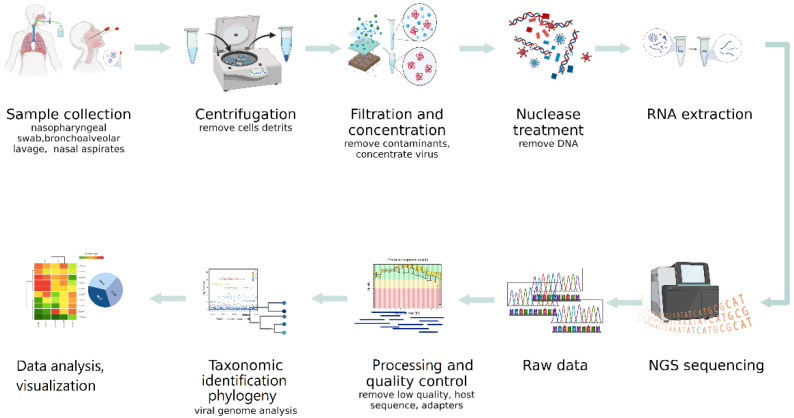
The COVID-19 pandemic and heightened perception of the risk of emerging viral infections have boosted the efforts to better understand the virome or complete repertoire of viruses in health and disease, with a focus on infectious respiratory diseases. Next-generation sequencing (NGS) is widely used to study microorganisms, allowing the elucidation of bacteria and viruses inhabiting different body systems and identifying new pathogens. However, NGS studies suffer from a lack of standardization, in particular, due to various methodological approaches and no single format for processing the results. Here, we review the main methodological approaches and key stages for studies of the human virome, with an emphasis on virome changes during acute respiratory viral infection, with applications for clinical diagnostics and epidemiologic analyses.
新冠疫情以及对新出现的病毒感染风险的更高认知,推动了人们为更好地了解健康和疾病状态下的病毒组或完整病毒库所做的努力,重点是传染性呼吸道疾病。下一代测序(NGS)被广泛用于研究微生物,能够阐明栖息于不同身体系统的细菌和病毒,并识别新的病原体。然而,NGS研究缺乏标准化,特别是由于存在各种方法学途径且没有单一的结果处理格式。在此,我们综述了人类病毒组研究的主要方法学途径和关键阶段,重点关注急性呼吸道病毒感染期间病毒组的变化,及其在临床诊断和流行病学分析中的应用。