Lambisia Arnold W, Mohammed Khadija S, Makori Timothy O, Ndwiga Leonard, Mburu Maureen W, Morobe John M, Moraa Edidah O, Musyoki Jennifer, Murunga Nickson, Mwangi Jane N, Nokes D James, Agoti Charles N, Ochola-Oyier Lynette Isabella, Githinji George
Kenya Medical Research Institute (KEMRI)-Wellcome Trust Research Programme (KWTRP), Kilifi, Kenya.
Department of Biological Sciences, University of Warwick, Coventry, United Kingdom.
Front Med (Lausanne). 2022 Feb 17;9:836728. doi: 10.3389/fmed.2022.836728. eCollection 2022.
The ARTIC Network's primer set and amplicon-based protocol is one of the most widely used SARS-CoV-2 sequencing protocol. An update to the V3 primer set was released on 18th June 2021 to address amplicon drop-off observed among the Delta variant of concern. Here, we report on an in-house optimization of a modified version of the ARTIC Network V4 protocol that improves SARS-CoV-2 genome recovery in instances where the original V4 pooling strategy was characterized by amplicon drop-offs.
We utilized a matched set of 43 clinical samples and serially diluted positive controls that were amplified by ARTIC V3, V4 and optimized V4 primers and sequenced using GridION from the Oxford Nanopore Technologies'.
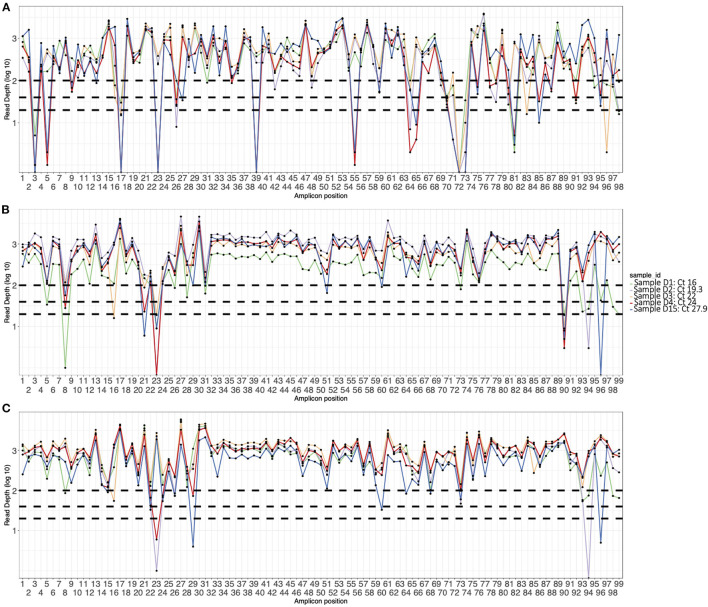
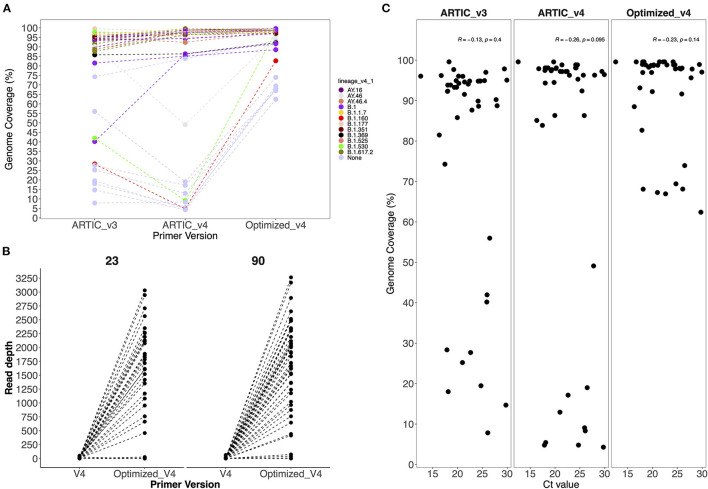
We observed a 0.5% to 46% increase in genome recovery in 67% of the samples when using the original V4 pooling strategy compared to the V3 primers. Amplicon drop-offs at primer positions 23 and 90 were observed for all variants and positive controls. When using the optimized protocol, we observed a 60% improvement in genome recovery across all samples and an increase in the average depth in amplicon 23 and 90. Consequently, ≥95% of the genome was recovered in 72% ( = 31) of the samples. However, only 60-70% of the genomes could be recovered in samples that had <28% genome coverage with the ARTIC V3 primers. There was no statistically significant ( > 0.05) correlation between Ct value and genome recovery.
Utilizing the ARTIC V4 primers, while increasing the primer concentrations for amplicons with drop-offs or low average read-depth, greatly improves genome recovery of Alpha, Beta, Delta, Eta and non-VOC/non-VOI SARS-CoV-2 variants.
ARTIC网络的引物组和基于扩增子的方案是最广泛使用的严重急性呼吸综合征冠状病毒2(SARS-CoV-2)测序方案之一。2021年6月18日发布了V3引物组的更新版本,以解决在关注的德尔塔变体中观察到的扩增子脱落问题。在此,我们报告了对ARTIC网络V4方案的修改版本进行的内部优化,该优化在原始V4混合策略以扩增子脱落为特征的情况下提高了SARS-CoV-2基因组回收率。
我们使用了一组匹配的43个临床样本和系列稀释的阳性对照,这些样本通过ARTIC V3、V4和优化的V4引物进行扩增,并使用牛津纳米孔技术公司的GridION进行测序。
与V3引物相比,使用原始V4混合策略时,我们在67%的样本中观察到基因组回收率提高了0.5%至46%。在所有变体和阳性对照中均观察到引物位置23和90处的扩增子脱落。使用优化方案时,我们观察到所有样本的基因组回收率提高了60%,扩增子23和90的平均深度增加。因此,72%(n = 31)的样本中≥95%的基因组被回收。然而,在使用ARTIC V3引物基因组覆盖率<28%的样本中,只有60 - 70%的基因组能够被回收。Ct值与基因组回收率之间没有统计学显著相关性(P>0.05)。
使用ARTIC V4引物,同时增加扩增子脱落或平均读取深度较低的引物浓度,可大大提高阿尔法、贝塔、德尔塔、伊塔和非关注变体/非感兴趣变体的SARS-CoV-2基因组回收率。