Department of Chemistry, Materials and Chemical Engineering "Giulio Natta", Politecnico di Milano, p.zza L. da Vinci 32, 20133 Milano, Italy.
Istituto di Scienze e Tecnologie Chimiche "Giulio Natta", Consiglio Nazionale delle Ricerche (SCITEC-CNR), Via Luigi Mancinelli 7, 20131 Milano, Italy.
Molecules. 2022 Dec 14;27(24):8879. doi: 10.3390/molecules27248879.
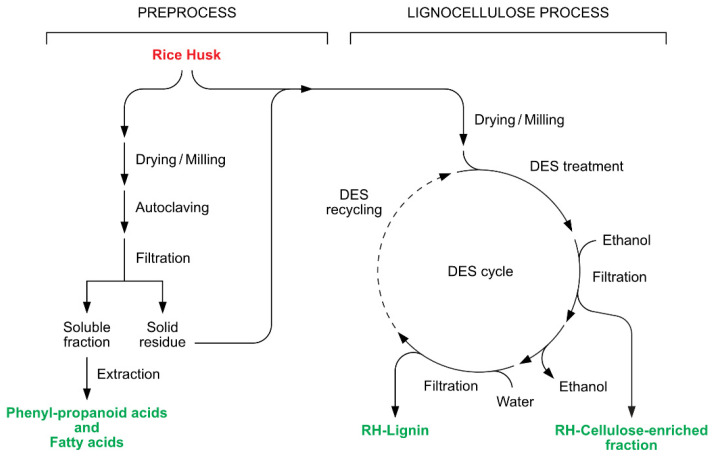
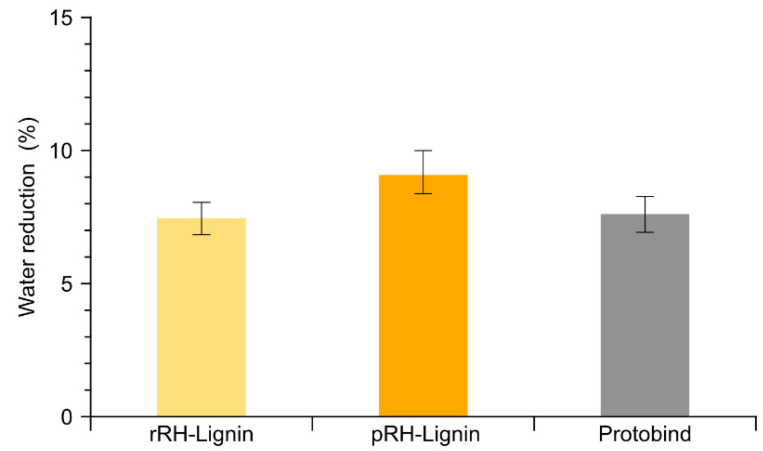
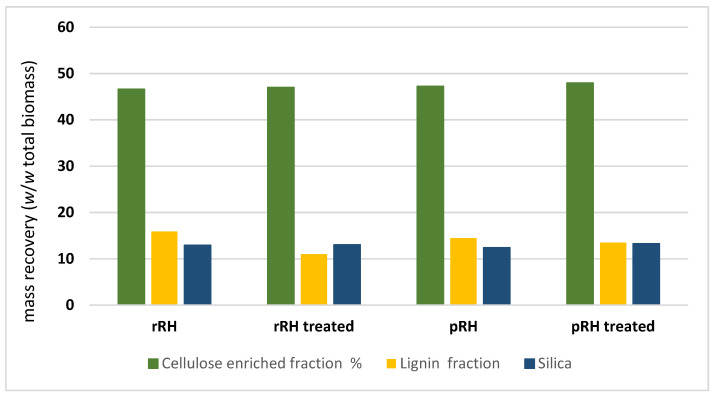
In the present work, rice husks (RHs), which, worldwide, represent one of the most abundant agricultural wastes in terms of their quantity, have been treated and fractionated in order to allow for their complete valorization. RHs coming from the raw and parboiled rice production have been submitted at first to a hydrothermal pretreatment followed by a deep eutectic solvent fractionation, allowing for the separation of the different components by means of an environmentally friendly process. The lignins obtained from raw and parboiled RHs have been thoroughly characterized and showed similar physico-chemical characteristics, indicating that the parboiling process does not introduce obvious lignin alterations. In addition, a preliminary evaluation of the potentiality of such lignin fractions as precursors of cement water reducers has provided encouraging results. A fermentation-based optional preprocess has also been investigated. However, both raw and parboiled RHs demonstrated a poor performance as a microbiological growth substrate, even in submerged fermentation using cellulose-degrading fungi. The described methodology appears to be a promising strategy for the valorization of these important waste biomasses coming from the rice industry towards a circular economy perspective.
在本工作中,稻壳(RH)是全球范围内数量最丰富的农业废弃物之一,对其进行了处理和分级,以实现其完全增值。来自生米和半熟米生产的 RH 首先经过水热预处理,然后进行深共晶溶剂分级,通过环保工艺分离不同成分。从生稻壳和半熟稻壳中获得的木质素进行了彻底的表征,表现出相似的物理化学特性,表明半熟处理过程不会引入明显的木质素变化。此外,对这些木质素级分作为水泥减水剂前体的潜在性进行了初步评估,结果令人鼓舞。还研究了基于发酵的可选预处理。然而,生稻壳和半熟稻壳作为微生物生长基质的性能都很差,即使在使用纤维素降解真菌的浸没发酵中也是如此。所描述的方法似乎是一种很有前途的策略,可以实现从水稻产业到循环经济视角的这些重要废生物质的增值。