Alosaimi Bandar, Alshanbari Huda M, Alturaiqy Muath, AlRawi Halah Z, Alamri Saad, Albujaidy Asma, Bin Sabaan Aljawharah, Alrashed Ahmed A, Alamer Ahmad, Alghofaili Fayez, Al-Duraymih Khaled, Alshalani Abdulaziz J, Alturaiki Wael
Research Center, King Fahad Medical City, Riyadh Second Health Cluster, Riyadh 11525, Saudi Arabia.
Department of Mathematical Sciences, College of Science, Princess Nourah bint Abdulrahman University, Riyadh 11671, Saudi Arabia.
Pharmaceuticals (Basel). 2022 Nov 24;15(12):1456. doi: 10.3390/ph15121456.
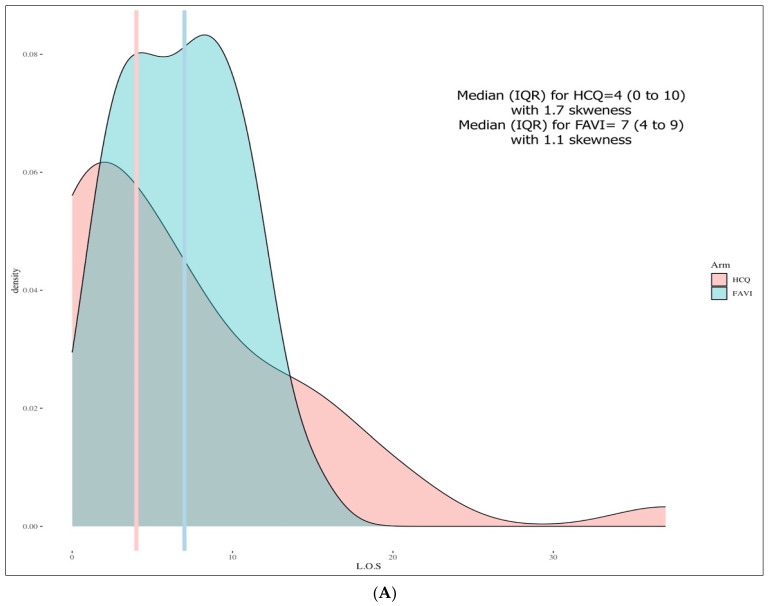
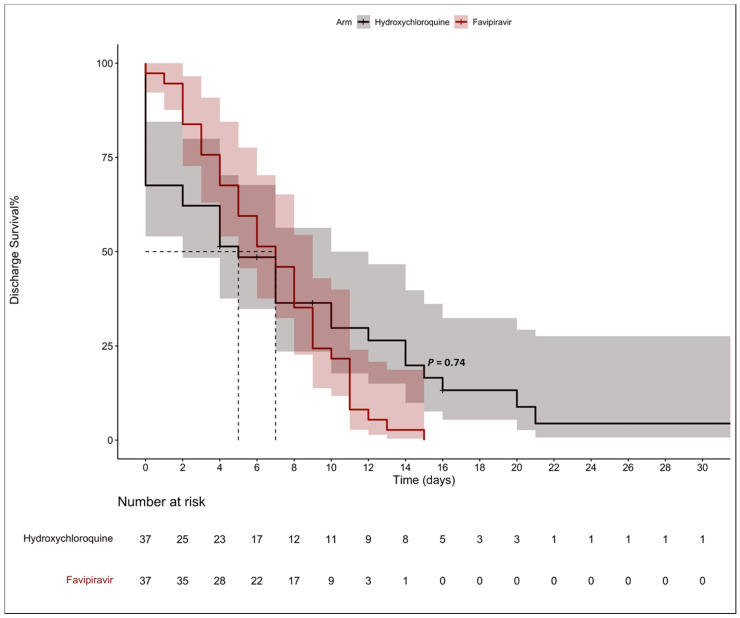
Background: The coronavirus 2019 (COVID-19) disease, caused by the severe acute respiratory syndrome coronavirus 2 (SARS-CoV-2) virus led to a global pandemic. HCQ and FPV were used early in the pandemic as a treatment modality for COVID-19. Various studies evaluated the HCQ and FPV effectiveness, based on the mortality endpoint and showed conflicting results. We hypothesize that analyzing the difference in the LOS as a significant endpoint would be of a major interest, especially for healthcare providers, to prevent a lengthy hospitalization and disease progression. Methods: This is a retrospective observational study, conducted via a medical chart review of COVD-19 patients who were admitted between April 2020 and March 2021 with a moderate to severe illness. The LOS endpoint was tested using the paired Wilcoxon signed-rank (WSR) model. Prior to using the WSR model, the balance between the HCQ and FPV groups, the propensity score matching, the LOS distribution, and the normality assumptions were tested. Two sensitivity statistical analyses were conducted to confirm the results (stratified log-rank test and U Welch test after transforming the LOS by the squared root values). Results: A total of 200 patients were included for the analysis: 83 patients in the HCQ group and 117 patients in the FPV group. Thirty-seven patients were matched in each group. The LOS data was positively skewed and violated the normality (Shapiro−Wilk p < 0.001) and had an unequal variance (Levene’s test, p = 0.019). The WSR test showed no statistical significance in the LOS endpoint, with a median of −0.75 days (95% confidence interval: −4.0 to 2.5, p = 0.629), in favor of the HCQ group (four days), in comparison to seven days of the FPV group. The WSR findings were further confirmed with the stratified log rank test (p = 740) and the U Welch test (p = 391). Conclusions: The study concluded that the HCQ and FPV treatments have a comparable effectiveness in terms of the LOS in the moderate to severe COVID-19 patients. This study highlights the importance of analyzing the LOS as a relevant endpoint, in order to prevent the costs of a lengthy hospitalization and disease progression. The current study also emphasizes the importance of applying the appropriate statistical testing when dealing with two-sample paired data and analyzing non-parametric data such as the LOS.
由严重急性呼吸综合征冠状病毒2(SARS-CoV-2)引起的2019冠状病毒病(COVID-19)导致了全球大流行。羟氯喹(HCQ)和法匹拉韦(FPV)在大流行早期被用作COVID-19的一种治疗方式。各种研究基于死亡率终点评估了HCQ和FPV的有效性,结果相互矛盾。我们假设,将住院时间(LOS)差异作为一个重要终点进行分析将具有重大意义,特别是对于医疗服务提供者而言,有助于防止长期住院和疾病进展。
这是一项回顾性观察研究,通过对2020年4月至2021年3月期间收治的中重度COVID-19患者的病历进行回顾。使用配对威尔科克森符号秩(WSR)模型对LOS终点进行检验。在使用WSR模型之前,对HCQ组和FPV组之间的平衡、倾向得分匹配、LOS分布以及正态性假设进行了检验。进行了两项敏感性统计分析以确认结果(分层对数秩检验以及对LOS取平方根值进行转换后的U威尔奇检验)。
总共200名患者纳入分析:HCQ组83例患者,FPV组117例患者。每组37例患者进行了匹配。LOS数据呈正偏态分布,违反正态性(夏皮罗-威尔克检验,p<0.001)且方差不齐(莱文检验,p = 0.019)。WSR检验显示LOS终点无统计学意义,中位数为-0.75天(95%置信区间:-4.0至2.5,p = 0.629),与FPV组的7天相比,HCQ组更有利(4天)。分层对数秩检验(p = 0.740)和U威尔奇检验(p = 0.391)进一步证实了WSR的结果。
该研究得出结论,在中重度COVID-19患者的LOS方面,HCQ和FPV治疗具有相当的有效性。本研究强调了将LOS作为一个相关终点进行分析的重要性,以防止长期住院的费用和疾病进展。当前研究还强调了在处理两组配对数据以及分析如LOS这样的非参数数据时应用适当统计检验的重要性。