
非酒精性脂肪性肝病小鼠模型中[F]氟-4-硫代油酸的心脏摄取情况
Heart Uptake of [F]Fluoro-4-Thia-Oleate in a Non-Alcoholic Fatty Liver Disease Mouse Model.
作者信息
Li Junfeng, Hu Weidong, Peng Jiangling, Wong Patty, Kandeel Fouad, Olafsen Tove, Shively John E
机构信息
Arthur Riggs Institute of Diabetes, Endocrinology and Metabolism, Beckman Research Institute of the City of Hope, Duarte, CA 91010, USA.
Department of Radiation Oncology, City of Hope National Medical Center, Duarte, CA 91010, USA.
出版信息
Pharmaceuticals (Basel). 2022 Dec 17;15(12):1577. doi: 10.3390/ph15121577.
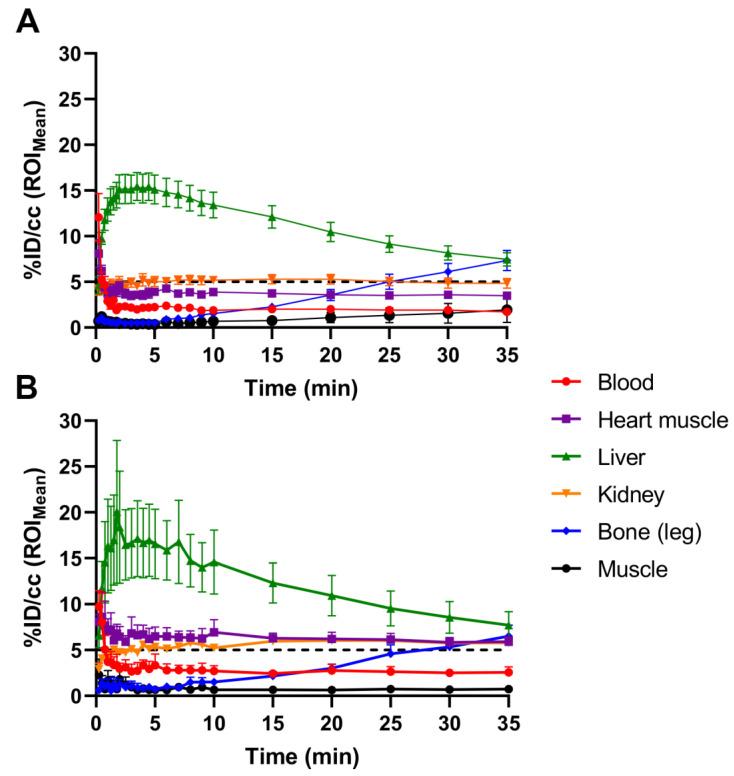
The world-wide high incidence of non-alcoholic fatty liver disease (NAFLD) is of concern for its progression to insulin resistance, steatohepatitis and cardiovascular disease (CVD). The increased uptake of fatty acids in critical organs plays a major role in NAFLD progression. Male Ceacam1−/− mice that develop NAFLD, insulin resistance and CVD on normal chow are a potential model for studying the dysregulation of fatty acid uptake. [18F]fluoro-4-thia-oleate ([18F]FTO) was chosen as a fatty acid reporter because of its higher uptake and retention in the heart in an animal model of CVD. Male wild-type (WT) or Ceacam1−/− mice fasted 4−6 h were administered [18F]FTO i.v., and dynamic PET scans were conducted in an MR/PET small animal imaging system along with terminal tissue biodistributions. Quantitative heart image analysis revealed significantly higher uptake at 35 min in Ceacam1−/− (6.0 ± 1.0% ID/cc) vs. WT (3.9 ± 0.6% ID/cc) mice (p = 0.006). Ex vivo heart uptake/retention (% ID/organ) was 2.82 ± 0.45 for Ceacam1−/− mice vs. 1.66 ± 0.45 for WT mice (p < 0.01). Higher kidney and pancreas uptake/retention in Ceacam1−/− was also evident, and the excretion of [18F]FTO into the duodenum was observed for both WT and Ceacam1−/− mice starting at 10 min. This study suggests that the administration of [18F]FTO as a marker of fatty acid uptake and retention may be an important tool in analyzing the effect of NAFLD on lipid dysregulation in the heart.
非酒精性脂肪性肝病(NAFLD)在全球范围内的高发病率令人担忧,因为它会发展为胰岛素抵抗、脂肪性肝炎和心血管疾病(CVD)。关键器官中脂肪酸摄取的增加在NAFLD的进展中起主要作用。在正常饮食条件下发生NAFLD、胰岛素抵抗和CVD的雄性Ceacam1−/−小鼠是研究脂肪酸摄取失调的潜在模型。[18F]氟-4-硫代油酸酯([18F]FTO)被选作脂肪酸报告分子,因为在CVD动物模型中它在心脏中的摄取和滞留较高。对禁食4-6小时的雄性野生型(WT)或Ceacam1−/−小鼠静脉注射[18F]FTO,并在MR/PET小动物成像系统中进行动态PET扫描以及终末组织生物分布研究。定量心脏图像分析显示,在35分钟时,Ceacam1−/−小鼠(6.0±1.0% ID/cc)的摄取量显著高于WT小鼠(3.9±0.6% ID/cc)(p = 0.006)。Ceacam1−/−小鼠的离体心脏摄取/滞留(% ID/器官)为2.82±0.45,而WT小鼠为1.66±0.45(p < 0.01)。Ceacam1−/−小鼠肾脏和胰腺的摄取/滞留也更高,并且在10分钟时WT和Ceacam1−/−小鼠均观察到[18F]FTO排入十二指肠。这项研究表明,给予[18F]FTO作为脂肪酸摄取和滞留的标志物可能是分析NAFLD对心脏脂质失调影响的重要工具。


 Zotero 插件