Sukhova Ekaterina, Ratnitsyna Daria, Sukhov Vladimir
Department of Biophysics, N.I. Lobachevsky State University of Nizhny Novgorod, Nizhny Novgorod 603950, Russia.
Plants (Basel). 2022 Dec 8;11(24):3435. doi: 10.3390/plants11243435.
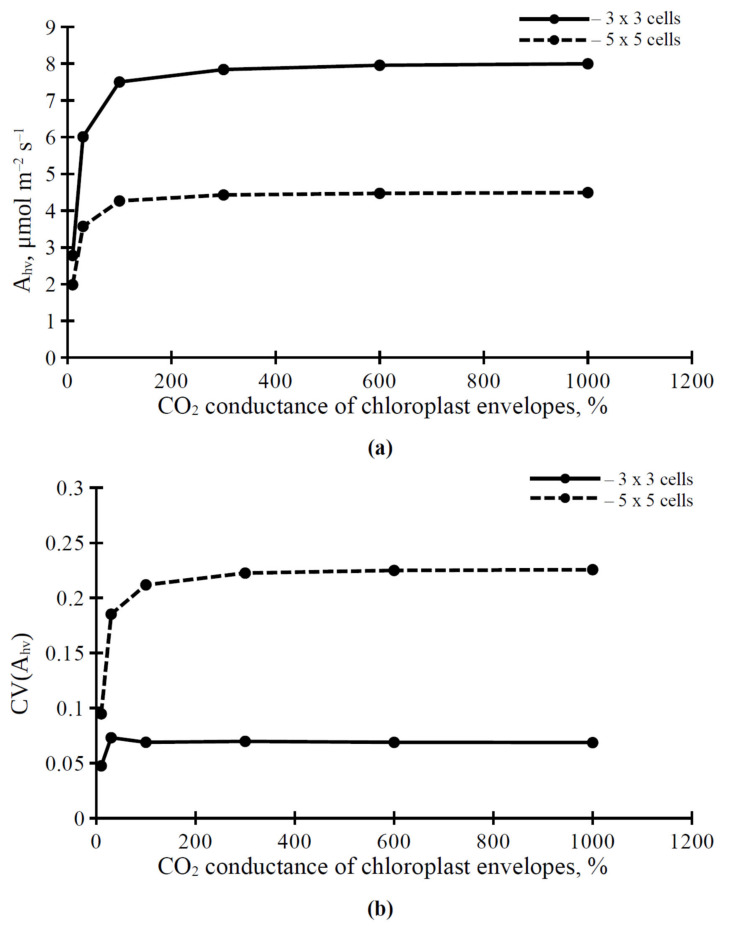
Photosynthesis is an important process in plants which influences their development and productivity. Many factors can control the efficiency of photosynthesis, including CO conductance of leaf mesophyll, which affects the CO availability for Rubisco. It is known that electrical stress signals can decrease this conductance, and the response is probably caused by inactivation of H-ATPase in the plasma membrane. In the current work, we analyzed the influence of both CO conductance in the plasma membrane, and chloroplast envelopes and H-ATPase activity on photosynthetic CO assimilation, using a two-dimensional mathematical model of photosynthesis in leaves. The model included a description of assimilation on the basis of the Farquhar-von Caemmerer-Berry model, ion transport through the plasma membrane, diffusion of CO in the apoplast, and transport of CO through the plasma membrane and chloroplast envelope. The model showed that the photosynthetic CO assimilation rate was mainly dependent on the plasma membrane and chloroplast envelope conductance; direct influence of the H-ATPase activity (through changes in pH and CO/HCO concentration ratio) on this rate was weak. In contrast, both changes in CO conductance of the plasma membrane and chloroplast envelopes and changes in the H-ATPase activity influenced spatial heterogeneity of the CO assimilation on the leaf surface in the simulated two-dimensional system. These effects were also observed under simultaneous changes in the CO conductance of the plasma membrane and H-ATPase activity. Qualitatively similar influence of changes in the CO conductance of the plasma membrane and chloroplast envelopes, and changes in the H-ATPase activity on photosynthesis were shown for two different densities of stomata in the simulated leaf; however, lowering the density of stomata decreased the assimilation rate and increased the heterogeneity of assimilation. The results of the model analysis clarify the potential influence of H-ATPase inactivation on photosynthesis, and can be the basis for development of new methods for remote sensing of the influence of electrical signals.
光合作用是植物体内的一个重要过程,它影响着植物的生长发育和生产力。许多因素可以控制光合作用的效率,包括叶肉细胞的CO2传导率,这会影响Rubisco酶可利用的CO2量。已知电应激信号会降低这种传导率,这种反应可能是由质膜上H+-ATP酶的失活引起的。在当前的工作中,我们使用叶片光合作用的二维数学模型,分析了质膜、叶绿体被膜的CO2传导率以及H+-ATP酶活性对光合CO2同化的影响。该模型包括基于Farquhar-von Caemmerer-Berry模型的同化描述、离子通过质膜的运输、CO2在质外体中的扩散以及CO2通过质膜和叶绿体被膜的运输。模型表明,光合CO2同化率主要取决于质膜和叶绿体被膜的传导率;H+-ATP酶活性(通过pH值和CO2/HCO3-浓度比的变化)对该速率的直接影响较弱。相反,质膜和叶绿体被膜的CO2传导率变化以及H+-ATP酶活性变化,都会影响模拟二维系统中叶表面CO2同化的空间异质性。在质膜CO2传导率和H+-ATP酶活性同时变化的情况下,也观察到了这些效应。对于模拟叶片中两种不同气孔密度,质膜和叶绿体被膜的CO2传导率变化以及H+-ATP酶活性变化对光合作用具有定性相似的影响;然而,降低气孔密度会降低同化率并增加同化的异质性。模型分析结果阐明了H+-ATP酶失活对光合作用的潜在影响,可为开发电信号影响的遥感新方法奠定基础。