Key Laboratory of Animal Models and Human Disease Mechanisms of the Chinese Academy of Sciences and Yunnan Province, Kunming Institute of Zoology, Chinese Academy of Sciences, Kunming, 650201, China.
Kunming College of Life Sciences, University of the Chinese Academy of Sciences, Kunming, 650204, China.
Adv Sci (Weinh). 2023 Feb;10(5):e2203884. doi: 10.1002/advs.202203884. Epub 2022 Dec 23.
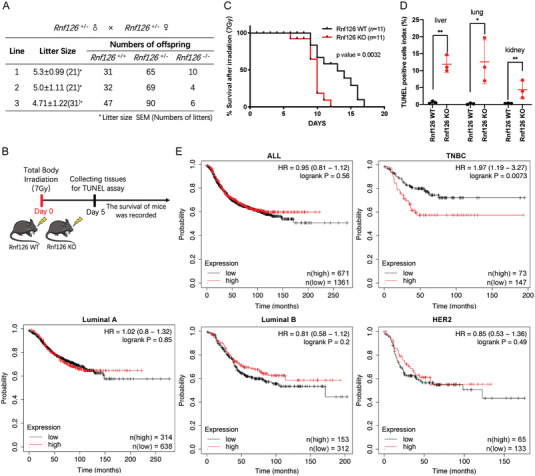
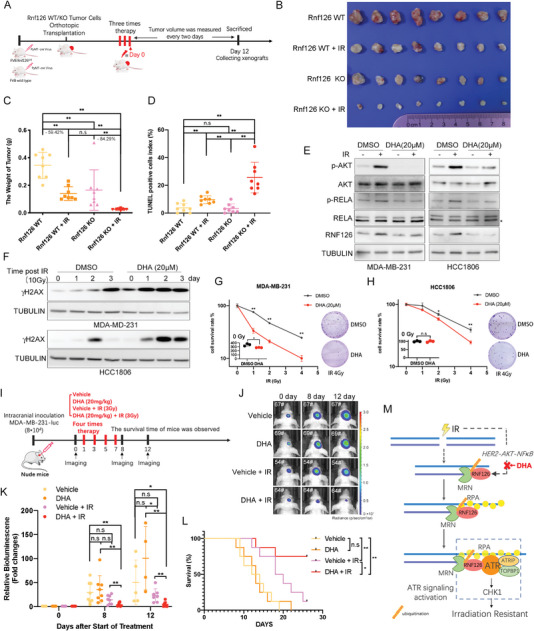
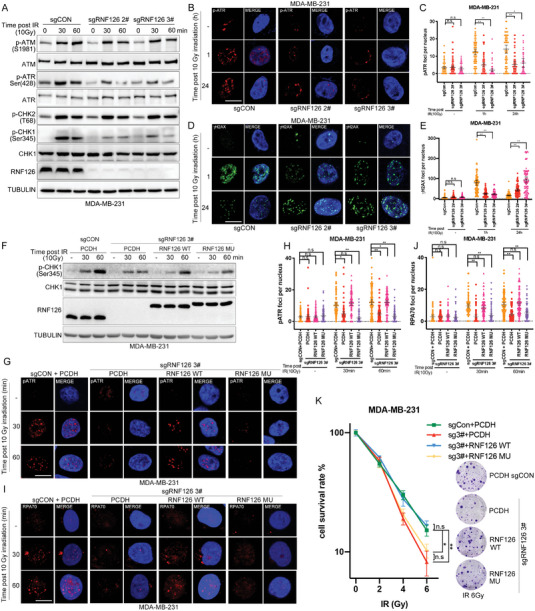
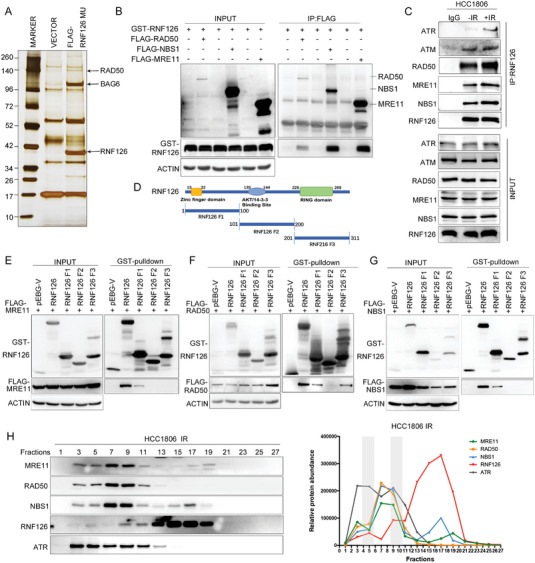
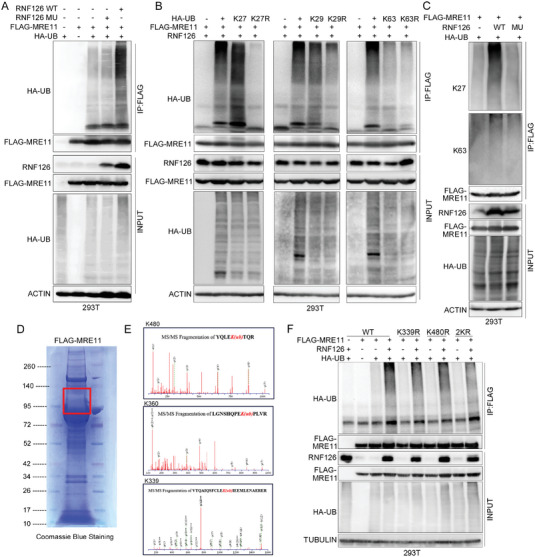
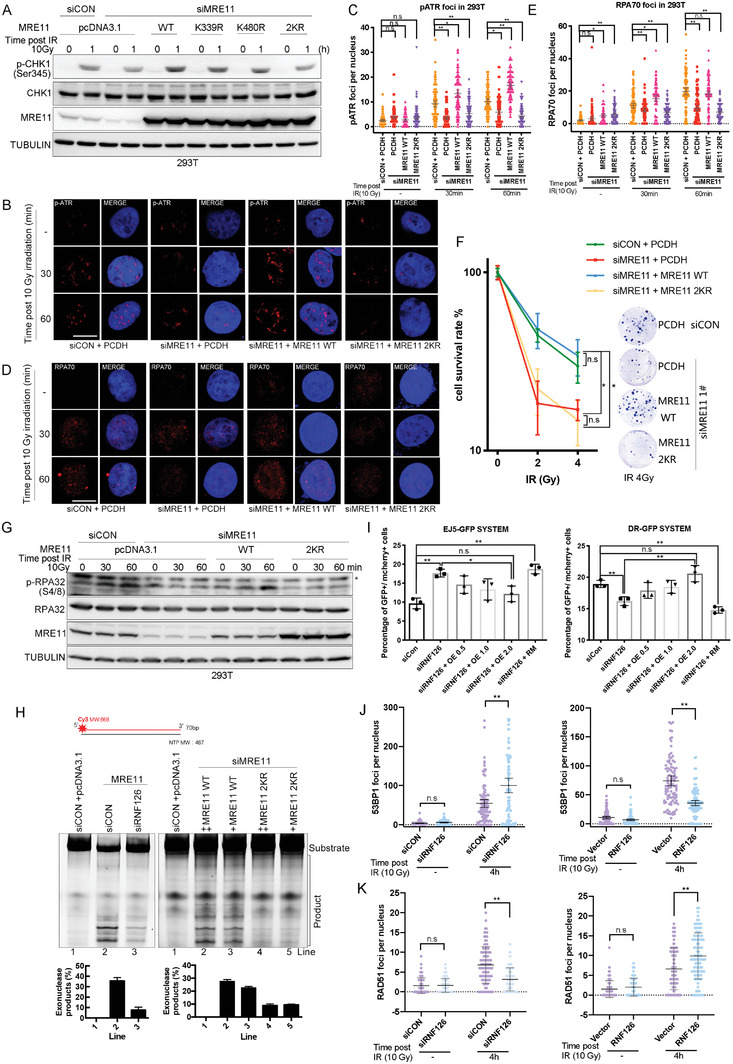
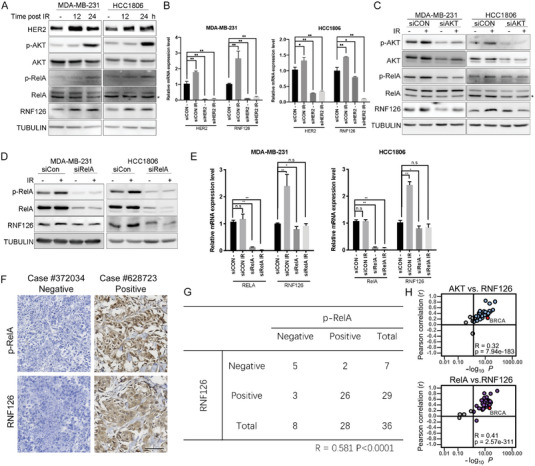
Triple-negative breast cancer (TNBC) has higher molecular heterogeneity and metastatic potential and the poorest prognosis. Because of limited therapeutics against TNBC, irradiation (IR) therapy is still a common treatment option for patients with lymph nodes or brain metastasis. Thus, it is urgent to develop strategies to enhance the sensitivity of TNBC tumors to low-dose IR. Here, the authors report that E3 ubiquitin ligase Ring finger protein 126 (RNF126) is important for IR-induced ATR-CHK1 pathway activation to enhance DNA damage repair (DDR). Mechanistically, RNF126 physically associates with the MRE11-RAD50-NBS1 (MRN) complex and ubiquitinates MRE11 at K339 and K480 to increase its DNA exonuclease activity, subsequent RPA binding, and ATR phosphorylation, promoting sustained DDR in a homologous recombination repair-prone manner. Accordingly, depletion of RNF126 leads to increased genomic instability and radiation sensitivity in both TNBC cells and mice. Furthermore, it is found that RNF126 expression is induced by IR activating the HER2-AKT-NF-κB pathway and targeting RNF126 expression with dihydroartemisinin significantly improves the sensitivity of TNBC tumors in the brain to IR treatment in vivo. Together, these results reveal that RNF126-mediated MRE11 ubiquitination is a critical regulator of the DDR, which provides a promising target for improving the sensitivity of TNBC to radiotherapy.
三阴性乳腺癌(TNBC)具有更高的分子异质性和转移潜能,预后最差。由于针对 TNBC 的治疗方法有限,放疗(IR)仍然是淋巴结或脑转移患者的常见治疗选择。因此,迫切需要开发策略来提高 TNBC 肿瘤对低剂量 IR 的敏感性。在这里,作者报告 E3 泛素连接酶环指蛋白 126(RNF126)对于 IR 诱导的 ATR-CHK1 通路激活以增强 DNA 损伤修复(DDR)很重要。在机制上,RNF126 与 MRE11-RAD50-NBS1(MRN)复合物物理结合,并在 K339 和 K480 上泛素化 MRE11,以增加其 DNA 外切酶活性,随后 RPA 结合和 ATR 磷酸化,以同源重组修复倾向的方式促进持续的 DDR。因此,在 TNBC 细胞和小鼠中,RNF126 的缺失会导致基因组不稳定性增加和辐射敏感性增加。此外,研究发现,IR 通过激活 HER2-AKT-NF-κB 通路诱导 RNF126 表达,并使用青蒿琥酯靶向 RNF126 表达,显著提高了体内 TNBC 肿瘤对脑 IR 治疗的敏感性。总之,这些结果表明,RNF126 介导的 MRE11 泛素化是 DDR 的关键调节剂,为提高 TNBC 对放疗的敏感性提供了有希望的靶标。