Brønnvik Hester, Safi Kamran, Vansteelant Wouter M G, Byholm Patrik, Nourani Elham
Department of Migration, Max Planck Institute of Animal Behavior, Radolfzell 78315, Germany.
Department of Biology, University of Konstanz, Konstanz 78464, Germany.
R Soc Open Sci. 2022 Dec 21;9(12):220746. doi: 10.1098/rsos.220746. eCollection 2022 Dec.
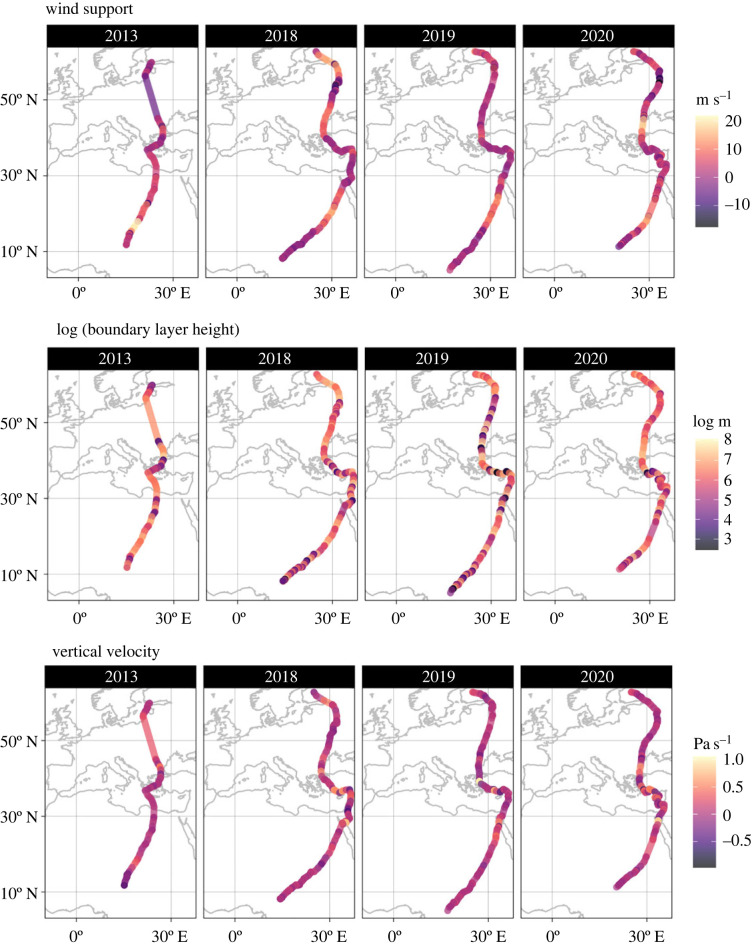
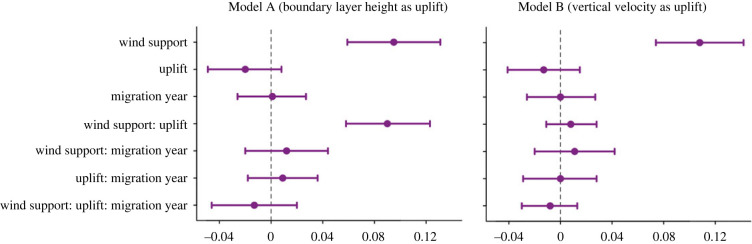
Migration is a complex behaviour that is costly in terms of time, energy and risk of mortality. Thermal soaring birds rely on airflow, specifically wind support and uplift, to offset their energetic costs of flight. Their migratory routes are a record of movement decisions to negotiate the atmospheric environment and achieve efficiency. We expected that, regardless of age, birds use wind support to select their routes. Because thermal soaring is a complex flight behaviour that young birds need to learn, we expected that, as individuals gain more experience, their movement decisions will also increasingly favour the best thermal uplift conditions. We quantified how route choice during autumn migration of young European honey buzzards () was adjusted to wind support and uplift over up to 4 years of migration and compared this with the choices of adult birds. We found that wind support was important in all migrations. However, we did not find an increase in the use of thermal uplifts. This could be due to the species-specific learning period and/or an artefact of the spatio-temporal scale of our uplift proxies.
迁徙是一种复杂的行为,在时间、能量和死亡风险方面代价高昂。利用热气流翱翔的鸟类依靠气流,特别是风力支持和上升气流,来抵消飞行的能量消耗。它们的迁徙路线记录了为应对大气环境并实现高效飞行而做出的移动决策。我们预计,无论年龄大小,鸟类都会利用风力支持来选择路线。由于利用热气流翱翔是一种年轻鸟类需要学习的复杂飞行行为,我们预计,随着个体获得更多经验,它们的移动决策也将越来越倾向于最佳的热上升气流条件。我们量化了欧洲蜂鹰幼鸟在长达4年的秋季迁徙过程中,其路线选择是如何根据风力支持和上升气流进行调整的,并将其与成年鸟类的选择进行了比较。我们发现,风力支持在所有迁徙过程中都很重要。然而,我们并未发现对热上升气流的利用有所增加。这可能是由于特定物种的学习期和/或我们用于衡量上升气流的代理指标在时空尺度上的局限性所致。