Department of Migration, Max Planck Institute of Animal Behavior, Germany.
Department of Biology, University of Konstanz, Germany.
Proc Biol Sci. 2021 Sep 8;288(1958):20211603. doi: 10.1098/rspb.2021.1603.
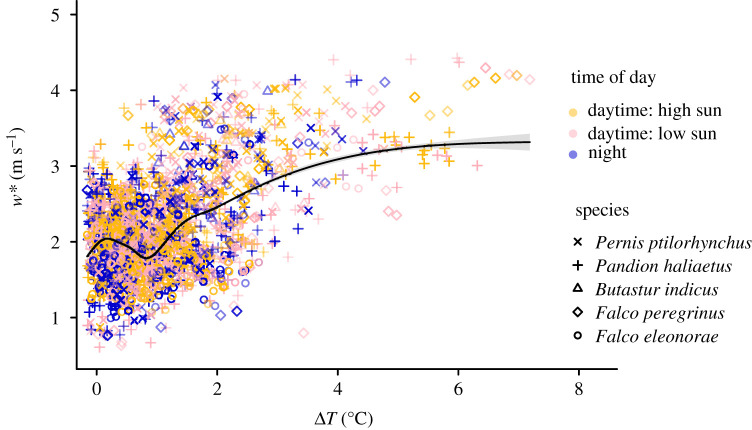
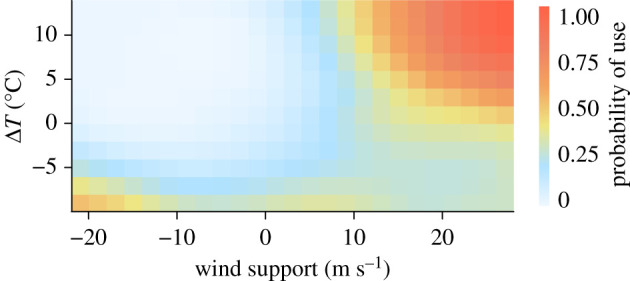
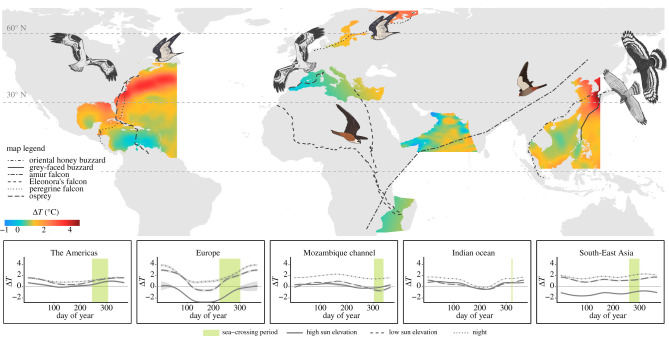
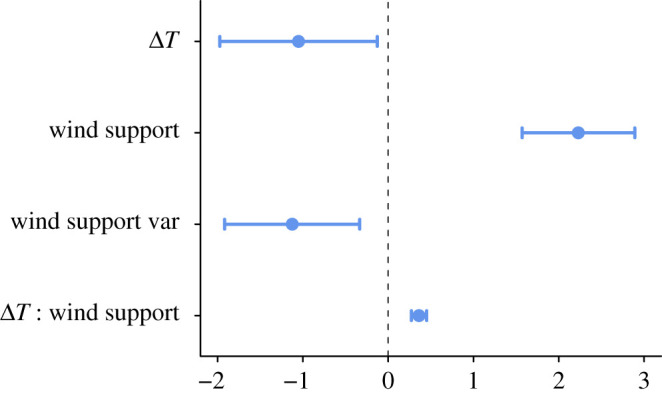
Flying over the open sea is energetically costly for terrestrial birds. Despite this, over-water journeys of many birds, sometimes hundreds of kilometres long, are uncovered by bio-logging technology. To understand how these birds afford their flights over the open sea, we investigated the role of atmospheric conditions, specifically wind and uplift, in subsidizing over-water flight at a global scale. We first established that Δ, the temperature difference between sea surface and air, is a meaningful proxy for uplift over water. Using this proxy, we showed that the spatio-temporal patterns of sea-crossing in terrestrial migratory birds are associated with favourable uplift conditions. We then analysed route selection over the open sea for five facultative soaring species, representative of all major migratory flyways. The birds maximized wind support when selecting their sea-crossing routes and selected greater uplift when suitable wind support was available. They also preferred routes with low long-term uncertainty in wind conditions. Our findings suggest that, in addition to wind, uplift may play a key role in the energy seascape for bird migration that in turn determines strategies and associated costs for birds crossing ecological barriers such as the open sea.
对于陆生鸟类来说,飞越开阔海域在能量上是非常耗费体力的。尽管如此,生物遥测技术还是发现了许多鸟类的跨海旅程,其中有些长达数百公里。为了了解这些鸟类如何负担得起在开阔海域的飞行,我们研究了大气条件,特别是风和上升气流,在全球范围内对跨海飞行的支持作用。我们首先确定,海面和空气之间的温度差Δ是衡量水上上升气流的一个有意义的指标。利用这个指标,我们表明,陆生候鸟的跨海迁徙时空模式与有利的上升气流条件有关。然后,我们分析了五种有选择翱翔能力的候鸟在开阔海域的选路行为,这些候鸟代表了所有主要的迁徙飞行路线。鸟类在选择跨海路线时最大限度地利用了风的支持,而在有合适的风支持时则选择了更大的上升气流。它们还更喜欢风况长期不确定性低的路线。我们的研究结果表明,除了风之外,上升气流可能在鸟类迁徙的能量景观中发挥关键作用,进而决定了鸟类穿越开阔海洋等生态障碍的策略和相关成本。