Lopez-Ridaura Santiago, Sanders Arie, Barba-Escoto Luis, Wiegel Jennifer, Mayorga-Cortes Maria, Gonzalez-Esquivel Carlos, Lopez-Ramirez Martin A, Escoto-Masis Rene M, Morales-Galindo Edmundo, García-Barcena Tomas S
Sustainable Intensification Program (SIP) International Maize and Wheat Improvement Center (CIMMYT), Mexico.
Zamorano University, Honduras.
Agric Syst. 2021 Aug;192:103178. doi: 10.1016/j.agsy.2021.103178. Epub 2021 May 18.
The COVID-19 pandemic has affected all sectors and human activities around the World.
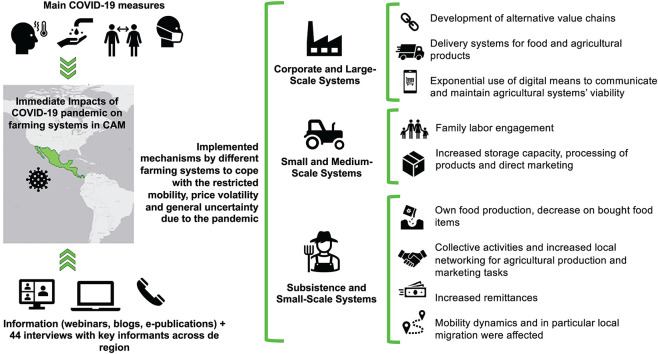
In this article we present a first attempt to understand the immediate impact of COVID-19 and the sanitary measures taken by governments on farming systems in Central America and Mexico (CAM).
Through a review of information generated in these initial months of the COVID-19 pandemic (webinars, blogs, electronic publications, media) and 44 interviews with key informants across the region, we have identified the main impacts felt by different types of farming systems in the region.
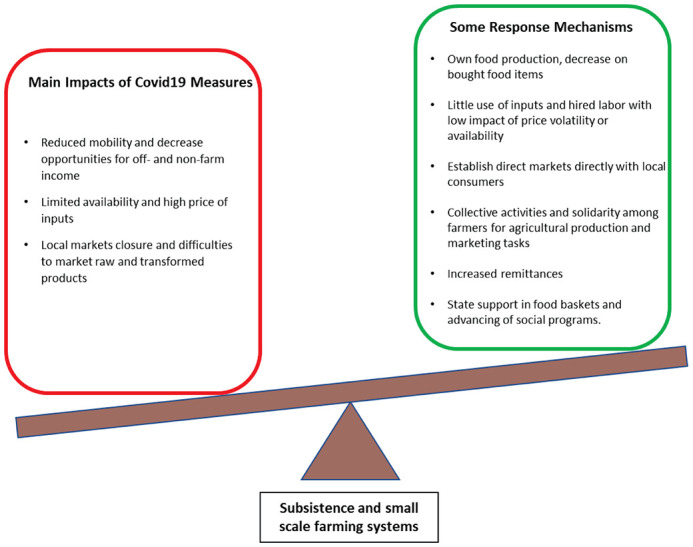
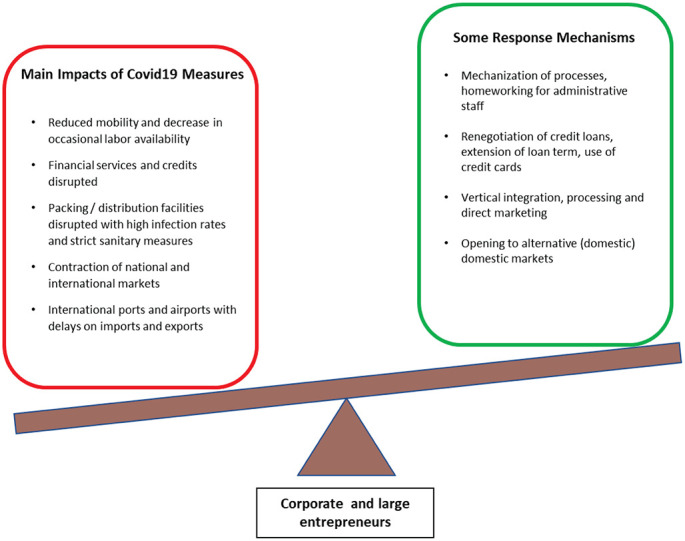
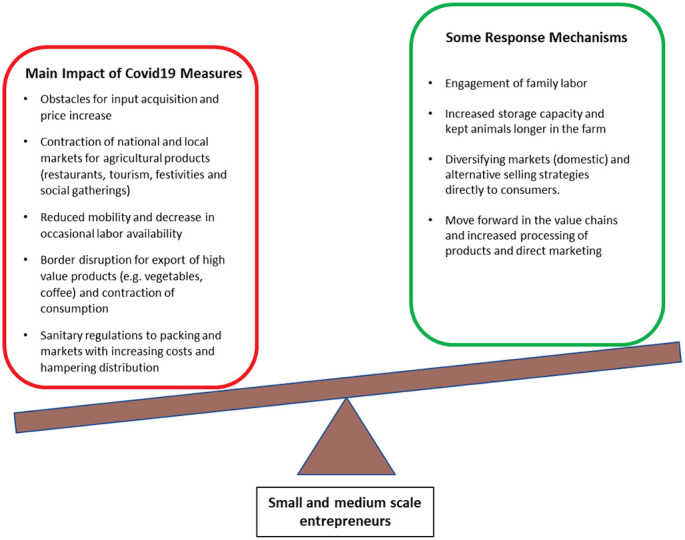
From corporate agricultural production systems, to small and medium scale entrepreneurs and smallholder subsistence farm households, all types of farming systems were impacted, more or less severely, by the different measures implemented by governments such as reduced mobility, closure of public and private venues and restrictions in borders. Larger corporate farming systems with vertical market integration and high level of control or coordination within the supply chain, and smallholder or subsistence farming systems with important focus on production for self-consumption and little external input use, were both relatively less impacted and showed greater adaptive capacity than the medium and small entrepreneurial farming systems dependent on agriculture as their primary income and with less control over the upstream and downstream parts of their supply chain. All types of farming systems implemented a series of mechanisms to cope with the COVID-19 pandemic including the development of alternative value chains, food and agricultural products delivery systems and the exponential use of digital means to communicate and maintain the viability of the different agricultural systems. Collective action and organization of farmers also proved to be an important coping mechanism that allowed some farmers to acquire inputs and deliver outputs in the context of restricted mobility, price volatility, and general uncertainty. Some features of the CAM region played an important role in mediating the impact of COVID-19 and associated sanitary measures. We identify as particularly relevant the nature of agricultural exports, the current structure of the agricultural sector, the diversified livelihood strategies of rural households, and the importance of mobility for rural livelihoods.
The results presented focus only in the immediate effect of COVID-19 pandemic and the mechanisms implemented by farmers in the first months. Whether these impacts and response mechanisms will result in a transformation of the farming systems towards greater resilience and sustainability is still an open question.
新冠疫情影响了全球所有部门和人类活动。
在本文中,我们首次尝试了解新冠疫情及其引发的政府卫生措施对中美洲和墨西哥(CAM)农业系统的直接影响。
通过回顾新冠疫情最初几个月产生的信息(网络研讨会、博客、电子出版物、媒体)以及对该地区44位关键信息提供者的访谈,我们确定了该地区不同类型农业系统所感受到的主要影响。
从企业农业生产系统到中小型企业家以及小农自给农户,所有类型的农业系统都或多或少受到了政府实施的不同措施的严重影响,这些措施包括行动受限、公共和私人场所关闭以及边境限制。具有垂直市场整合且供应链内控制或协调水平较高的大型企业农业系统,以及主要侧重于自给自足生产且很少使用外部投入的小农或自给农业系统,相比依赖农业作为主要收入且对供应链上下游控制较少的中小型创业农业系统,受到的影响相对较小,且表现出更强的适应能力。所有类型的农业系统都实施了一系列应对新冠疫情的机制,包括发展替代价值链、食品和农产品配送系统,以及大量使用数字手段进行沟通并维持不同农业系统的活力。农民的集体行动和组织也被证明是一种重要的应对机制,使一些农民能够在行动受限、价格波动和普遍不确定性的情况下获取投入并交付产出。CAM地区的一些特征在调节新冠疫情及其相关卫生措施的影响方面发挥了重要作用。我们认为特别相关的是农产品出口的性质、农业部门的当前结构、农村家庭多样化的生计策略以及流动性对农村生计的重要性。
所呈现的结果仅关注新冠疫情的直接影响以及农民在最初几个月实施的机制。这些影响和应对机制是否会导致农业系统朝着更强的恢复力和可持续性转变仍是一个悬而未决的问题。