Mello Júlio B, Pedretti Augusto, Bergmann Gabriel G, Gaya Anelise R, Ubago-Guisado Esther, Gaya Adroaldo C A
EFiDac Group, Physical Education School, Pontificia Universidad Católica de Valparaíso, Valparaíso, Chile.
PROESP-Br Group, Universidade Federal do Rio Grande do Sul, Post Graduate Program in Human Movement Science, Porto Alegre, Brazil.
Front Physiol. 2022 Dec 8;13:1066462. doi: 10.3389/fphys.2022.1066462. eCollection 2022.
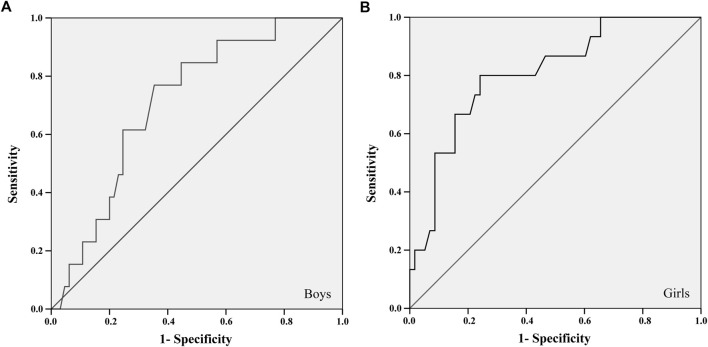
The possibility of carrying out screening, with acceptable accuracy, of a child's bone mass status based on a physical fitness test can advance the concept of health-related physical fitness. In addition, the relevance of the applicability of this type of screening in educational environments is mainly due to the difficulty of direct assessments of bone health indicators. This study aimed to propose cut-off points for physical fitness tests based on children's bone health indicators. This is a two-phase cross-sectional study. Phase-1: 160 children (6-11 years-old) performed the 20-m sprint test (20-mST) and the 2 kg medicine ball throw test (2 kgMBTT). Areal bone mineral density (aBMD) and content was assessed by DXA. The area under the ROC curve greater than 70% was considered valid. Phase-2: It was carried out a secondary analysis in a sample with 8,750 Brazilians (6-11 years-old). The percentile values (identified in phase-1) were used to identify the values of the cut-off points in the unit of measurement of the tests. The validation of the cut-off points found was by odds ratio values and ≤ 0.05. Phase 1: The areas under the ROC curve were 0.710, 0.712 (boys and girls-20-mST), 0.703, and 0.806 (boys and girls-2 kgMBTT) with total spine and pelvis aBMD as the outcome. Phase 2: From percentile values, we find valid cut-off points in the Brazilian sample (OR > 3.00; < 0.001) for boys and girls. Values ranged between 5.22 s-4.00 s to 20-mST and between 125.0 cm-160.0 cm to 2 kgMBTT. Conclusion. The 20-mST and the 2 kgMBTT presented sufficient accuracy for the screening of children aged between 6 and 11 years with greater chances of having low aBMD in the total spine and pelvis, with valid cut-off points.
基于体能测试以可接受的准确度筛查儿童骨量状况的可能性,可以推进与健康相关的体能概念。此外,这类筛查在教育环境中适用性的相关性主要源于直接评估骨骼健康指标的困难。本研究旨在根据儿童骨骼健康指标提出体能测试的切点。这是一项两阶段的横断面研究。第一阶段:160名儿童(6至11岁)进行了20米短跑测试(20-mST)和2千克药球投掷测试(2 kgMBTT)。通过双能X线吸收法(DXA)评估面积骨密度(aBMD)和骨量。ROC曲线下面积大于70%被认为是有效的。第二阶段:对8750名巴西人(6至11岁)的样本进行了二次分析。(在第一阶段确定的)百分位数用于确定测试测量单位中的切点值。所发现切点的验证采用比值比,且≤0.05。第一阶段:以全脊柱和骨盆aBMD为结果时,ROC曲线下面积分别为0.710、0.712(男孩和女孩 - 20-mST)、0.703和0.806(男孩和女孩 - 2 kgMBTT)。第二阶段:根据百分位数,我们在巴西样本中找到了男孩和女孩的有效切点(OR > 3.00;< 0.001)。20-mST的值在5.22秒至4.00秒之间,2 kgMBTT的值在125.0厘米至160.0厘米之间。结论。20-mST和2 kgMBTT在筛查6至11岁、全脊柱和骨盆aBMD较低可能性较大的儿童时具有足够的准确性,且有有效的切点。