Department of Surgery, Washington University School of Medicine, St. Louis, MO, United States.
Department of Medicine, Washington University School of Medicine, St. Louis, MO, United States.
Front Immunol. 2022 Dec 8;13:1039226. doi: 10.3389/fimmu.2022.1039226. eCollection 2022.
Cancer neoantigens are important targets of cancer immunotherapy and neoantigen vaccines are currently in development in pancreatic ductal adenocarcinoma (PDAC) and other cancer types. Immune regulatory mechanisms in pancreatic cancer may limit the efficacy of neoantigen vaccines. Targeting immune checkpoint signaling pathways in PDAC may improve the efficacy of neoantigen vaccines.
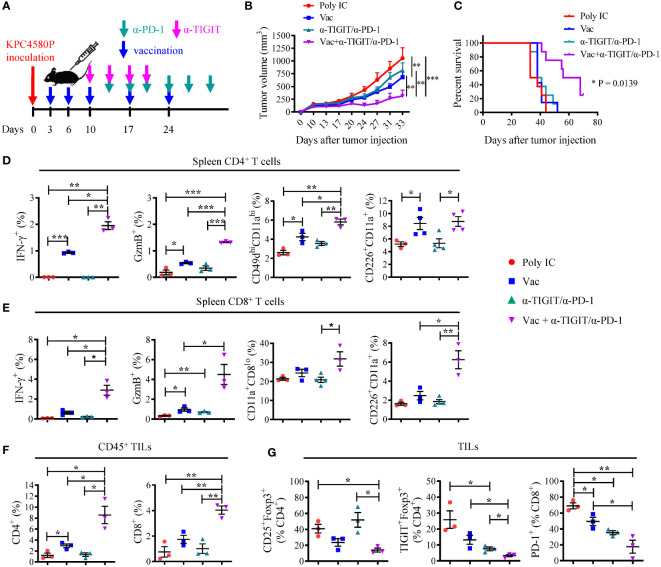
We used KPC4580P, an established model of PDAC, to test whether neoantigen vaccines can generate therapeutic efficacy against PDAC. We focused on two immunogenic neoantigens associated with genetic alterations in the CAR12 and CDK12 genes. We tested a neoantigen vaccine comprised of two 20-mer synthetic long peptides and poly IC, a Toll-like receptor (TLR) agonist. We investigated the ability of neoantigen vaccine alone, or in combination with PD-1 and TIGIT signaling blockade to impact tumor growth. We also assessed the impact of TIGIT signaling on T cell responses in human PDAC.
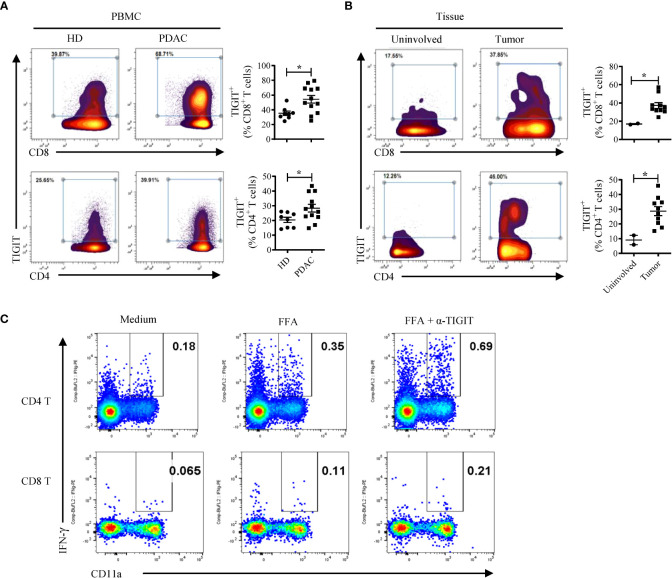
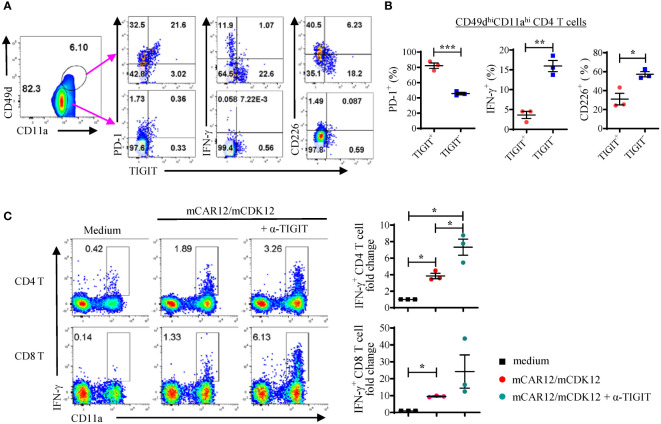
Neoantigen vaccines induce neoantigen-specific T cell responses in tumor-bearing mice and slow KPC4580P tumor growth. However, KPC4580P tumors express high levels of PD-L1 and the TIGIT ligand, CD155. A subset of neoantigen-specific T cells in KPC4580P tumors are dysfunctional, and express high levels of TIGIT. PD-1 and TIGIT signaling blockade reverses T cell dysfunction and enhances neoantigen vaccine-induced T cell responses and tumor regression. In human translational studies, TIGIT signaling blockade enhances neoantigen-specific T cell function following vaccination.
Taken together, preclinical and human translational studies support testing neoantigen vaccines in combination with therapies targeting the PD-1 and TIGIT signaling pathways in patients with PDAC.
癌症新生抗原是癌症免疫治疗的重要靶点,目前正在开发用于胰腺导管腺癌(PDAC)和其他癌症类型的新生抗原疫苗。胰腺癌中的免疫调节机制可能会限制新生抗原疫苗的疗效。针对 PDAC 中的免疫检查点信号通路可能会提高新生抗原疫苗的疗效。
我们使用 KPC4580P,一种已建立的 PDAC 模型,来测试新生抗原疫苗是否可以针对 PDAC 产生治疗效果。我们专注于与 CAR12 和 CDK12 基因遗传改变相关的两种免疫原性新生抗原。我们测试了一种由两种 20 个氨基酸的合成长肽和 Poly IC(一种 Toll 样受体(TLR)激动剂)组成的新生抗原疫苗。我们研究了单独使用新生抗原疫苗或与 PD-1 和 TIGIT 信号阻断联合使用对肿瘤生长的影响。我们还评估了 TIGIT 信号对人 PDAC 中 T 细胞反应的影响。
新生抗原疫苗可在荷瘤小鼠中诱导新生抗原特异性 T 细胞反应,并减缓 KPC4580P 肿瘤的生长。然而,KPC4580P 肿瘤表达高水平的 PD-L1 和 TIGIT 配体 CD155。KPC4580P 肿瘤中的一部分新生抗原特异性 T 细胞功能失调,并表达高水平的 TIGIT。PD-1 和 TIGIT 信号阻断可逆转 T 细胞功能障碍,增强新生抗原疫苗诱导的 T 细胞反应和肿瘤消退。在人类转化研究中,TIGIT 信号阻断可增强疫苗接种后新生抗原特异性 T 细胞的功能。
综上所述,临床前和人类转化研究支持在 PDAC 患者中测试与 PD-1 和 TIGIT 信号通路靶向治疗联合使用的新生抗原疫苗。