Duan Wenqi, Zhi Hui, Keefe Daniel W, Gao Bingtao, LeFevre Gregory H, Toor Fatima
Department of Electrical and Computer Engineering, University of Iowa, 205 North Madison Street, Iowa City, Iowa 52242, United States.
Iowa Technology Institute, University of Iowa, 330 South Madison Street, Iowa City, Iowa 52242, United States.
ACS Omega. 2022 Dec 6;7(50):47341-47348. doi: 10.1021/acsomega.1c00210. eCollection 2022 Dec 20.
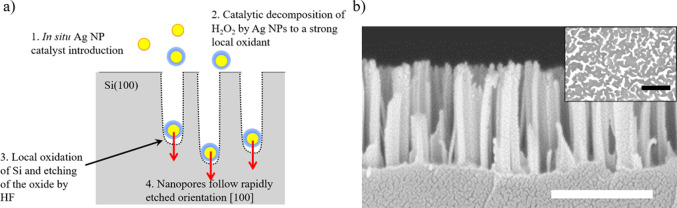
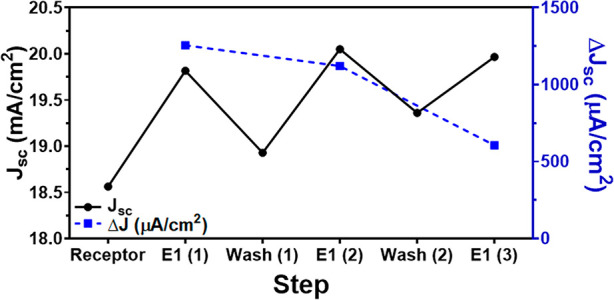
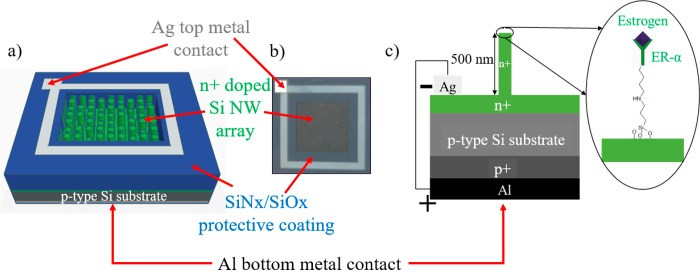
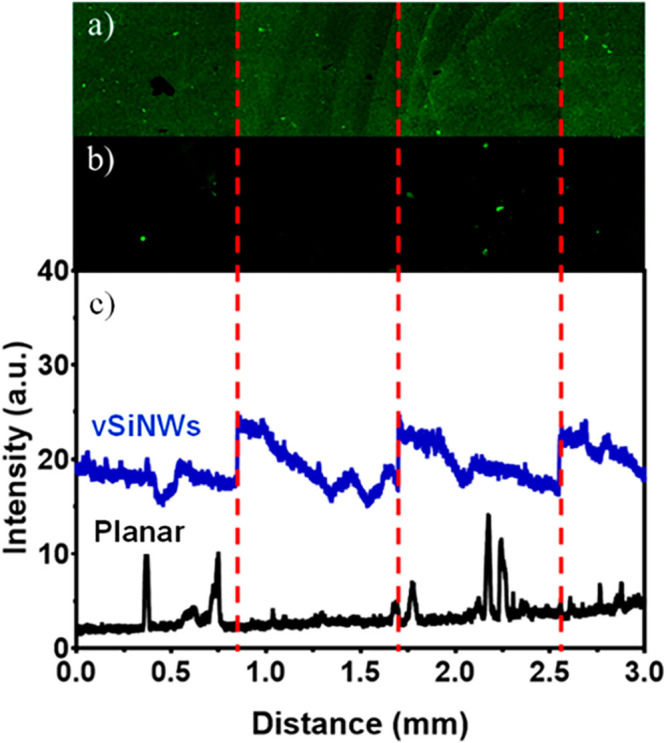
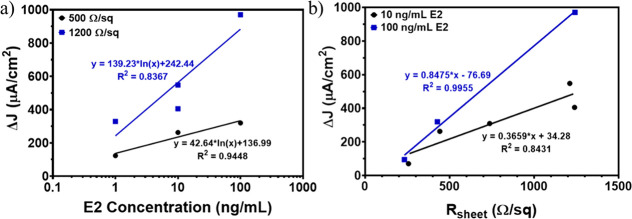
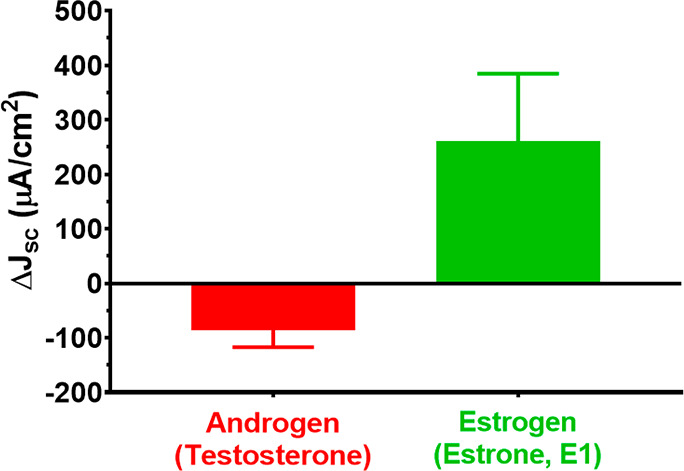
Estrogens and estrogen-mimicking compounds in the aquatic environment are known to cause negative impacts to both ecosystems and human health. In this initial proof-of-principle study, we developed a novel vertically oriented silicon nanowire (vSiNW) array-based biosensor for low-cost, highly sensitive and selective detection of estrogens. The vSiNW arrays were formed using an inexpensive and scalable metal-assisted chemical etching (MACE) process. A vSiNW array-based p-n junction diode (vSiNW-diode) transducer design for the biosensor was used and functionalized via 3-aminopropyltriethoxysilane (APTES)-based silane chemistry to bond estrogen receptor-alpha (ER-α) to the surface of the vSiNWs. Following receptor conjugation, the biosensors were exposed to increasing concentrations of estradiol (E2), resulting in a well-calibrated sensor response ( ≥ 0.84, 1-100 ng/mL concentration range). Fluorescence measurements quantified the distribution of estrogen receptors across the vSiNW array compared to planar Si, indicating an average of 7 times higher receptor presence on the vSiNW array surface. We tested the biosensor's target selectivity by comparing it to another estrogen (estrone [E1]) and an androgen (testosterone), where we measured a high positive electrical biosensor response after E1 exposure and a minimal response after testosterone. The regeneration capacity of the biosensor was tested following three successive rinses with phosphate buffer solution (PBS) between hormone exposure. Traditional horizontally oriented Si NW field effect transistor (hSiNW-FET)-based biosensors report electrical current changes at the nanoampere (nA) level that require bulky and expensive measurement equipment making them unsuitable for field measurements, whereas the reported vSiNW-diode biosensor exhibits current changes in the microampere (μA) range, demonstrating up to 100-fold electrical signal amplification, thus enabling sensor signal measurement using inexpensive electronics. The highly sensitive and specific vSiNW-diode biosensor developed here will enable the creation of low-cost, portable, field-deployable biosensors that can detect estrogenic compounds in waterways in real-time.
已知水生环境中的雌激素和雌激素模拟化合物会对生态系统和人类健康产生负面影响。在这项初步的原理验证研究中,我们开发了一种基于新型垂直取向硅纳米线(vSiNW)阵列的生物传感器,用于低成本、高灵敏度和高选择性地检测雌激素。vSiNW阵列是使用廉价且可扩展的金属辅助化学蚀刻(MACE)工艺形成的。该生物传感器采用基于vSiNW阵列的p-n结二极管(vSiNW-二极管)换能器设计,并通过基于3-氨丙基三乙氧基硅烷(APTES)的硅烷化学进行功能化,以将雌激素受体α(ER-α)结合到vSiNW的表面。受体偶联后,将生物传感器暴露于浓度不断增加的雌二醇(E2)中,从而产生校准良好的传感器响应(浓度范围为1-100 ng/mL时,≥0.84)。荧光测量定量了与平面硅相比雌激素受体在vSiNW阵列上的分布,表明vSiNW阵列表面上受体的存在平均高出7倍。我们通过将生物传感器与另一种雌激素(雌酮[E1])和一种雄激素(睾酮)进行比较来测试其目标选择性,其中我们在E1暴露后测量到高的正电生物传感器响应,而在睾酮暴露后测量到最小响应。在激素暴露之间用磷酸盐缓冲溶液(PBS)连续冲洗三次后,测试了生物传感器的再生能力。传统的基于水平取向硅纳米线场效应晶体管(hSiNW-FET)的生物传感器报告的电流变化处于纳安(nA)水平,这需要庞大且昂贵的测量设备,使其不适合现场测量,而报道的vSiNW-二极管生物传感器表现出微安(μA)范围内的电流变化,证明了高达100倍的电信号放大,从而能够使用廉价的电子设备进行传感器信号测量。这里开发的高灵敏度和特异性的vSiNW-二极管生物传感器将能够创建低成本、便携式、可现场部署的生物传感器,可实时检测水道中的雌激素化合物。