Shan Dan, Li Shaoyang, Xu Ruichen, Nie Glen, Xie Yangyiran, Han Junchu, Gao Xiaoyi, Zheng Yuandian, Xu Zhen, Dai Zhihao
Department of Biobehavioral Sciences, Columbia University, New York, NY, United States.
Faculty of Science, The Hong Kong Polytechnic University, Kowloon, Hong Kong SAR, China.
Front Aging Neurosci. 2022 Dec 9;14:1077384. doi: 10.3389/fnagi.2022.1077384. eCollection 2022.
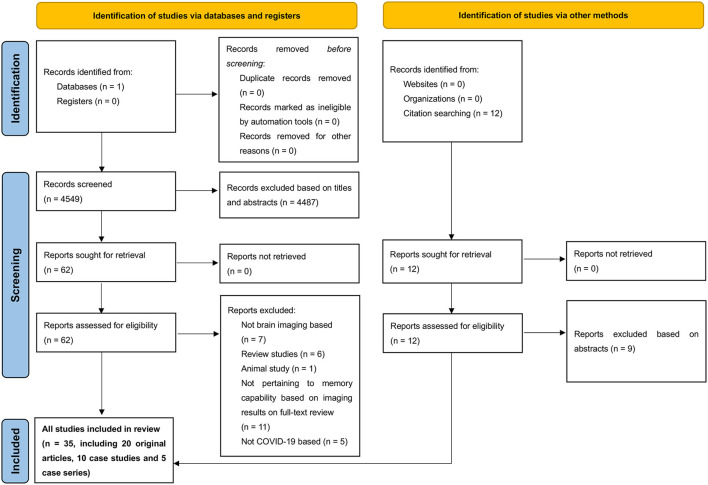
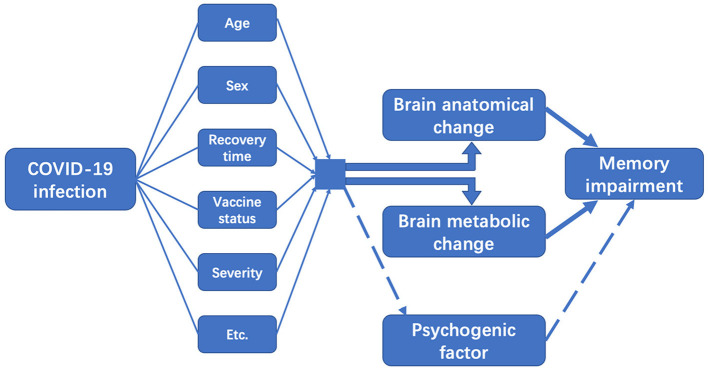
Many people with coronavirus disease 2019 (COVID-19) report varying degrees of memory impairment. Neuroimaging techniques such as MRI and PET have been utilized to shed light on how COVID-19 affects brain function in humans, including memory dysfunction. In this PRISMA-based systematic review, we compared and summarized the current literature looking at the relationship between COVID-19-induced neuropathological changes by neuroimaging scans and memory symptoms experienced by patients who recovered from COVID-19. Overall, this review suggests a correlational trend between structural abnormalities (e.g., cortical atrophy and white matter hyperintensities) or functional abnormalities (e.g., hypometabolism) in a wide range of brain regions (particularly in the frontal, parietal and temporal regions) and memory impairments in COVID-19 survivors, although a causal relationship between them remains elusive in the absence of sufficient caution. Further longitudinal investigations, particularly controlled studies combined with correlational analyses, are needed to provide additional evidence.
许多2019冠状病毒病(COVID-19)患者报告有不同程度的记忆障碍。MRI和PET等神经影像学技术已被用于阐明COVID-19如何影响人类大脑功能,包括记忆功能障碍。在这项基于PRISMA的系统评价中,我们比较并总结了当前关于通过神经影像学扫描观察到的COVID-19诱发的神经病理变化与从COVID-19中康复的患者所经历的记忆症状之间关系的文献。总体而言,本评价表明,广泛脑区(特别是额叶、顶叶和颞叶区域)的结构异常(如皮质萎缩和白质高信号)或功能异常(如代谢减低)与COVID-19幸存者的记忆障碍之间存在相关趋势,尽管在缺乏充分谨慎性的情况下,它们之间的因果关系仍不明确。需要进一步的纵向研究,特别是结合相关分析的对照研究,以提供更多证据。