Jennings Glenn, Monaghan Ann, Xue Feng, Duggan Eoin, Romero-Ortuño Román
School of Medicine, Trinity College Dublin, D02 R590 Dublin, Ireland.
Mercer's Institute for Successful Ageing, St. James's Hospital, D08 N80H Dublin, Ireland.
J Clin Med. 2022 Jun 15;11(12):3440. doi: 10.3390/jcm11123440.
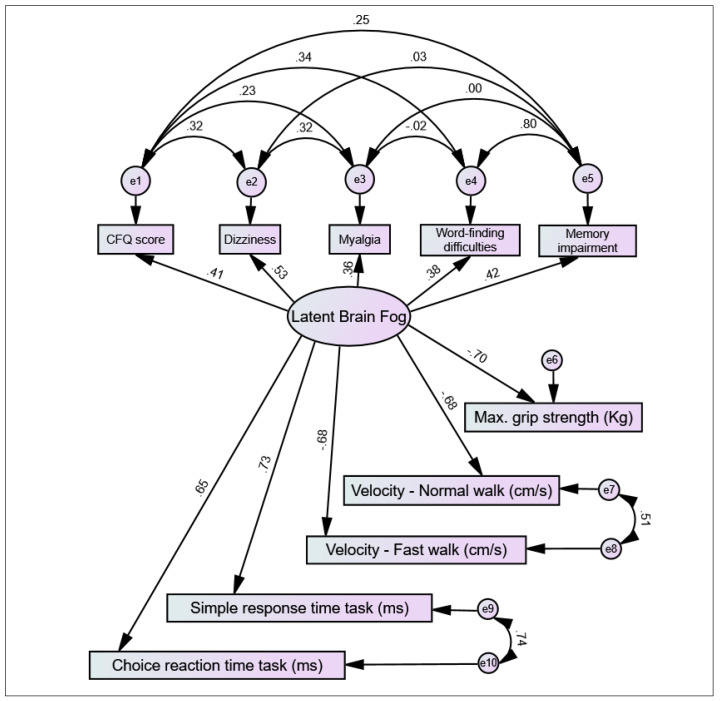
(1) Introduction: A subset of individuals experiencing long COVID symptoms are affected by 'brain fog', a lay term that often refers to general cognitive dysfunction but one that is still poorly characterised. In this study, a comprehensive clinical characterisation of self-reported brain fog was conducted vis-à-vis other long COVID symptoms and parameters of mental, cognitive, and physical health. (2) Methodology: Adult participants reporting long COVID symptoms were recruited from hospital clinics and as self-referrals. Participants completed a battery of questionnaires and clinical assessments, including COVID-19 history, symptomatology, self-reported scales (Chalder Fatigue Scale [CFQ], Center for Epidemiological Studies Depression Scale, and Impact of Events Scale-Revised), computer-based cognitive assessments (simple response time and choice reaction time tasks), physical performance tests (gait velocity and muscle strength assessments), and an orthostatic active stand test. A systematic comparison between participants with and without self-reported brain fog was conducted, and a backwards binary logistic regression model was computed to identify the strongest independent associations with brain fog. This was complemented by an automatic cluster analysis to rank the importance of associations. Finally, a structural equation model was postulated with a causal model of key symptomatic indicators and functional consequences of brain fog as a latent variable. (3) Results: Of 108 participants assessed, brain fog was a self-reported symptom in 71 (65.7%) participants. Those with brain fog were at a longer point in time since COVID-19 onset and reported longer duration of low activity during the acute illness. When assessed, those with brain fog had higher frequencies of subjective memory impairment, word-finding difficulties, dizziness, myalgia, arthralgia, hyperhidrosis, cough, voice weakness, throat pain, visual and hearing problems, dysosmia, paraesthesia, chest pain, skin rashes, and hair loss; mean scores in fatigue, depression, and post-traumatic stress scales were higher; performance in both computer-based cognitive tasks was poorer; and measured gait speed and grip strength were lower. The logistic regression suggested that the best independent associations with brain fog were memory impairment, CFQ, and myalgia. The cluster analysis suggested that the most important associations with brain fog were CFQ, dizziness, myalgia, reduced gait speed, word-finding difficulties, reduced grip strength, and memory impairment. The SEM was consistent with key indicators of brain fog being CFQ, dizziness, myalgia, word-finding difficulties, and memory impairment; and reduced grip strength, gait speed, and cognitive response times its functional consequences. (4) Conclusions: The findings indicate that self-reported brain fog in long COVID is a recognisable symptom cluster primarily characterised by fatigue, dizziness, myalgia, word-finding difficulties, and memory impairment and has adverse psychological and psychomotor correlates. In long COVID, brain fog should be regarded as a wide-ranging symptom and addressed holistically with medical, psychological, and rehabilitative supports as guided by individual needs.
(1)引言:一部分患有长期新冠症状的人受到“脑雾”的影响,这是一个非专业术语,通常指一般的认知功能障碍,但目前对其特征的描述仍很不足。在本研究中,针对自我报告的脑雾与其他长期新冠症状以及心理、认知和身体健康参数进行了全面的临床特征分析。(2)方法:从医院诊所招募报告有长期新冠症状的成年参与者,并接受自我推荐。参与者完成了一系列问卷和临床评估,包括新冠病史、症状学、自我报告量表(查尔德疲劳量表[CFQ]、流行病学研究中心抑郁量表和事件影响量表修订版)、基于计算机的认知评估(简单反应时间和选择反应时间任务)、身体性能测试(步态速度和肌肉力量评估)以及直立主动站立测试。对有和没有自我报告脑雾的参与者进行了系统比较,并计算了向后二元逻辑回归模型以确定与脑雾最强的独立关联。通过自动聚类分析对关联的重要性进行排序作为补充。最后,假设了一个结构方程模型,将关键症状指标的因果模型和脑雾的功能后果作为一个潜在变量。(3)结果:在108名接受评估的参与者中,71名(65.7%)参与者自我报告有脑雾症状。有脑雾的参与者自新冠发病以来的时间更长,并且报告在急性疾病期间低活动持续时间更长。评估时,有脑雾的参与者主观记忆障碍、找词困难、头晕、肌痛、关节痛、多汗、咳嗽、声音虚弱、咽痛、视觉和听力问题、嗅觉障碍、感觉异常、胸痛、皮疹和脱发的发生率更高;疲劳、抑郁和创伤后应激量表的平均得分更高;在两项基于计算机的认知任务中的表现更差;测量的步态速度和握力更低。逻辑回归表明,与脑雾最强的独立关联是记忆障碍、CFQ和肌痛。聚类分析表明,与脑雾最重要的关联是CFQ、头晕、肌痛、步态速度降低、找词困难、握力降低和记忆障碍。结构方程模型与脑雾的关键指标为CFQ、头晕、肌痛、找词困难和记忆障碍一致;握力降低、步态速度降低和认知反应时间是其功能后果。(4)结论:研究结果表明,长期新冠中自我报告的脑雾是一个可识别的症状群,主要特征为疲劳、头晕、肌痛、找词困难和记忆障碍,并且与不良的心理和精神运动相关。在长期新冠中,脑雾应被视为一种广泛的症状,并根据个体需求,在医学、心理和康复支持的指导下进行全面处理。