National Nutrition Surveillance Centre, School of Public Health, Physiotherapy and Sports Science, University College Dublin, Woodview House, Belfield, Dublin, Ireland.
Department of Health and Nutritional Sciences, Atlantic Technological University, Sligo, Ireland.
Int J Behav Nutr Phys Act. 2022 Dec 26;19(1):158. doi: 10.1186/s12966-022-01396-9.
Evidence available on the determinants of vegetable intake in young populations is inconsistent. Vegetable intake is particularly low in adolescents from less-affluent backgrounds, yet no systematic review of qualitative studies investigating determinants for vegetable intake specifically has been conducted to date in this group. This systematic review aimed to identify determinants of vegetable intake in adolescents from socioeconomically disadvantaged urban areas located in very high-income countries reported in qualitative studies.
Five electronic databases (PubMed, Web of Science, CINAHL, PsycINFO and ERIC) were searched until August 2022. The search strategy used combinations of synonyms for vegetable intake, adolescents, and qualitative methodologies. Main inclusion criteria were studies exploring views and experiences of motivators and barriers to vegetable intake in a sample of adolescents aged 12-18 years from socioeconomically disadvantaged urban areas in very high income countries. Study quality assessment was conducted using criteria established in a previous review.
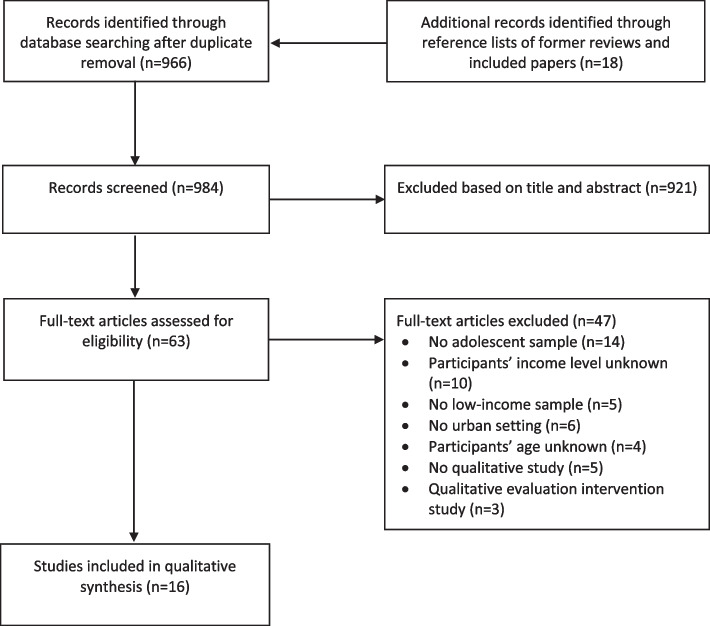
Sixteen studies were included out of the 984 screened citations and 63 full texts. The synthesis of findings identified the following determinants of vegetable intake: sensory attributes of vegetables; psychosocial factors (nutrition knowledge, preferences/liking, self-efficacy, motivation); lifestyle factors (cost/price, time, convenience); fast food properties (taste, cost, satiety); home environment and parental influence; friends' influence; school food environment, nutrition education and teachers' support; and availability and accessibility of vegetables in the community and community nutrition practices. Studies attained between 18 and 49 out of 61 quality points, with eleven of 16 studies reaching ≥ 40 points. One main reason for lower scores was lack of data validation.
Multiple determinants of vegetable intake were identified complementing those investigated in quantitative studies. Future large scale quantitative studies should attempt to examine the relative importance of these determinants in order to guide the development of successful interventions in adolescents from socioeconomically disadvantaged backgrounds.
关于年轻人蔬菜摄入量决定因素的现有证据并不一致。来自经济条件较差背景的青少年蔬菜摄入量特别低,但迄今为止,针对这一人群的蔬菜摄入量的决定因素,尚未进行系统的定性研究综述。本系统综述旨在确定来自高收入国家城市中经济条件较差地区的青少年蔬菜摄入量的决定因素,这些研究均来自定性研究。
直到 2022 年 8 月,我们在五个电子数据库(PubMed、Web of Science、CINAHL、PsycINFO 和 ERIC)中进行了检索。该检索策略使用了蔬菜摄入量、青少年和定性方法的同义词的组合。主要纳入标准是研究探索了经济条件较差的高收入国家城市地区 12-18 岁青少年对蔬菜摄入量的促进因素和障碍的看法和经验。使用先前综述中建立的标准对研究质量进行评估。
在筛选出的 984 篇引文和 63 篇全文中,有 16 篇研究被纳入。研究结果的综合分析确定了蔬菜摄入量的以下决定因素:蔬菜的感官属性;心理社会因素(营养知识、偏好/喜好、自我效能、动机);生活方式因素(成本/价格、时间、便利性);快餐属性(味道、成本、饱腹感);家庭环境和父母影响;朋友的影响;学校的食物环境、营养教育和教师的支持;以及社区中蔬菜的供应和可及性以及社区营养实践。这些研究获得了 61 分中的 18-49 分,其中 16 项研究中有 11 项得分≥40 分。得分较低的一个主要原因是缺乏数据验证。
确定了补充定量研究中调查的蔬菜摄入量决定因素的多种因素。未来的大规模定量研究应尝试检验这些决定因素的相对重要性,以指导针对经济条件较差背景的青少年的成功干预措施的制定。