Department of Biology, Pennsylvania State University, University Park, Pennsylvania, United States.
Department of Entomology, Pennsylvania State University, University Park, Pennsylvania, United States.
PeerJ. 2022 Dec 21;10:e14555. doi: 10.7717/peerj.14555. eCollection 2022.
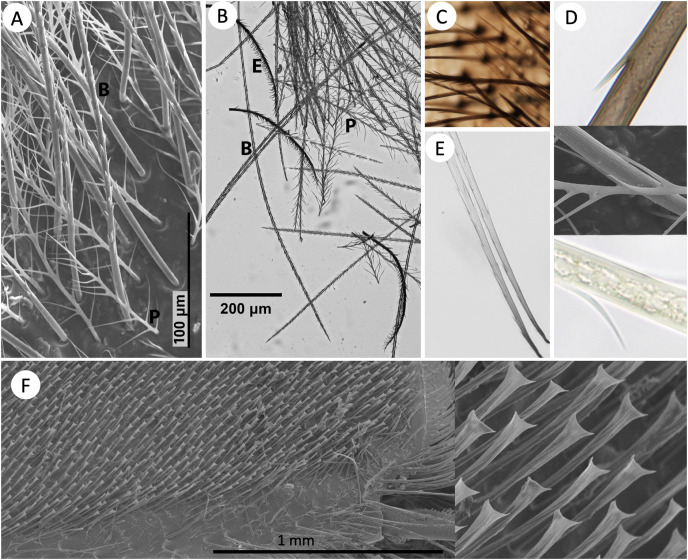
Bumble bees are characterized by their thick setal pile that imparts aposematic color patterns often used for species-level identification. Like all bees, the single-celled setae of bumble bees are branched, an innovation thought important for pollen collection. To date no studies have quantified the types of setal morphologies and their distribution on these bees, information that can facilitate understanding of their adaptive ecological function. This study defines several major setal morphotypes in the common eastern bumble bee Cresson, revealing these setal types differ by location across the body. The positions of these types of setae are similar across individuals, castes, and sexes within species. We analyzed the distribution of the two most common setal types (plumose and spinulate) across the body dorsum of half of the described bumble bee species. This revealed consistently high density of plumose (long-branched) setae across bumble bees on the head and mesosoma, but considerable variation in the amount of metasomal plumosity. Variation on the metasoma shows strong phylogenetic signal at subgeneric and smaller group levels, making it a useful trait for species delimitation research, and plumosity has increased from early ancestors. The distribution of these setal types suggests these setae may serve several functions, including pollen-collecting and thermoregulatory roles, and probable mechanosensory functions. This study further examines how and when setae of the pile develop, evidence for mechanosensory function, and the timing of pigmentation as a foundation for future genetic and developmental research in these bees.
熊蜂的特征是其浓密的刚毛丛,赋予了它们常用于物种水平鉴定的警戒色图案。与所有蜜蜂一样,熊蜂的单细胞刚毛分枝,这一创新被认为对花粉收集很重要。迄今为止,还没有研究量化这些刚毛形态的类型及其在这些蜜蜂上的分布,这些信息可以促进对其适应性生态功能的理解。本研究在常见的东部熊蜂 Cresson 中定义了几种主要的刚毛形态类型,揭示了这些刚毛类型在身体不同部位的分布存在差异。这些刚毛类型在个体、性别和性别之间的分布位置相似。我们分析了两种最常见的刚毛类型(羽状和刺状)在描述的一半熊蜂物种的体背分布。结果表明,熊蜂头部和中胸的羽状刚毛密度很高,但后胸的刚毛密度变化很大。后胸的刚毛密度变化在亚属和更小的群体水平上具有强烈的系统发育信号,使其成为物种划分研究的有用特征,并且刚毛密度从早期祖先开始增加。这些刚毛类型的分布表明这些刚毛可能具有多种功能,包括花粉收集和热调节作用,以及可能的机械感觉功能。本研究进一步探讨了这些刚毛的发育方式和时间、机械感觉功能的证据,以及色素沉着的时间,为这些蜜蜂的未来遗传和发育研究奠定了基础。