Narah Jaya, Streinzer Martin, Chakravorty Jharna, Megu Karsing, Spaethe Johannes, Brockmann Axel, Schmitt Thomas
Rajiv Gandhi University, Papum Pare, Arunachal Pradesh, India.
National Centre for Biological Sciences - Tata Institute of Fundamental Research, Bengaluru, Karnataka, India.
J Chem Ecol. 2024 Dec;50(12):969-977. doi: 10.1007/s10886-024-01486-x. Epub 2024 Mar 12.
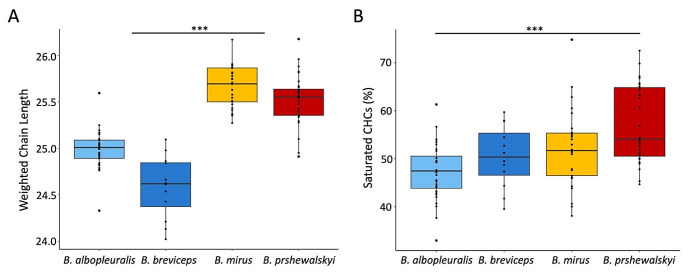
Bumble bees are important pollinators in natural environments and agricultural farmlands, and they are in particular adapted to harsh environments like high mountain habitats. In these environments, animals are exposed to low temperature and face the risk of desiccation. The Eastern Himalayas are one of the recognized biodiversity hotspots worldwide. The area covers subtropical rainforest with warm temperature and high precipitation as well as high mountain ranges with peaks reaching up to 7,000 m, shaping a diverse floral and faunal community at the different elevational zones. To identify possible adaptation strategies, we investigated the cuticular hydrocarbon profiles of four bumble bee species occurring at different elevational ranges in Arunachal Pradesh, the northeastern most state in India. At 17 locations along an elevational gradient, we collected workers of two species from lower elevations (B. albopleuralis and B. breviceps; ~ 100 m - 3,000 m asl) and two species from higher elevations (B. prshewalskyi and B. mirus; ~ 2,800 m - 4,500 m asl). The CHC profiles of all four species showed a significant degree of variation in the composition of hydrocarbons, indicating species specificity. We also found clear correlation with elevation. The weighted mean chain length of the hydrocarbons significantly differed between the low and high elevation species, and the proportion of saturated hydrocarbons in CHC profiles significantly increased with the elevational range of the bumble bee species. Our results indicate that bumble bees living at high elevations reduce the risk of water loss by adapting their CHC composition on their cuticle, a phenomenon that has also been found in other insects like ants and fruit flies.
熊蜂是自然环境和农田中的重要传粉者,它们特别适应高山栖息地等恶劣环境。在这些环境中,动物面临低温和脱水风险。东喜马拉雅地区是全球公认的生物多样性热点地区之一。该地区涵盖了温暖且降水丰富的亚热带雨林以及山峰高达7000米的山脉,在不同海拔区域形成了多样的动植物群落。为了确定可能的适应策略,我们调查了印度最东北部的阿鲁纳恰尔邦不同海拔范围内出现的四种熊蜂的表皮碳氢化合物谱。沿着海拔梯度在17个地点,我们采集了来自低海拔的两种熊蜂(白侧熊蜂和短头熊蜂;海拔约100米至3000米)以及来自高海拔的两种熊蜂(普氏熊蜂和奇异熊蜂;海拔约2800米至4500米)的工蜂。所有四种熊蜂的碳氢化合物谱在碳氢化合物组成上都表现出显著的差异,表明了物种特异性。我们还发现与海拔有明显的相关性。低海拔和高海拔物种的碳氢化合物加权平均链长度存在显著差异,并且碳氢化合物谱中饱和碳氢化合物的比例随着熊蜂物种的海拔范围显著增加。我们的结果表明,生活在高海拔的熊蜂通过调整其表皮上的碳氢化合物组成来降低失水风险,这种现象在蚂蚁和果蝇等其他昆虫中也有发现。